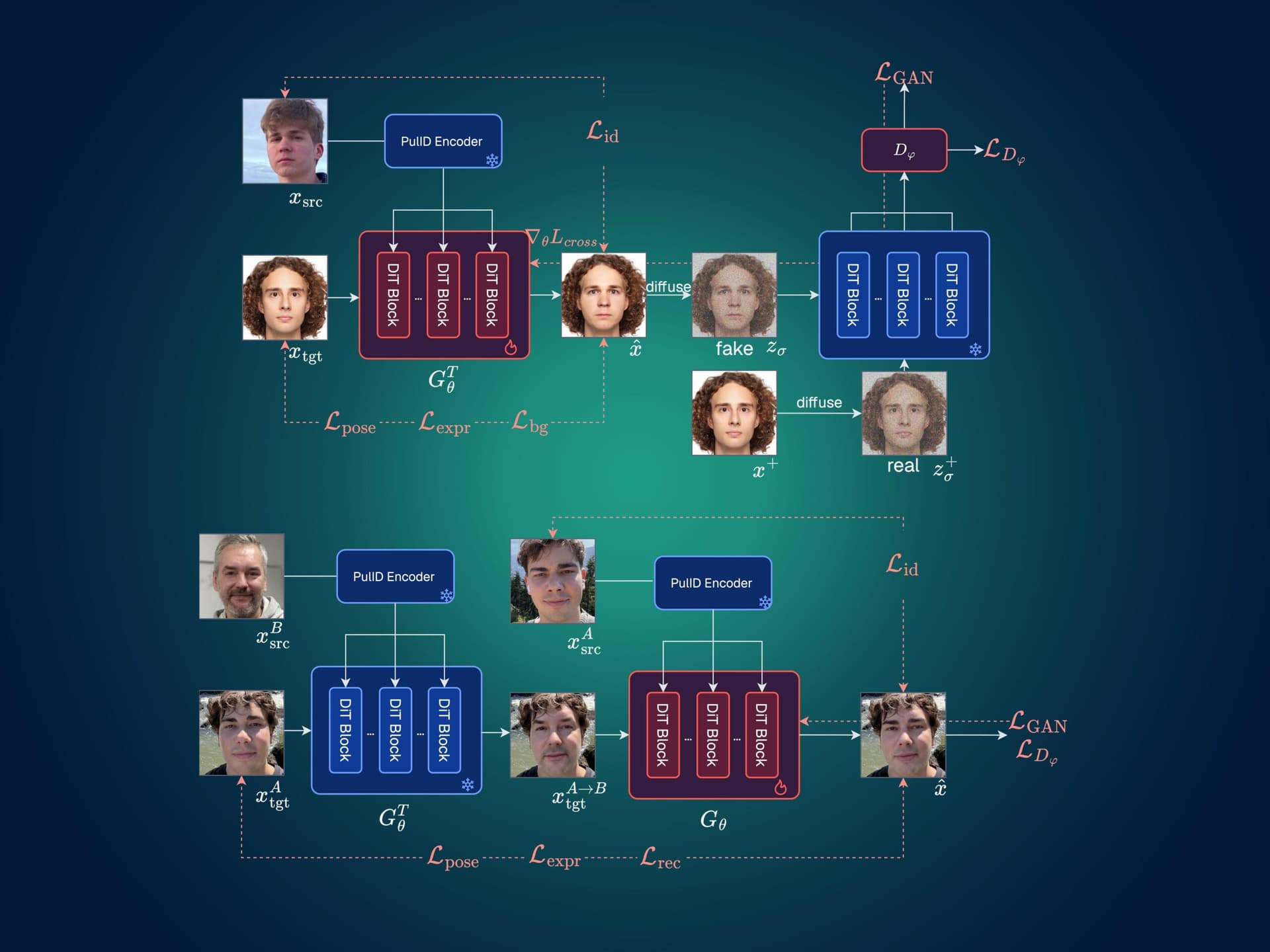
The ‘ALADDIN’ framework matches top diffusion realism 28 times faster in a single step, cutting red-team fraud simulations from days to hours.
Sumsub and Constructor University have developed a new generative AI model designed to help identity verification systems stay ahead of emerging deepfake threats. Named ALADDIN, the state of the art AI model generates highly realistic face swaps 28 times faster than a leading diffusion-based approach, enabling more extensive testing of biometric defenses against advanced identity manipulation. The breakthrough has been recognized by the IEEE/CVF Winter Conference on Applications of Computer Vision (WACV) 2027, where the joint research paper will be presented.
The research directly addresses an escalating threat landscape. According to the Sumsub Identity Fraud Report 2025–2026, sophisticated identity fraud grew 180% year over year. In one common scheme, fraudsters use a stolen ID document and swap the owner's face onto their own during the liveness check. While current tools often fail on variables like head angles, eyewear, contrasting lighting, and age gaps, defenders must prepare for next-generation generative models before criminals adopt them at scale.
To preempt these emerging threat vectors, the joint research team developed ALADDIN (Adversarial LAtent Diffusion Distillation for One-Step Identity SwappiNg), an advanced face-swapping framework. Starting from a high-capacity diffusion model, the team applied modern distillation techniques to compress the multi-step generative process down to a single inference step. While preserving the target subject’s precise pose, expression, lighting, background, and occlusions, ALADDIN transfers the source identity seamlessly, generating photorealistic outputs.
"To reliably defeat identity manipulation, we must master the underlying technology down to its mathematical foundations," said Vyacheslav Zholudev, Co-founder and CTO at Sumsub. "By generating ultra-realistic swaps in a single step, ALADDIN cuts our red-team testing from days to hours. This allows us to simulate millions of complex edge cases and harden our liveness defenses long before emerging threats reach production environments."
ALADDIN marks the first peer-reviewed milestone from Sumsub’s AI Academic Program, launched in September 2025 with Constructor University to bridge foundational machine learning with real-world fraud defense. Developed through close weekly collaboration between Constructor University’s Bayes Group and Sumsub’s ML engineering team, the initiative directly aligns advanced algorithmic compression with enterprise security demands.
“Deepfakes are a problem where academia and industry need each other, yet the two usually work apart. We know how to build the most advanced generative models, and Sumsub knows how fraudsters actually use them, knowledge that rarely reaches a university lab. ALADDIN is what happens when the two sides stop working apart,” said Prof. Dr. Dmitry Vetrov, Head of the Bayes Group at Constructor University. “From the first idea to the final paper, our group and Sumsub's ML team built it together. What surprised us most is that no complex distillation objective was needed: a strong diffusion model as the starting point, plus adversarial training on that model's own internal features, was enough to reach top quality in a single network evaluation instead of 28."
Beyond architectural efficiency, the researchers resolved a systemic benchmarking flaw in the field. Prevailing academic tests favored methods evaluated by models identical to those that trained them; the ALADDIN team re-evaluated existing baselines using an independent scoring framework to establish a fair, objective standard.
To support the defensive security community under a responsible AI framework, ALADDIN is being released in stages. The research code is publicly available alongside an open classifier on Hugging Face developed specifically to detect ALADDIN-generated imagery. To ensure the technology is used exclusively to strengthen security defenses, model weights are accessible solely through a gated application process for legitimate academic and defensive research.
The paper is publicly available on arXiv and will be presented at WACV 2027 in Orlando, Florida.
+++
About Constructor University
Founded in 2001, Constructor University is a top-ranked, English-language, private university, with a campus in Bremen. With its interdisciplinary approach, advanced digital learning tools and accredited programs, it equips students with fundamental knowledge, critical thinking and practical skills to build their professional career and address the world's most pressing challenges.
The University emphasizes a synergetic and entrepreneurial spirit, offering program mentoring from top-tier professors and industry experts. Partner collaborations include Carnegie Mellon, the National University of Singapore, the University of Geneva, and industry references such as JetBrains and ChemDiv. Research-centric faculty projects at the University are funded by the German Research Foundation, the European Union's Framework Program for Research and Innovation, and globally leading companies.
Internationality and diversity lie at the heart of Constructor University, with more than 130 nations at its vibrant and close-knit campus community in Bremen. There, students enjoy active campus life, with access to clubs, professional networks and academic counselling, essential to their personal and academic growth.