Business Registry & Company Data Coverage for KYB
Business Verification
Get business registry coverage worldwide
Why check coverage
before choosing a vendor?
by market
integration
easily
moving
Which registries does Sumsub cover in your markets?
- Handelsregister (Commercial Register)
- Bundesanzeiger Verlagsgesellschaft mbH/Common register portal of the federal states
- Business & Commercial Registers, Transparency Register
- Unternehmensregister (Company Register)
- Common Register Portal
- Business Register System
How it works
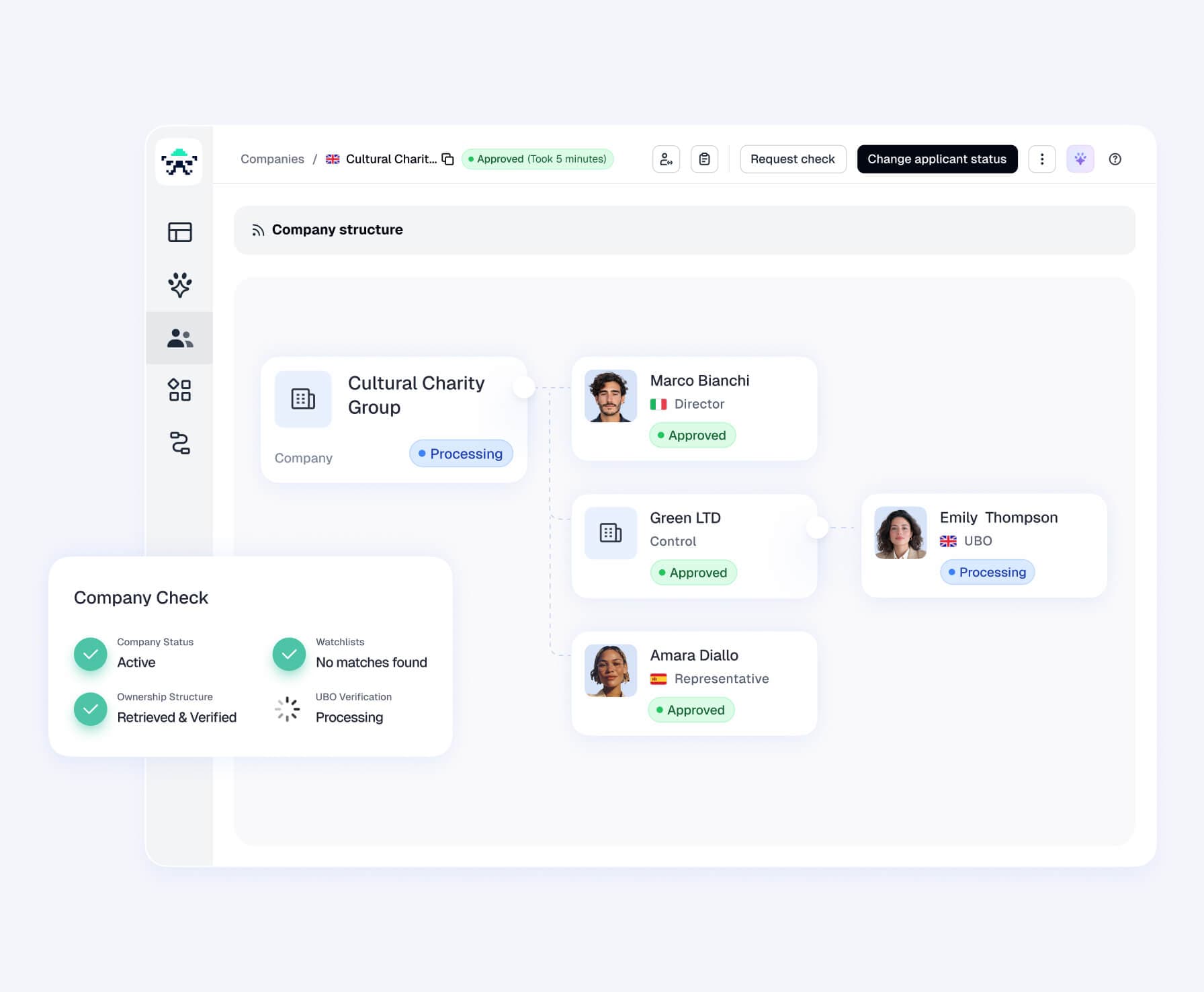
Enter the country of registration and the company name. Approximate name matching handles spelling variations, legal suffixes, and transliterations.
Sumsub checks the registries and data providers connected for that jurisdiction, in the order set by your coverage package.
Company, director, shareholder, and ownership data returns in one structure across every market, and prefills the verification flow.
Add UBO identity checks, AML screening, ownership mapping, risk scoring, and periodic rechecks in the same workflow.
See why 4,000+ clients choose Sumsub
- We chose Sumsub for its comprehensive identity verification suite, ease of integration, and ability to support both internal compliance needs and external client offerings. A key differentiator was Sumsub's ability to handle KYC, KYB, and AML screening within a single platform.
 Andrés FonsecaCo-Founder & COO at VIIO
- For us at Blaaiz, one of the biggest advantages has been having these workflows connected within the same platform. User verification, business onboarding, and transaction monitoring operate as part of a single compliance process rather than separate systems.
 Ibukun OgunwemimoCompliance Team Lead at Blaaiz
- We’re very happy with the platform. It has saved our compliance team hundreds of hours that would otherwise have been spent on manual work, especially tasks like business due diligence and preparing audit-ready reports. We also believe Sumsub’s fraud detection solution will be key as we scale, helping us get ahead of potential issues before they appear.
 Arya DemehriHead of Compliance at HIFI
Award-winning verification platform to keep your business compliant and future-ready
Leading vendor for Business and Entity Verification
Liminal's 2026 Index Report

Leading Vendor for Business & Entity Verification for Fintechs
Liminal's 2024 Index Report

Winner in Financial Crime and Compliance 50
Chartis 2025

A leader for AML Transaction Monitoring
Liminal's Link Index for AML Transaction Monitoring, 2025

Users Love Us
G2 2025 Identity Verification Spring Report

A Regional Leader in Europe
G2 2025 Identity Verification Fall Report

A Momentum Leader
G2 2025 Identity Verification Fall Report

Easiest Setup
G2 2024
FAQ
Which countries does Sumsub's business registry coverage include?
Sumsub covers more than 220 countries and territories through government registries and licensed company-data providers. Coverage depth varies: some markets return full company, director, and ownership records automatically, while others return company details only, or require corporate documents. The directory above lists sources and available fields per jurisdiction.
Which business registries does Sumsub connect to?
Sumsub queries official registries including Companies House in the United Kingdom, Handelsregister in Germany, and ASIC in Australia, alongside licensed commercial providers in markets where the registry has no API or charges per lookup. Each country entry names the source behind every check.
Can Sumsub retrieve director, shareholder, and UBO data?
Yes, in markets where that information is filed and accessible. Sumsub returns director names, dates of birth, roles, and appointment dates, plus shareholder and beneficial owner records with direct, indirect, and beneficial ownership percentages. Brazil, for example, has 100% coverage of UBO identity data.
Can you verify a business that is not in any registry?
Yes. The flow switches to corporate document collection. The Automated Company Document Reading agent extracts data from incorporation certificates and shareholder registers in any machine-readable language, then cross-checks it against registry records. Higher-risk entities route to Sumsub's compliance team, with a 15-hour median review time.
How long does business verification take with Sumsub?
Automated registry checks return results in 15 seconds on average. Manual corporate document review has a median turnaround of 15 hours. Total onboarding time depends on how many entities, representatives, and beneficial owners your policy requires, and on whether documents are needed in that market.
What is the difference between cached and real-time registry data?
Cached data comes from a stored copy of registry records, which keeps cost and response time down. Real-time data is pulled from the source at the moment of the check, which matters where filings change often. You choose per country, and cheaper sources can run ahead of expensive ones.
How do I check whether Sumsub covers a specific jurisdiction?
Search the country in the directory on this page to see available sources, check types, and data fields. The full source matrix is in Sumsub documentation, updated with every change to a connection. For state-level questions or edge cases, book a session and bring your country list.