Sumsub’s Identity Fraud Report 2026-2027 shows that while average identity fraud rate fell 28% YoY, deepfakes grew 31% globally, and fraud complexity increased driven by AI
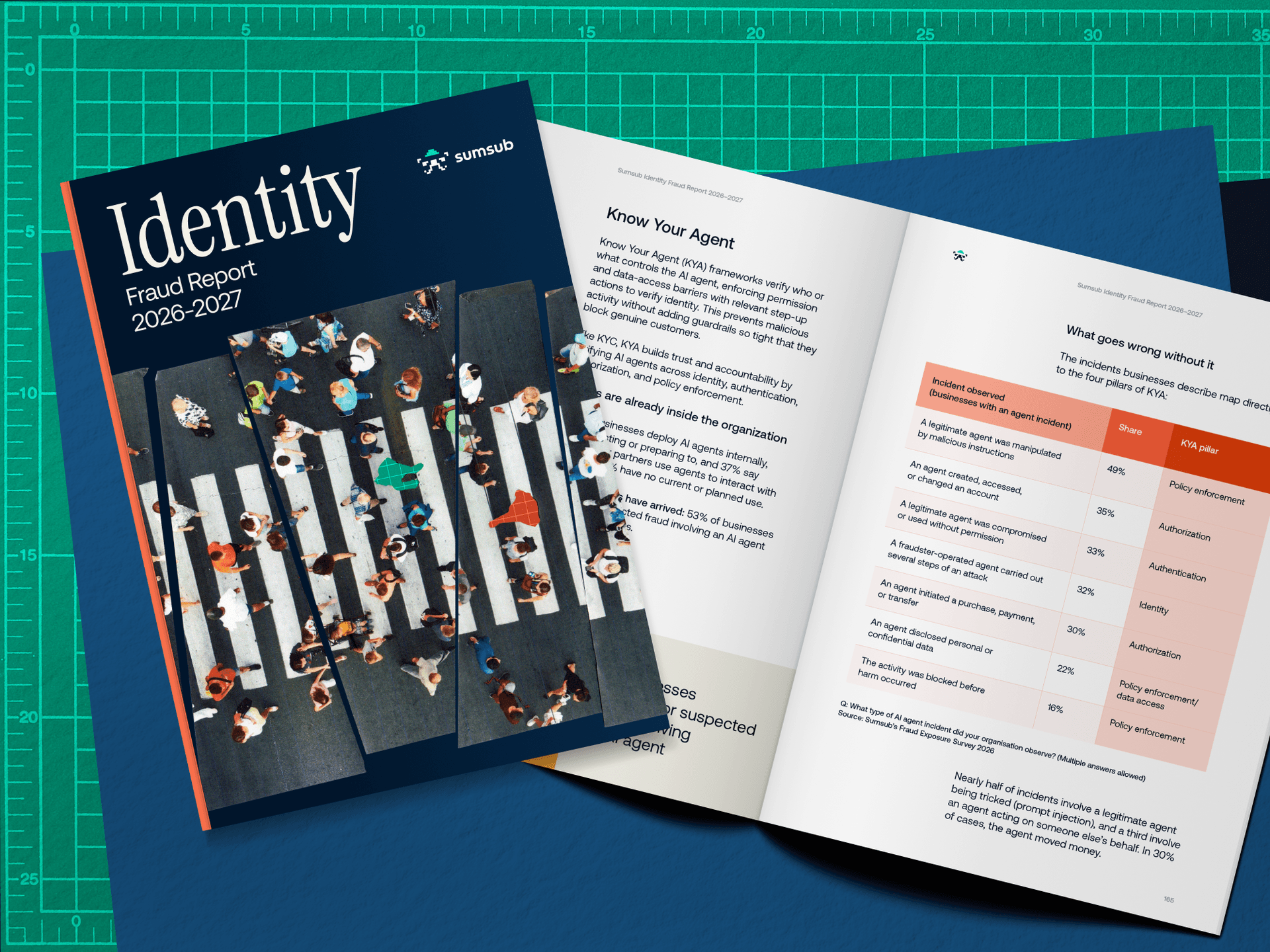
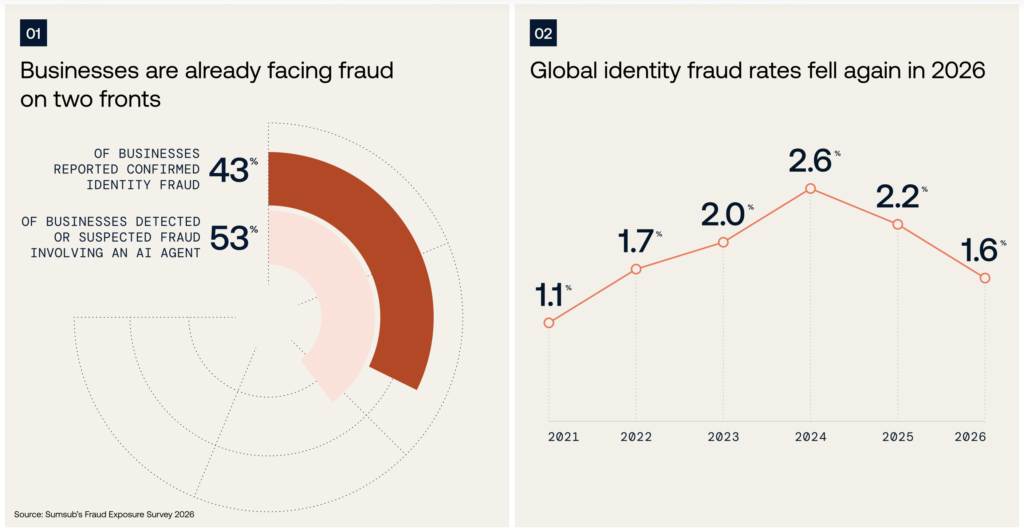
More than half (53%) of businesses have already been hit by fraud involving AI agents, yet only 12% can suspend or revoke an agent’s access, according to Sumsub’s sixth annual Identity Fraud Report 2026–2027. Findings from the company reveal that, while the global identity fraud rate fell 28% year on year to 1.6%, attacks are becoming harder to detect, more organized and increasingly driven by AI, with deepfakes up 31% globally.
The report’s results point to a growing disconnect between fraud frequency and complexity as fewer fraudulent attempts do not signify less exposure. As fraudsters adopt more advanced technologies, operate through interconnected networks and exploit AI-driven workflows, global businesses face a more comprehensive challenge than simply identifying suspicious users or detecting risky transactions.
"We see a fundamental shift in digital fraud: while fraud rates are declining in some regions, threats are becoming more sophisticated, interconnected and harder to detect across all regions. AI is accelerating this evolution, exposing the limitations of traditional account- and transaction-focused fraud prevention. Businesses aiming to respond effectively to this increasingly complex threat landscape must prioritize building a unified trust infrastructure that combines verification and compliance needs with advanced fraud detection and risk intelligence”, comments Andrew Sever, co-founder and CEO at Sumsub.
The AI authorisation gap: Companies struggle to control non-human actors
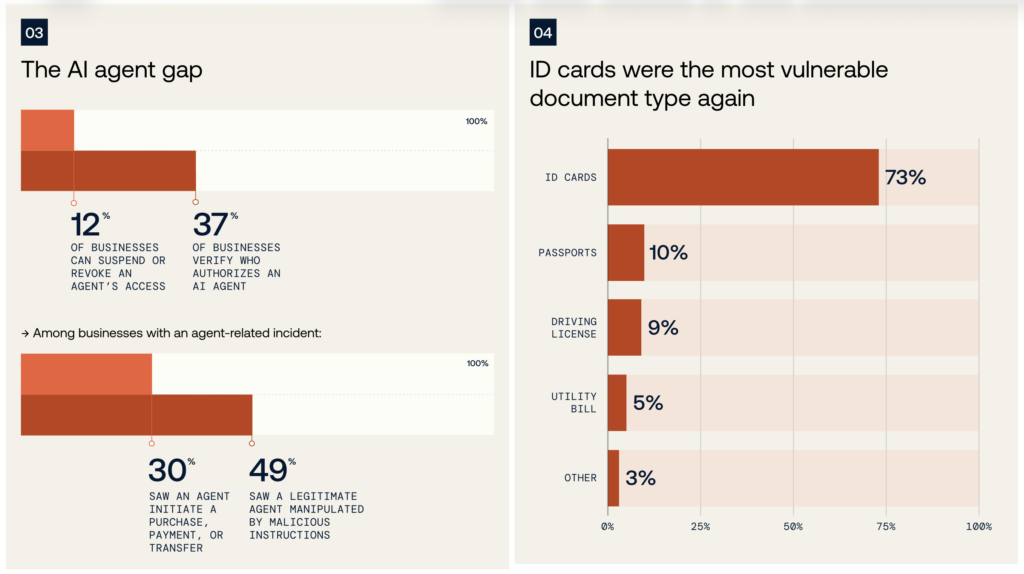
One of the most significant emerging challenges is the rise of agentic fraud. According to Sumsub's Fraud Exposure Survey 2026, most businesses have already been affected by fraud involving AI agents. Exposure is surging, yet only 37% of companies track who deploys AI agents, and a mere 12% have the ability to suspend or revoke their access.
This highlights a widening agentic control deficiency. Businesses are increasingly allowing software to act on behalf of people in organisations without the means to establish its identity, verify its authority or withdraw its permissions when necessary.
"Automation is neither inherently good nor bad; in fact, agentic software is becoming an essential link between individuals and their digital information. However, this growing convenience must be matched by effective oversight”, explains Vyacheslav Zholudev, CTO and co-founder of Sumsub. “With AI Agent Verification, Sumsub is the first to bind AI agents to verified human identities at scale. The recent solution upgrade also enables teams to control what data is available to the agents at any given moment, making agentic deployment transparent, traceable and customizable according to the business needs".
Fraud is moving from isolated cases to a network-based activity
Another major finding is the growing role of coordinated groups of fraudsters, or fraud networks. The report defines these networks as an advanced form of coordinated identity fraud involving specific patterns that may still evade security systems. The risk extends throughout the user lifecycle, since accounts can be compromised or personal data can leak at any time, turning a previously trusted profile into a risk signal for internal systems. Yet, Sumsub's Fraud Exposure Survey 2026 reveals that 74% of companies miss network-level fraud signals, highlighting a significant blind spot.
Among businesses that experienced fraud, 33% reported that at least a quarter of their confirmed fraud cases were connected to a wider network. These connections can emerge through shared contact details, devices, payment instruments, locations, IP patterns or document templates. Initial user onboarding is, in most cases, not enough to spot those.
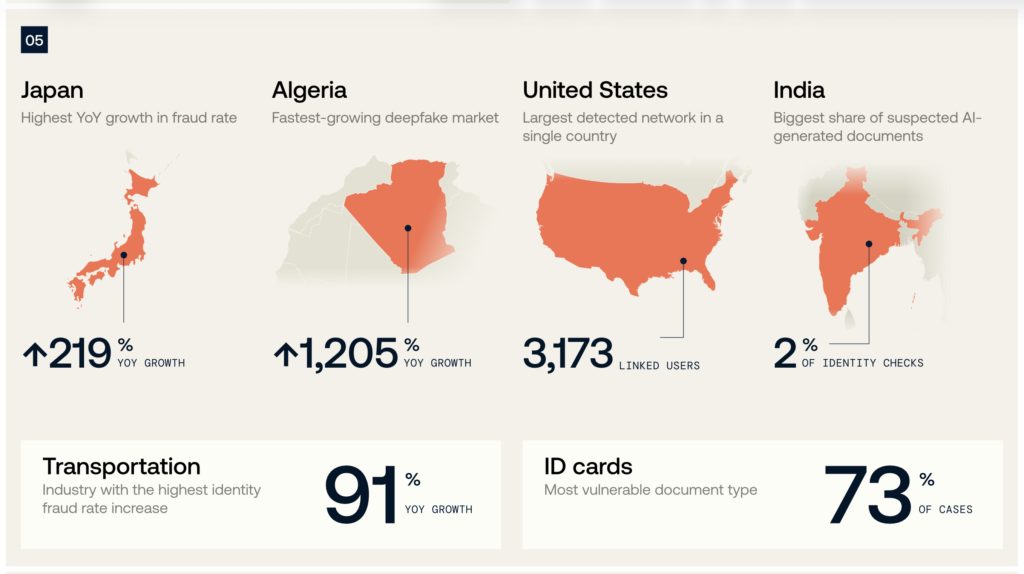
Sumsub internal data reinforces the external survey findings: approximately one in 50 (2%) verified users are later associated with a fraudulent cluster, sometimes spanning several countries and including hundreds or even thousands of other users. Despite the scale of the issue, only 21% of surveyed businesses deploy fraud network analysis.
This problem has long been exemplified by money mules: groups of initially legitimate user accounts that are sold or handed over to fraudsters to move stolen or laundered funds.
Regional picture: fraud is changing differently across the globe
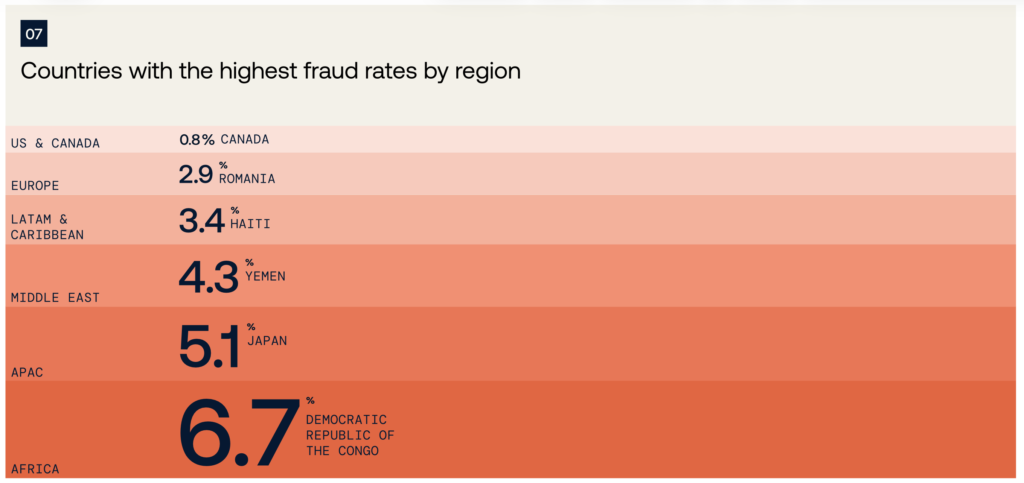
Regional trends reveal distinct patterns in how threats are evolving. Key highlights include:
- APAC recorded close to a million confirmed fraud attempts, the highest across all regions, with the biggest share of fraudulent networks (33%). Fraud complexity increased by 14% YoY, with Japan’s fraud rate up 219% to 5.1% of all verifications.
- North America shows the largest fraud network size, 3,173 users in the U.S. Fraud rates declined by 41% in the region, while fraud complexity went up by 5%.
- Latin America has the highest consumer fraud exposure (85%) and reporting rate (82%), with fraud complexity up 29% and fraud rates down 33%.
- In Africa, both fraud rate and complexity increased by 10% and 15%. Five countries experienced deepfake surges (by over 200%), with Algeria facing the highest globally at +1,205%.
- While fraud rates declined by 21% in the Middle East, attacks’ technical complexity rose 8%, with deepfakes surging in 11 out of 13 analyzed markets.
- Throughout Europe, despite mature regulations and the overall fraud rate declining by 8%, deepfakes grew by 41% and fraud complexity rose 13%.
Fraud frequency and complexity trends: varying paths across industries
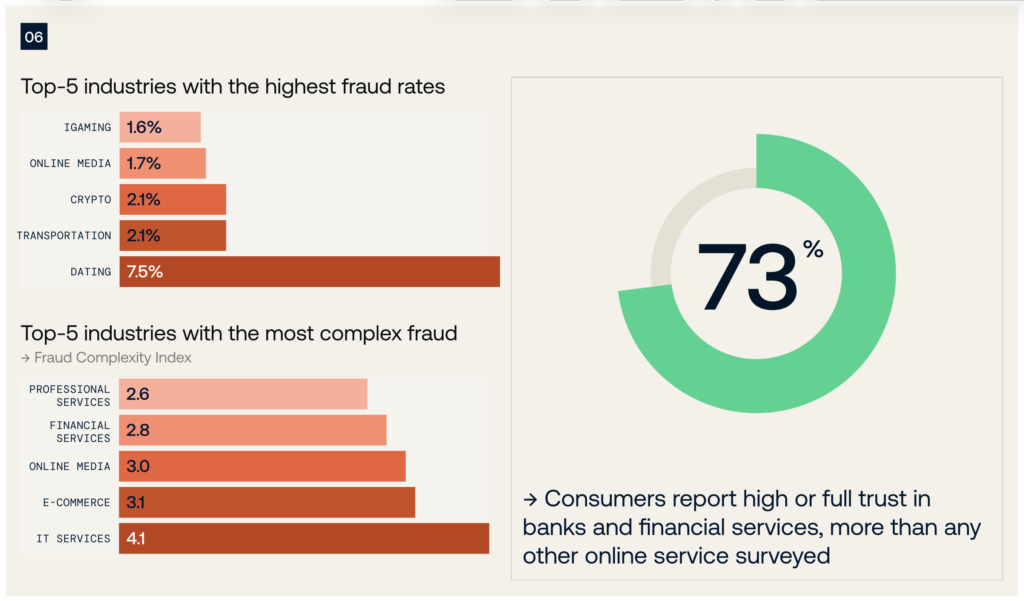
The report revealed that the fraud mix differs sharply by industry, with several patterns being common everywhere: document manipulation or forgery, identity mismatch, repeated fraudulent attempts or linked profiles, and AI-generated documents. Other notable scenarios were visible:
- Fraud rates declined, risk underneath became more complex: Financial Services, Crypto platforms and Online Media.
- Both fraud rate and its complexity worsened: E-commerce and IT Services
- Fraud frequency up, attacks getting simpler: iGaming and Transportation providers
- Both fraud volumes and complexity stayed roughly the same: Trading
- Highest fraud rate and least consumer trust: Dating apps
Looking ahead: Five identity and fraud prevention trends to watch in 2027
As fraud tactics evolve powered by AI, people and organizations need to rethink how they establish and maintain digital trust. New Sumsub report includes key predictions to identity fraud landscape in 2027:
- Privacy and age verification: Growing regulatory requirements and consumer expectations will accelerate demand for privacy-preserving verification that goes beyond a personʼs identity to their age, account ownership and authority to act.
- Trusting AI Agents: With further advancement of the agentic digital economy, organisations will need mechanisms to verify agents’ identities, establish their human owners and delegated authority, and continuously monitor their permissions.
- Organized fraud threat: Fraud detection will shift from individual accounts and separate transfers to catching wider signals and identifying networks around them.
- Non-document verification: The adoption of alternative verification methods will continue to grow, allowing businesses to establish identity and eligibility without relying exclusively on traditional identity document uploads.
- Context-based measures: Increased fraud complexity will also call for a smart, multi-layered and risk intelligence-driven approach that does not create additional friction for legitimate users, while effectively stopping fraud across AI-agent interactions or at any point of the customer lifecycle.
Research methodology note
The Identity Fraud Report 2026-2027 combines Sumsub's internal identity verification and user activity data from 2025 and 2026, covering 5.8 million fraud samples globally, with the results of Sumsub Fraud Exposure Survey 2026, which included responses from 1,400 risk professionals and 1,500 end-users. Data was drawn across various industries and multiple regions, including only insights from jurisdictions with at least 15,000 verification attempts.
To learn more and access the full report for free, please go to https://sumsub.com/identity-fraud-report-2026/