Euro transfers now clear in ten seconds, but only 18% of financial institutions have identity, fraud, payment and AML data fully integrated in real time
European banks, insurers, fintechs and other financial institutions are fighting increasingly sophisticated fraud with disconnected systems that can’t see the whole customer journey, according to our new research.
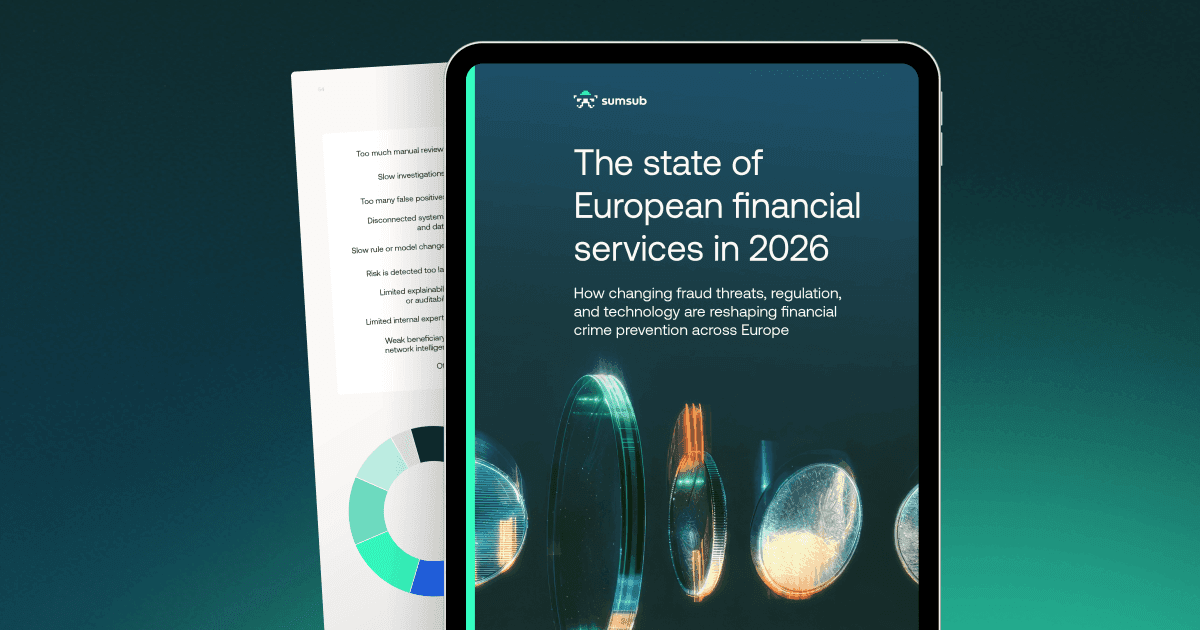
Sumsub's new report, The State of European Financial Services: 2026, finds that most firms run prevention and compliance processes through fragmented systems that can’t share data quickly enough to stop fraud in progress:
- Only 9% of financial institutions run an integrated platform across fraud and compliance functions
- 18% have identity, fraud, payment and AML data fully integrated in real time
- Nearly half of institutions say a quarter or more of alerts still require manual review
- Detecting fraud earlier is the industry's top priority for the next 24 months (37%)
UK and Ireland lead Europe on integration but still catch fraud late
The UK and Ireland are the most advanced on joined-up systems: 13% of firms run an integrated fraud and compliance platform and over 1 in 5 (21%) have fully real-time data integration, both above the European average. Even so, fraud is still most often first caught at account access (41%) or payment initiation (37%), with only 17% of firms most commonly detecting fraud at onboarding, before fraudsters can do any serious damage.
- Unauthorised payment fraud and impersonation fraud are the joint top fraud challenges (according to 33% of firms), with identity theft close behind (32%)
- KYC is the biggest source of compliance pressure for almost half of firms (46%)
- Detecting fraud earlier is the top priority for 41% of firms
Elsewhere in Europe, the gaps are wider. In DACH, just 8% of firms run an integrated platform and only 10% have fully real-time data integration, the lowest of all the regions surveyed. In France and Benelux, over one in four (26%) most commonly catch fraud only after a payment has settled, the highest share of any region.
Central Europe is the only region where detecting fraud earlier isn’t the top priority, with firms instead prioritising improving AML effectiveness (35%). This aligns with the region's wider compliance landscape: sanctions screening is its biggest source of compliance pressure (36%), and EU AML reform is the change expected to demand the most work (35%).
Fraud is largely being caught when the money is already moving
The report finds only 17% of firms say fraud is first detected at onboarding, meaning that the fraudsters who pass those initial checks can move undetected between siloed systems until they’re ready to act.
Fraud is more often first caught during account access (32%), payment initiation (29%) or withdrawal (29%). In nearly one in four cases (24%) fraudulent activity only comes to light after a customer complaint.
Regulation is forcing finance to move at a speed fraud teams can't match
Institutional pressure is being intensified by the EU's Instant Payments Regulation, which requires euro transfers to complete within ten seconds, leaving firms with far less time to stop a fraudulent transaction. Meanwhile, much of the industry still runs on manual review, often with limited workforces, leaving no margin for error at instant payment speeds.
- Practitioners rank the Instant Payments Regulation (27%) and Verification of Payee (26%) above the EU AI Act (21%) and the EU AML Regulation (22%) as the developments forcing the greatest change over the next 24 months
- One in three (32%) say slow investigations are their biggest operational weakness
- Staff capacity is the biggest challenge in responding to regulatory change (36%), ahead of integrating new controls (34%) and budget (33%), meaning firms can’t simply hire their way out
Execs fear reputational damage more than fines
The top two biggest concerns for executives are reputational harm (42%) and criminal liability (37%), far outranking regulatory penalties (24%). A fine is a one-off cost that firms can absorb, but as reputational damage compounds, customers quickly lose faith.
Customer churn ranks as the third-biggest fraud fear (31%). Unlike a fine, lost trust keeps costing the firm every time a would-be customer chooses a rival that appears safer.
Almost six in ten firms expect their fraud and compliance technology budgets to increase over the next 12 months, but the data suggests much of that spend will land on systems that are already fragmented. Nearly four in ten firms only have identity, fraud, payment and AML data partially integrated at best. The real-time capabilities that would close those gaps are stuck in pilot, with real-time decisioning more often partially deployed (36%) than fully live (29%).
"European financial institutions are not short of fraud and compliance tools, but those tools don’t talk to each other," said Ilya Brovin, Chief Growth Officer at Sumsub. "Fraudsters exploit the gaps between siloed systems, and regulation is now demanding decisions in seconds that many firms still make in days. The case for a single view of the customer journey has moved from the operations team's agenda to the board's."
Sumsub's The State of European Financial Services: 2026 report is available to download here: https://sumsub.com/blog/guides-reports/the-state-of-european-financial-services-2026/.
About Sumsub
Sumsub is a leading full-cycle verification platform that enables fraud-free, scalable compliance. Its adaptive, no-code solution covers everything from identity and business verification to ongoing monitoring – quickly adjusting to evolving risks, regulations, and market demands. Recognised as a Leader by Gartner, Forrester, and IDC, Sumsub combines seamless integration with advanced fraud prevention to deliver industry-leading performance. Sumsub also invests in responsible AI innovation through its AI Academic Program, forming alliances with top academia and institutions globally to enhance the world's resilience against AI-powered fraud.
About the data
The data is based on proprietary research conducted by Sumsub in 2026. The survey captured responses from 804 professionals across fraud, compliance, risk, operations and related roles within banks, investment firms, fintechs and other financial institutions operating in Europe. Fraud-specific questions were answered by respondents with fraud responsibilities (n=315) and compliance-specific questions by those with compliance responsibilities (n=386). All responses were anonymised and aggregated for the purposes of analysis and publication.