Crypto transactions move quickly, but the risks attached to them can be harder to assess. A wallet may link to illicit activity that isn't visible from the transaction itself. Funds can pass through mixers, hacked services, mule networks, or other high-risk counterparties before reaching a business.
For crypto companies, checking a wallet or transaction only after funds have moved can be too late. Compliance teams need to assess blockchain risk before transactions are completed and keep monitoring activity as it changes.
Sumsub’s Crypto Monitoring brings blockchain analytics providers, wallet and transaction risk scoring, rules, and case management into one platform. Companies can screen transactions and wallets in real time, assess counterparty exposure, and take action when activity meets their risk criteria.
Why companies need crypto monitoring
Crypto businesses operate across blockchain networks where transaction histories are public but hard to interpret without specialized blockchain intelligence. A wallet that appears normal at first might have been exposed to a sanctioned entity, darknet service, mixer, hacked exchange, or other source of illicit funds.
Compliance and fraud teams need enough information to make decisions without slowing legitimate transactions or building separate processes for every blockchain and risk category, or else it will be a challenge to monitor the activities effectively.
Traditional transaction monitoring doesn't provide the full picture of on-chain activity. Crypto companies need to look at the wallets involved, the origin and destination of funds, and the risk associated with counterparties.
A dedicated crypto monitoring solution lets firms screen activity before transactions go on-chain and keep monitoring risk as new information becomes available.
How to choose the right crypto monitoring solution
The right solution should give you enough blockchain intelligence to assess risk without creating another fragmented system. When evaluating a crypto monitoring provider, companies should look at several key areas.
1. Wallet and transaction screening
The solution should screen both individual wallets and transactions to assess counterparty risk before funds move and identify suspicious activity during ongoing monitoring.
2. Blockchain analytics coverage
A good crypto monitoring tool should support the relevant blockchains and provide access to reliable blockchain analytics for companies operating across multiple networks.
3. Flexible risk rules
Different businesses have different risk appetites. Compliance teams should be able to set rules around the types of activity they want to block, review, or allow, rather than relying on one fixed risk model.
4. Real-time monitoring
The risk score can change after a wallet has already been evaluated. With continuous monitoring in place, companies can identify new exposure to risk and respond when a previously acceptable wallet becomes associated with higher-risk activity.
5. A clear workflow for investigations
A risk alert is only useful if a compliance team can act on it. The right solution should connect alerts with the relevant transaction and wallet information and give investigators a clear way to review and resolve cases.
What sets Sumsub’s Crypto Monitoring apart
Sumsub’s Crypto Monitoring brings blockchain analytics into the same platform that companies can use for identity verification, AML screening, transaction monitoring, and case management.
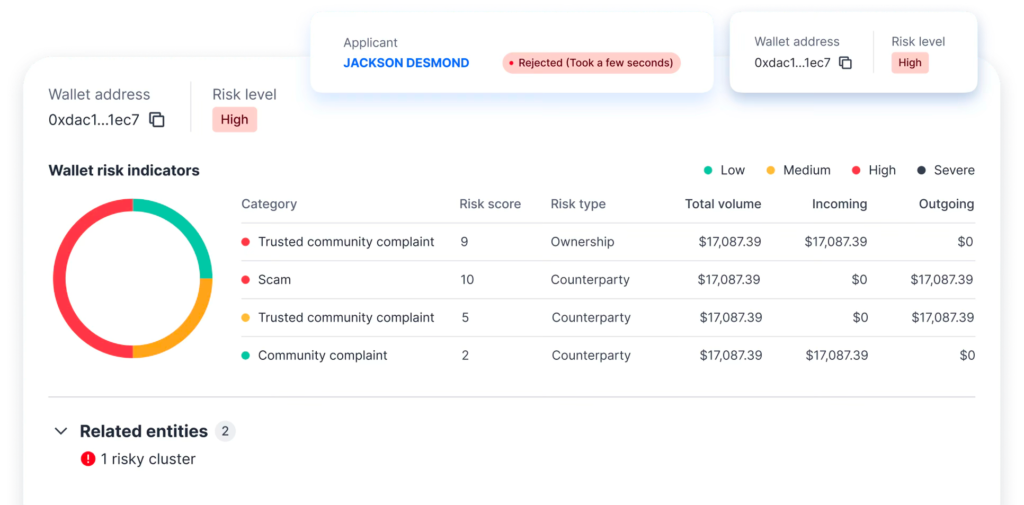
Companies can connect their existing blockchain analytics provider through Sumsub’s Bring Your Own Key (BYOK) model or use supported providers through Sumsub. The current setup includes Crystal Intelligence, Chainalysis, Elliptic, Merkle Science, and TRM Labs.
Sumsub’s solution provides:
- Wallet risk scoring: Assess the reputation and exposure of crypto wallets before completing transactions.
- Transaction scoring: Review transactions using blockchain intelligence and risk signals.
- Ready-made rule bundles: Apply provider-specific rules to screen wallets and transactions without building every monitoring scenario from scratch.
- Real-time and ongoing monitoring: Continue checking transaction activity instead of relying only on a single point-in-time assessment.
- Counterparty risk assessment: Identify exposure to high-risk wallets and transaction paths.
- Case management: Send suspicious activity into an investigation workflow so compliance teams can review the relevant information and decide.
- Partner flexibility: Use different blockchain analytics providers depending on the company's existing setup and risk requirements.
Sumsub also supports monitoring before a transaction goes on-chain. This gives crypto firms a chance to stop suspicious activity before funds leave their platform, rather than investigating the transaction after the fact.
How clients benefit from Sumsub’s Crypto Monitoring
HIFI: Building compliance into stablecoin infrastructure
HIFI is a software platform that helps companies build financial products on stablecoins. Its infrastructure operates across multiple blockchain networks and payment rails, so compliance needs to work across different parts of the business.
HIFI uses Sumsub as a centralized risk management platform, with Crypto Monitoring combined with several other modules in different stages of the customer lifecycle. Its compliance team can manage these processes within one setup rather than maintaining separate systems for different checks.
For HIFI, flexibility was an important part of the decision. The company needed a system that could integrate with its existing tools and support custom compliance workflows as it expanded its work. The company also saves hundreds of hours with automation now, particularly on business due diligence and preparing audit-ready reports.

Arya Demehri
Head of Compliance at HIFI
What’s been useful for us is that the platform fits into the way the team actually works. We can adjust workflows as requirements change and get a clearer overview of alerts and investigations that gives the team more room to focus on more strategic compliance work.
TransFi: Managing crypto compliance across global markets
TransFi provides infrastructure for businesses that want to offer crypto and fiat payment services, with different compliance requirements across different markets globally.
The company selected Sumsub for its broader compliance setup, which offers crypto monitoring, Travel Rule, KYC, KYB, and other tools in one platform. TransFi also needed to tailor compliance standards for different customer categories and risk levels, which Sumsub’s customization easily allows.
The firm found it easy to implement transaction monitoring and crypto monitoring rules, so all transactions are now subject to transaction monitoring, crypto monitoring, and bank card checks.

Raj Kamal
CEO at Transfi
These solutions help us meet regulatory requirements and have a smooth user experience. All this with easy integrations for developers.
BTCC: Building a safer crypto trading experience
BTCC is the world's longest-serving cryptocurrency exchange, which provides trading and digital asset services to users worldwide. The company offers reliable, accessible crypto trading in a secure environment for users of all experience levels.
Before implementing Sumsub’s solutions, BTCC struggled with heavy manual verification, increased operational workload, and an inefficient onboarding process. Thus, they needed a platform that brings AML compliance, transaction monitoring, and crypto-specific risk management into one system.
With Sumsub, the company has gained a comprehensive automated compliance suite with KYC, AML, and verification. Sumsub’s crypto monitoring helps them assess wallet risk and identify suspicious activity. On top of that, they have seen many operational improvements since the implementation.

Compliance team at BTCC
We were looking for more than a verification provider. We needed a platform that could bring together identity verification, AML compliance, transaction monitoring, and crypto-specific risk controls, especially Travel Rule and crypto monitoring, in one place. Sumsub met those requirements and helped simplify compliance across our global operations.
Results that speak for themselves
Crypto monitoring is most useful when it fits into the wider compliance operation. Screening a wallet is only one part of the process. Teams also need to know what action to take when a risk signal appears and keep a record of the decision.
Sumsub connects crypto monitoring with its wider compliance platform. Blockchain intelligence can sit alongside identity data, AML screening, transaction activity, and investigation workflows, giving teams a broader view of customer and transaction risk.
The platform currently supports 350 blockchain networks and integrates six blockchain analytics providers, with options for managed integrations and BYOK depending on the provider.
For companies such as HIFI and TransFi, this approach also means crypto monitoring can sit alongside the other compliance controls they already need. VALR, for example, uses Sumsub to screen crypto wallets and transactions and assess counterparty risk before the users move their funds, and other crypto exchanges such as MEXC have found Sumsub’s system valuable in their day-to-day work.
Crypto monitoring strategies for compliance and risk teams
Effective crypto monitoring begins before a transaction is completed. Companies shouldn’t start screening a wallet or transaction only after funds have moved because that leaves less room to act.
They should instead decide which blockchain risks matter most to their business and set rules around those risks, as well as review activity continuously, because a wallet's risk profile can change over time. It’s equally important to connect blockchain intelligence with the rest of the compliance process: when a suspicious transaction gets an alert, investigators need the relevant information in front of them and a clear workflow that will help them decide what happens next.
A centralized approach makes this easier. With Sumsub, companies can view blockchain analytics, transaction screening, wallet risk scoring, rules, and case management in one compliance setup and avoid rushing between multiple systems.
A system that adapts to different providers, risk requirements, and transaction flows gives compliance teams more room to respond as a user’s risk score changes.