The study reveals a growing traceability gap as organizations scale AI decision-making beyond direct human oversight, increasing exposure across compliance, operations, and customer trust.
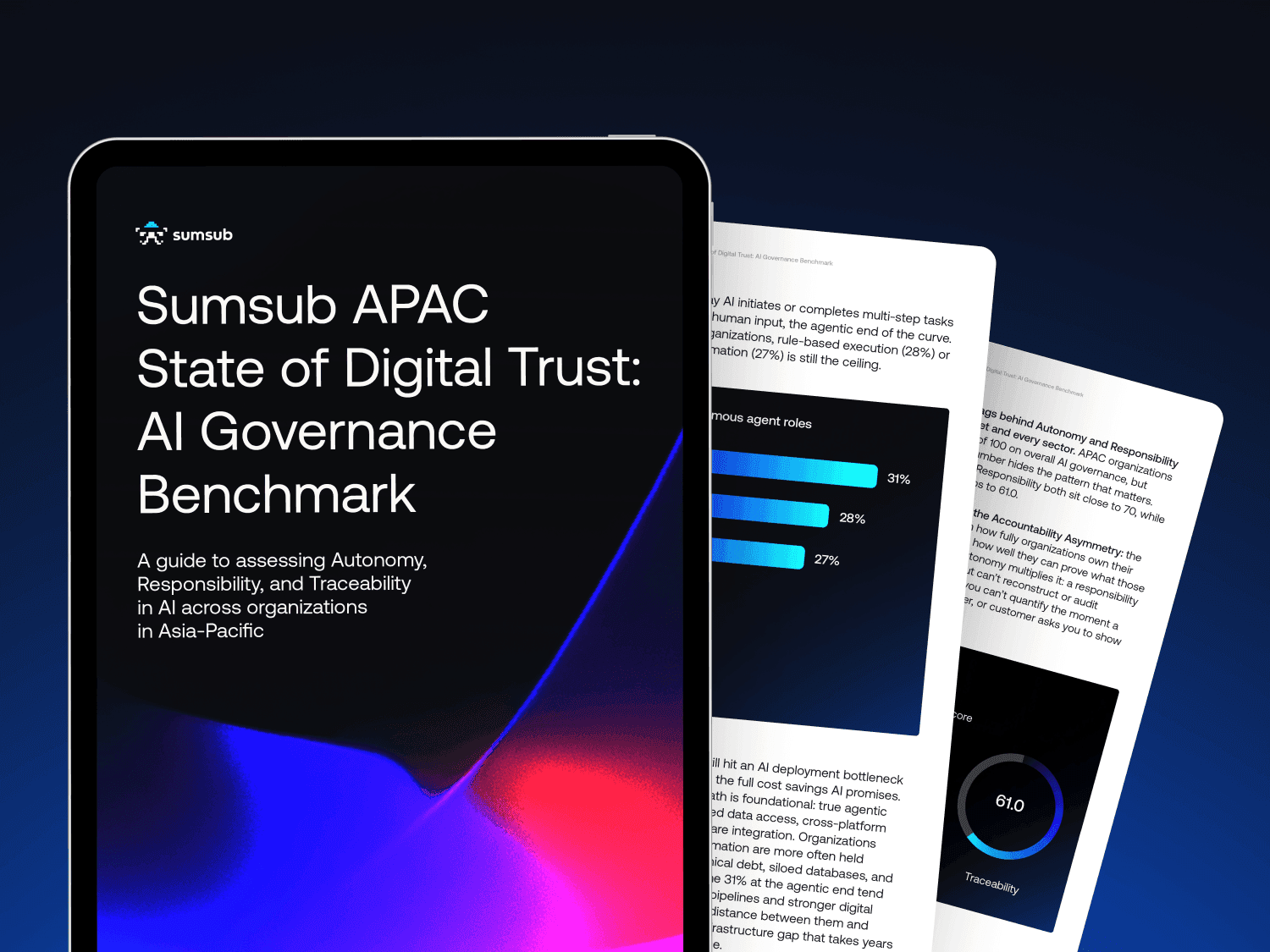
Sumsub, the first AI-powered trust infrastructure for compliance at scale, has unveiled the findings of a research study jointly conducted with the Singapore Fintech Association (SFA). The Sumsub APAC State of Digital Trust: AI Governance Benchmark report* reveals an urgent need for local enterprises to develop capabilities to track AI agent decision making. In Singapore, 94% of businesses are now using or piloting multi-step AI systems. However, a structural mismatch remains as many local businesses still lack the infrastructure to monitor and audit AI decision pathways.
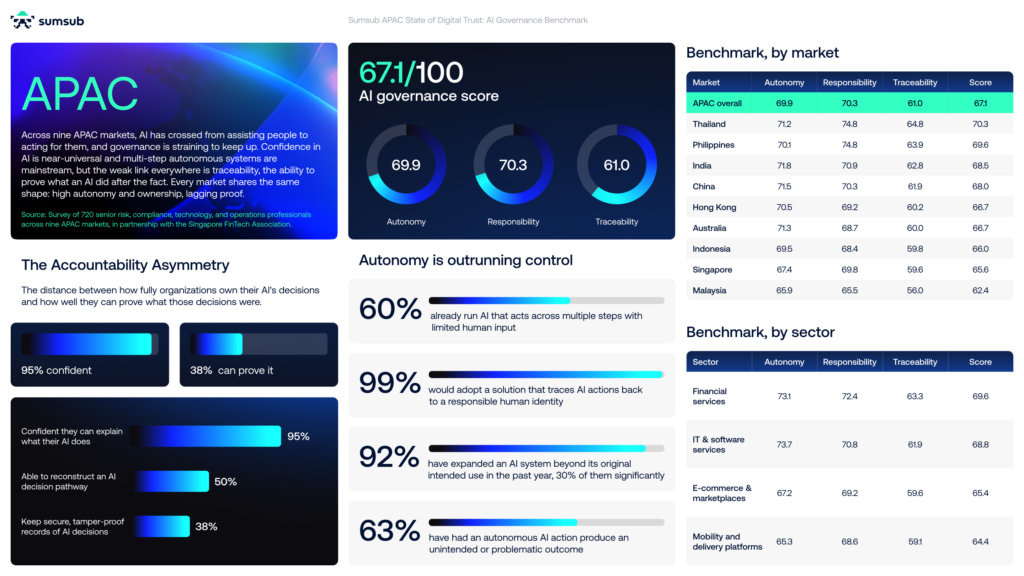
This gap is termed the Accountability Asymmetry, referring to how fully organizations own their AI's decisions, and how well they can actually prove what those choices were to regulators, shareholders, or customers. Without a traceable record, every unmonitored action an AI takes is simply a cost deferred and not avoided, exposing businesses to operating losses, compliance fines, and broken customer trust.
The report assesses how effectively businesses in Singapore and APAC are governing autonomous AI agents by evaluating them on three dimensions: how far AI is already acting independently (Autonomy), how clearly ownership of AI-driven outcomes is defined (Responsibility), and how well those decisions can be reconstructed and explained (Traceability).
Key Singapore findings from the report include:
- Strong framework anchors AI accountability: 70% of Singapore businesses maintain explicit guidelines that assign direct responsibility for AI outcomes to a specific person (40%) or team (30%), matching the APAC average (70%).
- Prudent risk boundaries for higher stake workflows: Singapore businesses demonstrate strong comfort levels (90%) when letting AI handle low-risk routine tasks, outpacing the APAC average (88%), but exercise more caution when financial liabilities are introduced.
- Safety over rapid AI scaling: 16% of Singapore businesses significantly increased the scope or autonomy of their AI systems in the last year. This is the most measured AI deployment rate in APAC, and reflects a safety-first strategy over rapid deployment.
- AI governance readiness runway: Reflecting ongoing efforts on infrastructure over immediate scaling, Singapore scored 65.6 on the overall governance benchmark, just shy of the APAC average of 67.1.
- Data analytics and core operations drive immediate value: Singapore businesses see the greatest real-world impact of AI within data related tasks (29%) and operations or workflow processing (21%), followed by critical security applications like fraud detection, AML, and risk monitoring (15%).
“Everyone is focused on how quickly AI is advancing, but the bigger question is whether governance is keeping pace. Our joint survey with Sumsub found that fewer than one in three organizations can produce an audit trail for AI-driven decisions. As AI moves beyond copilots into autonomous agents handling increasingly critical workflows, the focus now should be on building the traceability, accountability and governance needed to deploy AI at scale. As an industry, that’s where our attention needs to be next,” said Holly Fang, President, Singapore Fintech Association.
AI Governance Scores in APAC Shaped by Regulatory Maturity
While Singapore sits near the lower end of the self-assessment index at 65.6, this position reflects its advanced regulatory foundation rather than a lack of progress. The Singapore government is the first in the world to provide governance guidance for AI agent use, having launched the Model AI Governance Framework for Agentic AI earlier in 2026. This has allowed local firms to measure their infrastructure against real-world technical benchmarks instead of basic paper checklists, resulting in more conservative self-assessments.
"Prudence, rather than a lack of strategic intent, defines how the enterprises are scaling AI agents," notes Penny Chai, Vice President, APAC at Sumsub. "When financial liabilities are on the line, immature traceability systems create an unacceptable operational risk. Establishing robust tracking architectures and guardrails is the vital prerequisite to safely deploying high-stakes AI at scale."
Varying regulatory environments are shaping market performance scores across APAC, with Thailand (70.3) and the Philippines (69.6) leading the region due to early alignment with strict digital laws and business requirements. Hong Kong (66.7), Australia (66.7), and Indonesia (66.0) continue to adapt existing privacy frameworks to cover autonomous systems, while India (68.5) and China (68.0) still rely on paper compliance or rigid state entry rules. Malaysia trails the region at 62.4, as its businesses prepare for an incoming AI Governance Bill.
Highly Regulated Sectors Anchor Regional AI Governance
Highly regulated fields dominate the benchmark, with Financial Services topping the index at 69.6 due to rigid compliance standards combined with a region-leading 68% audit trail adoption rate. The IT & Software Services sector follows closely at 68.8, though its aggressive deployment rate raises the risk that adoption will outpace governance.
Conversely, sectors with lesser financial liability tend to favor immediate utility over AI governance. E-commerce platforms (65.4) leverage AI tools heavily to drive sales but rarely use independent audits (29%) due to thin profit margins. Trailing last, the Mobility and Delivery sector (64.4) prioritizes operational speed at the expense of oversight tracking, leaving its logistics vulnerable to systemic blind spots if automated AI systems glitch.
Overcoming Technical Roadblocks for Safer AI Scaling
The next phase of secure AI scaling is being shaped by practical, commercial compliance priorities around accountability and system reliability. To address these concerns, Singapore businesses have identified three primary engineering priorities: navigating the inherent technical complexity of modern models (66%), ensuring smooth integration between platforms (50%), and building specialized tracking parameters for actions taken by third-party or external AI tools (49%).
Moving Beyond Paper Compliance to Verifiable Trust Guardrails
True digital trust in the agentic era requires a structural shift toward a unified trust infrastructure that binds every automated action to both an authorized AI agent and a responsible human overseer. Market alignment on this transition is virtually unanimous: 98% of Singapore businesses report that they are ready to adopt a third-party verification solution that ties autonomous AI actions back to a verified identity network.
“Public-private collaboration is the critical engine for APAC’s AI future. Regulators are laying down the policy blueprints, but the tech sector must step up with the operational plumbing to address system integration and model complexity” Chai concludes. “Long-term success hinges on ecosystems where national frameworks, like MAS’ Safeguards for Agentic Finance at Runtime (SAFR), are powered by industry recognized trust infrastructure. By anchoring automated actions to a secure, human-accountable digital trail, businesses can seamlessly turn compliance into verifiable digital trust.”
To explore Sumsub’s APAC State of Digital Trust: AI Governance Benchmark report in full detail, please download here: https://sumsub.com/ai-governance-benchmark-apac/
*Methodology
The Sumsub APAC State of Digital Trust: AI Governance Benchmark report measures the readiness of autonomy, responsibility, and traceability in AI across organisations in the Asia-Pacific region. Grounded in a comprehensive mixed-methodology framework, the study combines an executive roundtable discussion with a quantitative survey conducted independently by Blackbox Research, in partnership with the Singapore Fintech Association, between April and June 2026.
The study surveyed 720 senior professionals across nine core APAC markets—Australia, China, Hong Kong, India, Indonesia, Malaysia, the Philippines, Singapore, and Thailand—spanning four key sectors: Financial Services, IT & Software Services, E-commerce, as well as Mobility and delivery platforms. All respondents consist entirely of vetted enterprise decision-makers holding direct responsibility for AI strategy, execution, or risk oversight, with 75% specifically within the Singapore cohort holding C-suite, Owner/Founder, or Senior Management roles.