Unhosted Wallet Verification
Unhosted wallet control, verified
Verify unhosted wallet control and keep compliant transactions flowing
Unhosted wallet verification confirms control of the wallet's private keys through accepted ownership proof methods.
Establish unhosted wallet control with risk‑based precision
Four commonly accepted ownership proof methods embedded into transaction flows.
Satoshi Test
Also known as microtransactions, the Satoshi Test is a widely accepted ownership proof method that verifies a user can transact from a given wallet address by requiring a small, predefined test amount to be deposited within a defined timeframe.
- Automated verification
- On-chain proof of wallet control
- Works with wallets capable of sending on-chain transactions
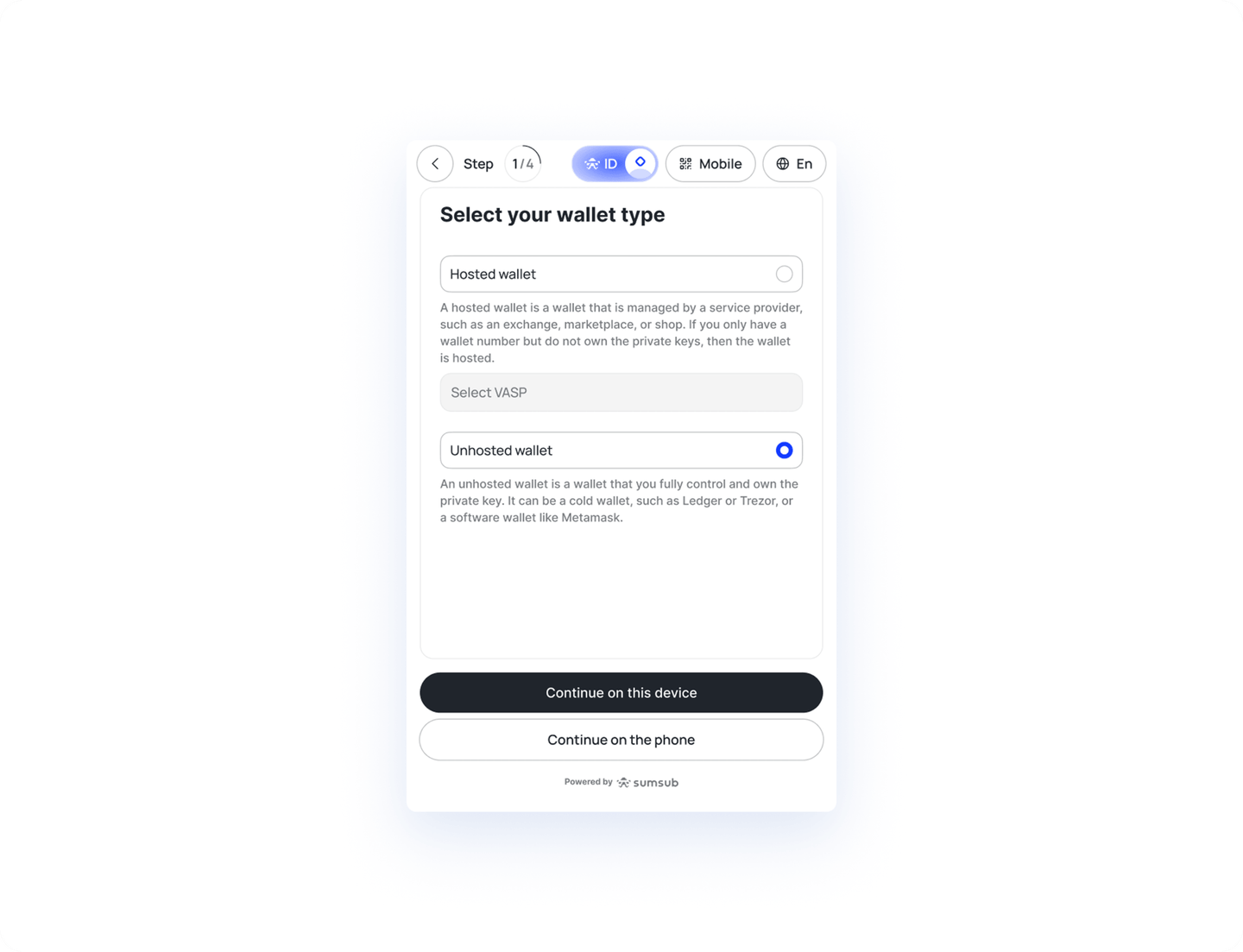
Simplify unhosted wallet checks with a Satoshi Test
Securely verify wallet control through a predefined microtransaction to support compliant crypto transfers.
Hosted and unhosted wallets require different controls in Travel Rule
FATF requires VASPs to distinguish between wallet types, as this determines the compliance actions they must take.
Managed by third parties
Controlled by the wallet holder
Originating VASP is responsible for collecting, verifying, checking, and transmitting the data to the counterparty.
Originating VASPs are not required to transmit the data; however, they are still expected to collect it, verify it, and perform the necessary checks.
These differences may include verification requirements, by transaction amount, how they are applied, and what data must be collected.
FAQ
What is an unhosted wallet?
An unhosted (non-custodial) wallet is a crypto wallet controlled directly by the wallet holder, who holds the private keys without a third-party provider.
How do you get a non-custodial wallet?
You create one by installing a software wallet or using a hardware wallet, which generates a wallet address and private keys under your control.
How do you prove ownership of a crypto wallet?
Ownership is typically proven by signing a message or transaction with the wallet's private key, demonstrating control of the address.
What is a Satoshi test?
A Satoshi test verifies wallet control by asking the wallet holder to send a small blockchain transaction (microtransaction) from the wallet being verified to a specified address within a defined timeframe.
What is required for Travel Rule compliance when transactions involve unhosted wallets?
VASPs must identify, assess, and mitigate risk in line with FATF guidance and local regulatory requirements when transactions involve unhosted wallets.
Prevent unhosted wallets from becoming a blind spot for illicit activity
Wallet verification that keeps legitimate activity moving while exposing high-risk wallets.
Resources
- Guide
- 10 min read
Travel Rule Buyer's Guide
 Read more
- Learning Course
- 4 hour watch
Travel Rule Course
 Watch now
- Webinar
- 2 min watch
Travel Rule explainer
 Watch now
- Report
- 10 min read
State of the Crypto Industry Report 2025
 Read more
- Report
- 10 min read
The Total Economic Impact™ Study of Sumsub's Transaction Monitoring
 Read more
- Guide
- 10 min read
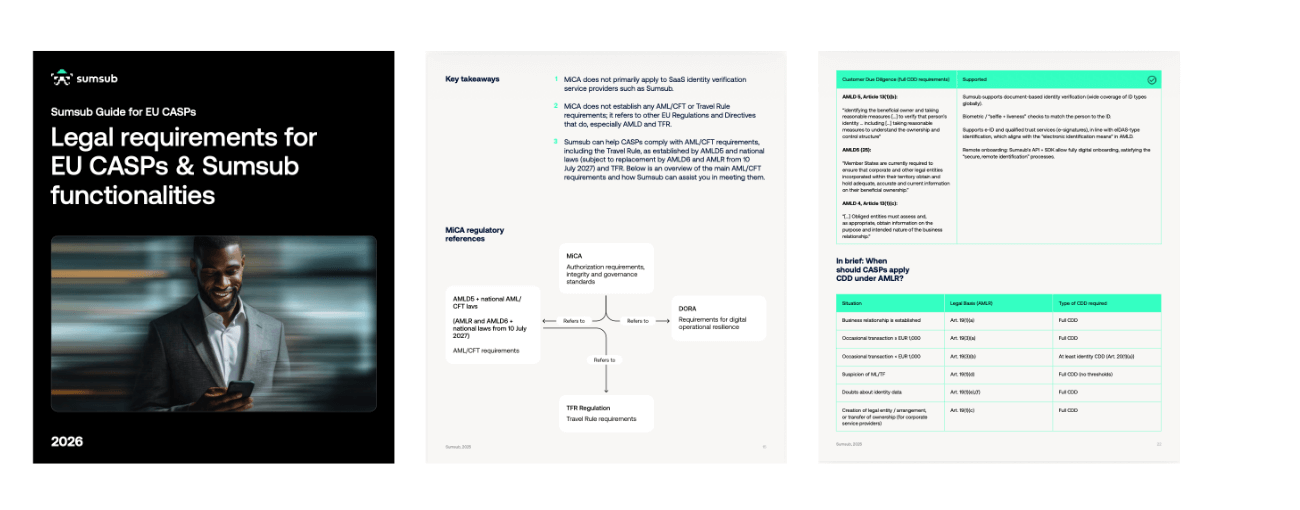
Sumsub for EU CASPs Legal requirements for EU CASPs & Sumsub functionalities
 Read more
- Guide
- 10 min read
Ask Sumsubers: How can the Travel Rule be applied in case of a transfer where one side is an unhosted wallet?
 Read more
- News
- 2 min read
From Wallets to Counterparties: Why VASP Attribution Matters for Proactive Compliance
 Read more
- News
- 2 min read
Chartis Award 2025 for Travel Rule
 Read more