The crypto industry is entering a phase where platforms should effectively integrate compliance, fraud resilience, and product design into a coherent operating model.
Sumsub, a leading full-cycle verification platform that enables scalable compliance, today released its fourth annual State of the Crypto Industry report*. The new research reveals how crypto companies are balancing fraud prevention, regulatory pressure, and user experience as they scale in 2026. This report draws on Sumsub’s internal data from 2024–2025 and insights from 300 crypto companies surveyed outside Sumsub’s customer base.
Some of the key global highlights include:
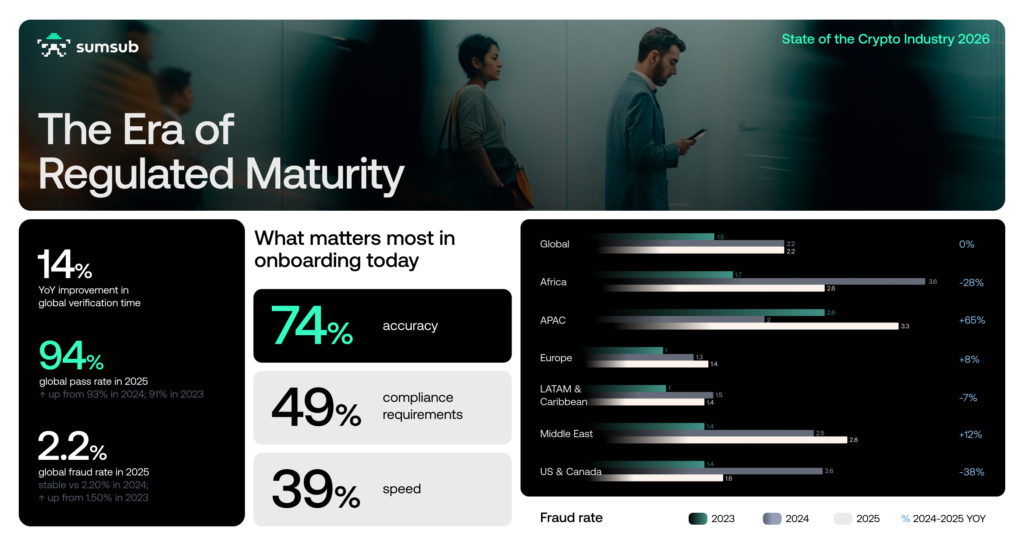
- Crypto firms are moving away from ‘growth at all costs’, with 74% now prioritizing verification accuracy over user onboarding speed (39%).
- Despite fraud rates remaining flat at 2.2% from 2024 to 2025, crypto firms operate in a structurally riskier environment where targeted, automated and AI-driven attacks are the new normal.
- Over half (55%) of surveyed companies confirmed they experienced fraud at least once in 2025, with 15% unsure if it happened or not–emphasizing the lag between detection capabilities and growing fraud sophistication.
User Experience Evolution in Crypto
According to surveyed crypto providers outside Sumsub’s customer base, three of the main verification hurdles in 2025 were false positives/false negatives (affecting 60%), slow verification times and poor UX (58% each). While verification accuracy is the top priority for almost three quarters of crypto companies, balancing onboarding speed and user experience alongside this remains critical.
That said, Sumsub internal data analysis reveals that the overall industry’s pivot toward accuracy, better internal processes, and more advanced technology is driving tangible improvements. Even as platforms faced stricter regulatory requirements and increasingly sophisticated fraud attempts, user pass ratescontinued to improve gradually, reaching 94% of all verification attempts on average, up one point from 2024—which translated into millions more successful legitimate users onboarded globally.
Another notable trend is UX merging with compliance, increasing popularity in Non-Doc and Reusable Identity solutions among future-oriented crypto platforms: the former refers to document-free user onboarding, and the latter allows to verify clients across multiple platforms without repetitive document uploads. In 2026, high pass rates are expected to be maintained alongside compliance requirements in increasingly complex cross-border onboarding scenarios.
“Crypto has entered a phase where operational discipline matters more than momentum.” said Andrew Sever, Co-Founder and CEO at Sumsub. “In 2025, the conversation shifted from ‘How fast can we grow?’ to ‘How well can we scale under scrutiny?’. Regulatory execution, fraud resilience, and onboarding efficiency are no longer separate challenges—they’re interconnected systems problems. In 2026, sustainable growth will belong to those who build reliability into the core of their product and infrastructure from day one.”
Crypto Fraud Trends
While global fraud rates remained largely stable from 2024 to 2025, the dynamics varied across regions: with a significant 65% rise in APAC (reaching 3.3% of all verification attempts) and a moderate 8% increase in Europe (still remaining the lowest fraud rate globally, 1.4%), some regions showed drops in fraud rates: -38% across North America (down to 1.6%), -7% in LATAM (same as the minimum in Europe, 1.4%) and -28% in Africa (reaching 2.6%).
Fraud exposure in 2025 was widespread across crypto platforms: 55% of respondents experienced fraud in 2025—25% at least once and 30% multiple times. Instead of relying on a single technique, modern fraud operations increasingly combine social engineering, synthetic identities, and mule networks to bypass controls and exploit weaknesses in identity verification and transaction monitoring, turning fraud into a targeted and persistent threat rather than a series of isolated incidents. Over half (57%) of surveyed crypto providers prioritise AI-powered fraud detection and 51% invest in advanced fraud analytics and monitoring.
Global Regulatory Updates
Adding to the complex fraud challenge, the 2025-2026 period marks a global regulatory inflection point for crypto, with regulators moving decisively from high‑level policy frameworks to operational enforcement—encompassing Travel Rule obligations, CARF tax‑reporting regimes, stablecoin oversight, VASP licensing, and more.
Recent enforcement actions highlight this shift. For example, in March 2026 South Korean regulators imposed a $24.6 million fine on a major crypto exchange and ordered a six-month partial suspension of certain operations due to anti-money laundering and customer verification failures, signaling a more assertive approach to compliance oversight across leading digital asset markets.
Crypto Travel Rule compliance is expected to become a baseline market requirement instead of a competitive differentiator, with the majority (51%) of surveyed platforms either fully ready (23%) or actively implementing (28%) FATF Recommendation 16, and the remaining 43% reporting uncertainty over their integration status.
Crypto has entered a regulated maturity era: growth in 2026 is defined by regulatory scrutiny, sophisticated fraud pressure, and competition to deliver compliant, low-friction onboarding at scale.
“Regulated maturity means building better systems, not just adding more rules. The platforms that win will be those that embed verification into their product DNA and wrap automation in strong controls, transparency, and accountability,” explains Ilya Brovin, Chief Growth Officer at Sumsub. "In the era of AI agents, the central dilemma is how AI-powered verification vendors continuously outmaneuver AI-driven fraud without eroding user experience or auditability. Those who solve this dynamic won’t just meet regulatory expectations — they’ll define the next standard of trust in crypto.”
To get the full State of the Crypto Industry 2026 report, please check https://sumsub.com/crypto-industry-report-2026/
*Note on Sumsub’s research methodology
The study combines three main data pillars: 1) internal identity verification and user activity data from 2023 to 2025, covering pass rates, verification time, and fraud attempts across various regions, based on over 23,000 fraud attempts analyzed daily; 2) results of Sumsub’s Crypto Industry Research Survey 2025, which features responses from 300+ companies across the crypto sector outside Sumsub’s customer base, including centralized exchanges, wallets, payment providers, on/off‑ramps, and token issuers; 3) external publicly available regulatory and policy data capturing 2025-2026 changes in crypto‑asset rules, Travel Rule implementation, and tax reporting obligations across high‑priority regions.


