74% of Hong Kong consumers call for verified AI agents, as regulators warn of escalating fraud, data leaks and misuse
Sumsub today released new survey findings revealing that consumers are increasingly delegating control to AI agents despite unresolved risks. Adoption may be starting to outpace understanding, creating growing challenges around trust, accountability and consumer protection.
In recent months, AI agent usage has accelerated. Most exposure has occurred within familiar apps and services—such as ecommerce platforms, banking and payment apps, travel and lifestyle services, and social or messaging platforms—where AI agents help answer questions, summarize information, plan purchases or trips, and automate routine tasks. In some cases, they also take actions on users’ behalf, for example by completing purchases or initiating payments.
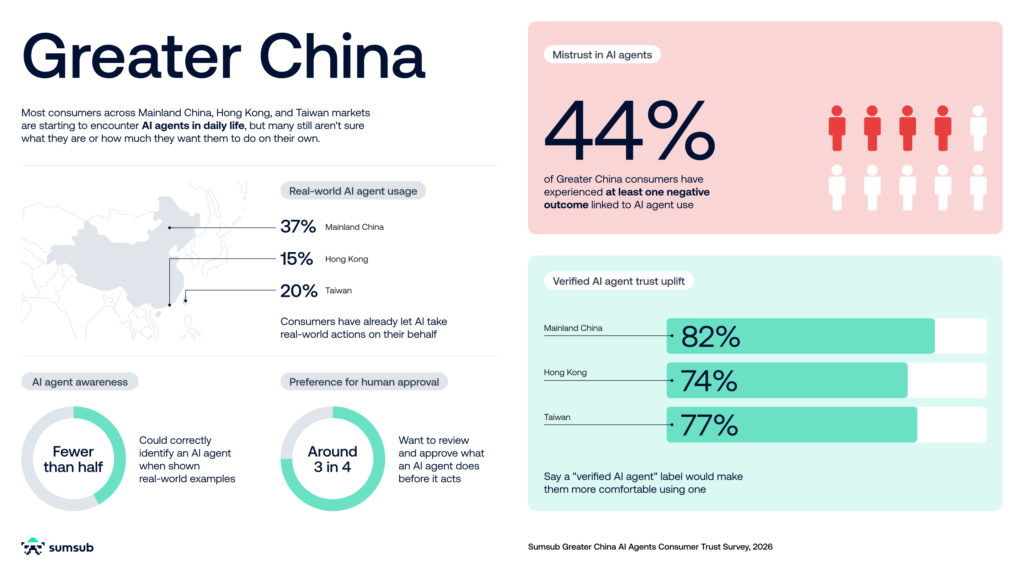
The Sumsub Greater China AI Agents Consumer Trust Survey, conducted among 1,050 respondents across Mainland China, Hong Kong, and Taiwan markets, shows that 44% of consumers have experienced at least one negative outcome linked to AI agent use—ranging from unintended actions (20%) and unauthorized purchases (16%) to personal data leaks (20%), fraud (16%), or account compromise (13%). Beyond individual incidents, the growing capability and autonomy of AI agents have drawn increasing regulatory attention globally. In March 2026, Hong Kong’s Office of the Privacy Commissioner for Personal Data (PCPD) warned both the public and organizations of privacy and security risks associated with AI agents.
Despite this, the survey found that in Q1 2026, 37% of consumers in Mainland China, 20% in the Taiwan market, and 15% in Hong Kong have already delegated actions to AI agents. What may be contributing to the risks amid increased usage is that less than half of respondents can distinguish AI agents from other forms of AI, including just 45% in Hong Kong, highlighting a critical knowledge gap around what AI agents should be permitted to do, and where human oversight remains essential.
Key findings:
- Among self‑identified early adopters, 59% trust AI agents to operate without human review.
- Nearly 80% Hong Kong respondents are either uncertain (38%) or unaware (41%) that platforms may have rules governing AI agent use.
- When service platforms impose limits, 42% Hong Kong consumers say they would still continue using AI agents by relying on its decision support while completing actions manually, working around limits, or switching to platforms that allow agent use.
- In Hong Kong, views on accountability are split when AI agents fail, with shared responsibility (40%) cited more often than any single party, including AI developers, service platforms, or users.
- 74% of Hong Kong consumers agree that verifying AI agents would boost confidence by confirming the agent’s identity, permissions, and actions.
“AI agents can dramatically improve efficiency, but they cannot replace human accountability,” said Penny Chai, Vice President, APAC at Sumsub. “They should only act as co‑pilots, providing assistance, not acting independently without oversight. As technology advances at an unprecedented pace, what consumers and businesses need most is clarity: how decisions are made, who is responsible, and what happens when things go wrong. Getting this right is essential to building digital trust, enabling adoption, and ensuring innovation does not come at the expense of security.”
Humans must remain gatekeepers as experimental use of AI agent takes off
Consumer trust remains closely tied to perceived risks. While consumers across Greater China are increasingly comfortable with AI agents handling non-financial tasks—with over 70% using them at least once a week, primarily for lower-risk, assistive tasks such as asking questions or generating content, organizing or summarizing information, and end-to-end planning or researching—confidence drops when financial decisions are involved. This contrast highlights the need for clear boundaries around autonomy where consequences are higher.
Underscoring this expectation of oversight, 77% of consumers across Greater China say they would feel more secure if human approval were required before AI agents proceed, especially for actions involving payments, sensitive data, or irreversible decisions. These findings reinforce that humans must remain the final gatekeepers, ensuring accountability as AI agent autonomy expands.
Digital trust leans on verification and shared accountability across public-private sectors
Consumers are also clear about what would help rebuild confidence. Respondents point to three factors that would meaningfully increase their comfort with AI agents: platform‑level protections (39%), additional verification checks (38%), and stronger regulation (37%). Notably, over seven in ten agree that verifying AI agents would boost their confidence in using them.
Trust is also distributed across stakeholders. Similar proportions of respondents say they place the greatest trust in AI platform builders (39%), governments and regulators (37%), and independent verification providers (36%) to ensure the security and accountability of AI agents, underscoring that no single actor can address these risks alone.
“Effective AI agent governance requires strong public‑private collaboration,” said Jason Chan, APAC Government Relations Lead at Sumsub. “At Sumsub, we are ready to work with governments, regulators, and industry partners to help establish clear standards, strengthen accountability, and raise awareness of responsible AI agent use that protects consumers and organizations, keeping these systems within transparent, enforceable safeguards.”
Building on the need for clearer accountability, Sumsub has launched its AI Agent Verification solution within its Know Your Agent (KYA) framework, designed to address growing risks and trust gaps. The solution verifies AI agents by linking their actions to a verified human identity, ensuring that only trusted, authorized automation can act, helping establish human accountability and protect consumers and organizations from AI‑driven fraud.
To learn more about Sumsub’s AI Agent Verification solution and KYA, please go to: https://sumsub.com/blog/know-your-agent/
Methodology note:
To assess consumer readiness for adopting AI agents and current usage levels, the Sumsub Greater China AI Agents Consumer Trust Survey was conducted in April 2026 by Blackbox, an independent market research house. The study surveyed 1,050 respondents across the Mainland China, Hong Kong, and Taiwan markets, examining trust levels, comfort with delegating tasks of varying complexity and risk, and the factors shaping usage and adoption intent. It also explores real‑world usage behavior, awareness of platform rules and limitations, and the security, privacy, and accountability concerns that continue to hold back wider adoption.