Where compliance and identity controls belong in an on-chain payment flow, and what risk, compliance, and architecture teams need to resolve before the first transfer is signed.
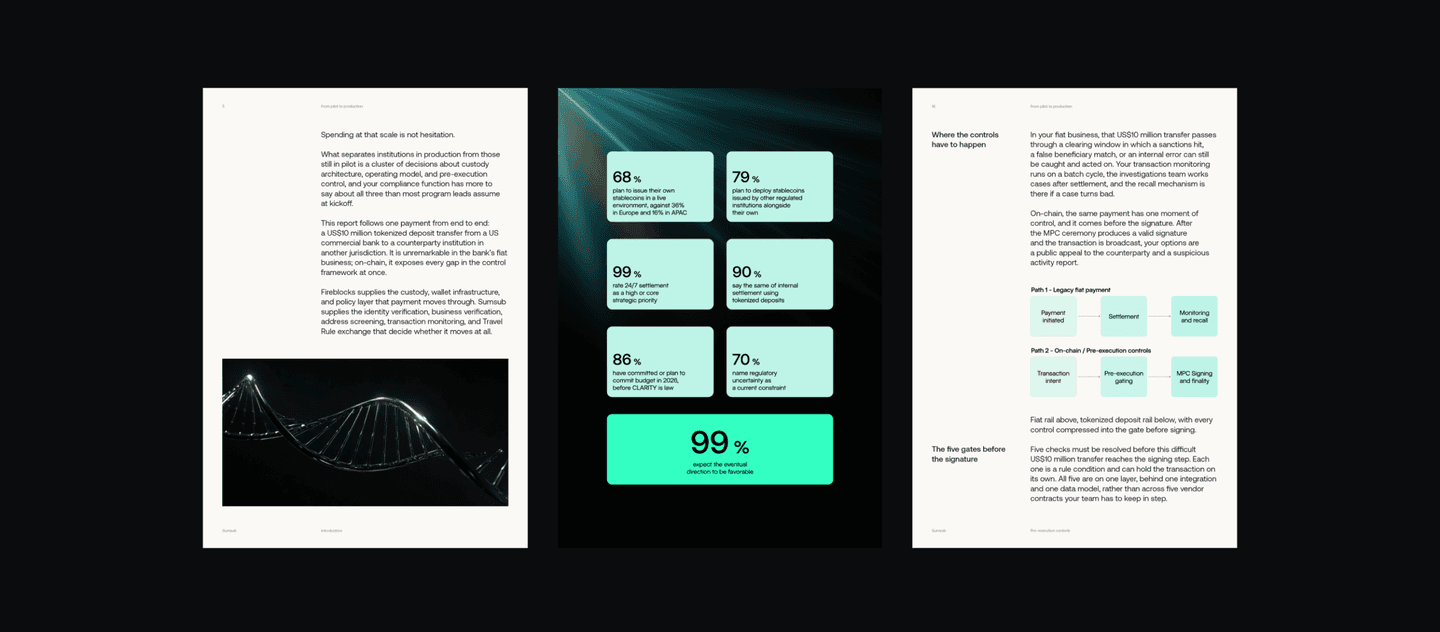
Stablecoins and tokenized deposits have moved past crypto experiment and into the plans of traditional financial institutions. In January 2026, Fireblocks surveyed 638 decision-makers at financial institutions and corporates for its Financial Grid research. Of the institutions surveyed, 88% have committed or will commit budget to digital asset infrastructure this year. Only 16% are in live production.
What separates the institutions in production from those still in pilot is a cluster of decisions about custody architecture, operating model, and pre-execution control. And compliance has more to say about all three than most program leads expect at kickoff.
Take pre-execution control as an example. In fiat, a wire sent to the wrong beneficiary can often be pulled back, and much financial crime work happens after payment: monitoring runs in batches, and investigations work cases after settlement. But an on-chain transfer that reaches finality can't be reversed by the bank, the counterparty, or the protocol. That means address screening, transaction monitoring, and Travel Rule checks have to run before the transaction is signed. Compliance becomes part of the architecture rather than an end-of-process review, and AML and Travel Rule policies written for correspondent banks and SWIFT messages have to be redrafted for wallet-to-wallet transfers.
In this joint report, Fireblocks and Sumsub follow one payment end to end: a US$10 million tokenized deposit transfer from a US commercial bank to a counterparty in another jurisdiction, through every check it has to clear before it's signed. The report brings together Fireblocks' expertise in custody, wallet infrastructure, and policy control, and Sumsub's work in identity verification, business verification, address screening, transaction monitoring, and the Travel Rule. Fireblocks has secured more than US$10 trillion in digital asset transactions across 120+ blockchains, for organizations including Worldpay, BNY, Galaxy, and Revolut. Sumsub serves more than 4,000 clients, and a Forrester Total Economic Impact study of Sumsub's AML Transaction Monitoring projected a 272% return on investment, with payback within six months. Fireblocks and Sumsub already work together: since November 2025, Sumsub has been the first live Travel Rule provider on Fireblocks' Travel Rule Link.
What you'll learn:
- Why so many digital asset pilots stall, and why the cause is usually organizational rather than technical
- How to build while US rules are still unfinished, what to keep configurable in the meantime, and what Europe's experience under MiCA suggests
- The five checks a cross-border transfer has to clear before it's signed, and how to handle payments to unhosted wallets
- How a US$10 million transfer moves from initiation to signing, where Fireblocks and Sumsub come in, and what happens when a check doesn't come back in time
- What production looks like for bank-issued stablecoins, interbank tokenized deposit clearing, and qualified custody and trading desk operations
- The questions each member of the buying committee should bring to vendor meetings, a realistic timeline to go live, and what has to be in place before you do
This report is for: Chief Risk Officers, Heads of Compliance, CISOs and chief architects, and Digital Asset Program Leads at commercial, transaction, and investment banks moving digital asset pilots into production, particularly institutions preparing to issue or support stablecoins and tokenized deposits.