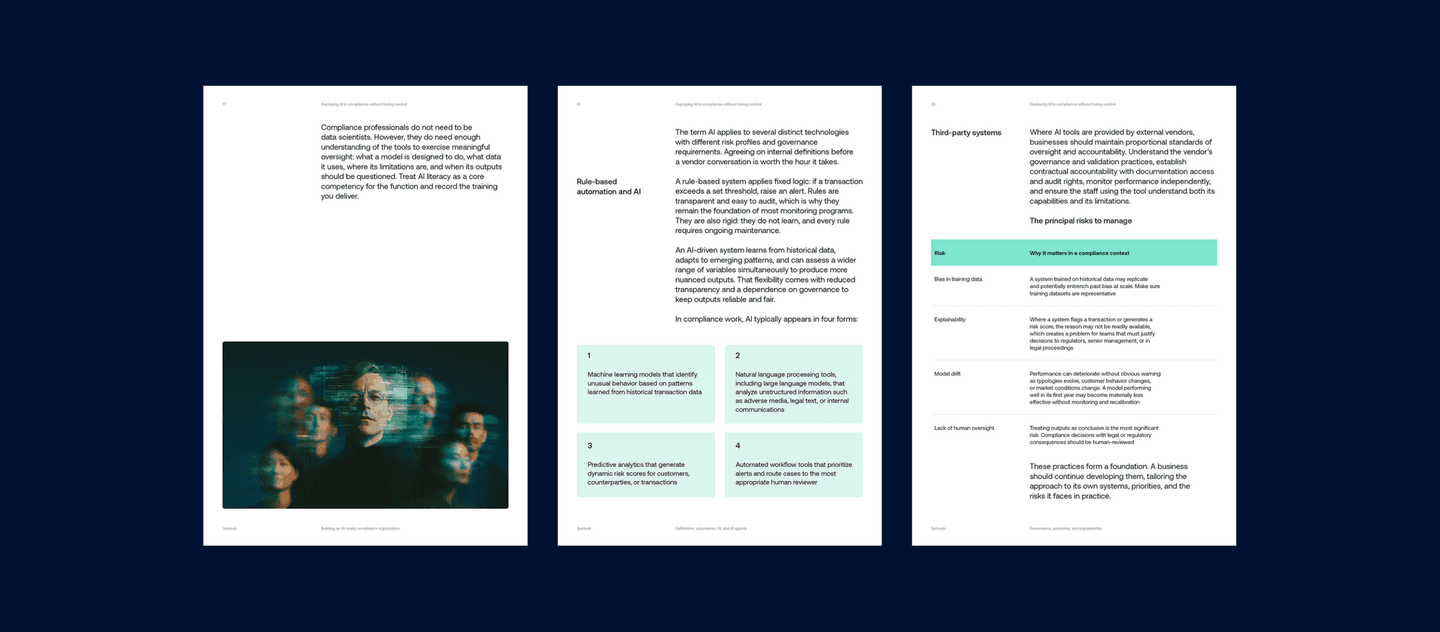
A practical guide to implementing AI across compliance, risk, and fraud operations without losing the audit trail, accountability, and human oversight regulators demand.
Automation changes who does the work. It doesn’t change who answers for it.
AI can help compliance teams tackle some of their biggest operational challenges: overwhelming alert queues, high false-positive rates, constantly changing regulations, and hours spent on case reviews and SAR/STR drafting.
But as AI takes on more work, a harder question emerges: how much of the decision can you trust to AI, and can you explain what happened when a regulator asks?
Learn how to:
- Draw the line between automation, AI, and AI agents
- Turn regulatory text into working programs: extract requirements, build risk matrices, and generate configurations straight from policy documents
- Fix the daily grind: queue reviews, false-positive resolution, alert triage, and SAR/STR drafting, without losing the paper trail
- Run the governance process: inventory your AI systems, map them to applicable regulation, and put controls in place that keep a human accountable for every output
- Get the country-by-country regulatory read: the EU AI Act, the US's 48-state patchwork, China, the UK, and Singapore
- See what's coming next: AI-driven fraud, the end of single-signal ID checks, and why you'll soon need to verify AI agents the way you verify people ("Know Your Agent")
This guide is for:
Compliance officers and MLROs evaluating or already deploying AI in a regulated environment, risk and fraud operations leads drowning in alert volume and manual case work, heads of AML/KYC program design building or replatforming programs across jurisdictions, and the compliance, product, and ops managers who will be asked to explain their AI-assisted controls to a supervisor.