Verification that works all the way to settlement.
Most systems treat verification as a one-time check: a user passes KYC at sign-up, and they’re verified for life. The problem is that risk isn’t limited to sign-up. It’s behavioral, and it moves as often as money does. Credentials that clear every onboarding check can quickly turn to fraud by transaction three hundred. And that’s something a single snapshot check will never catch.
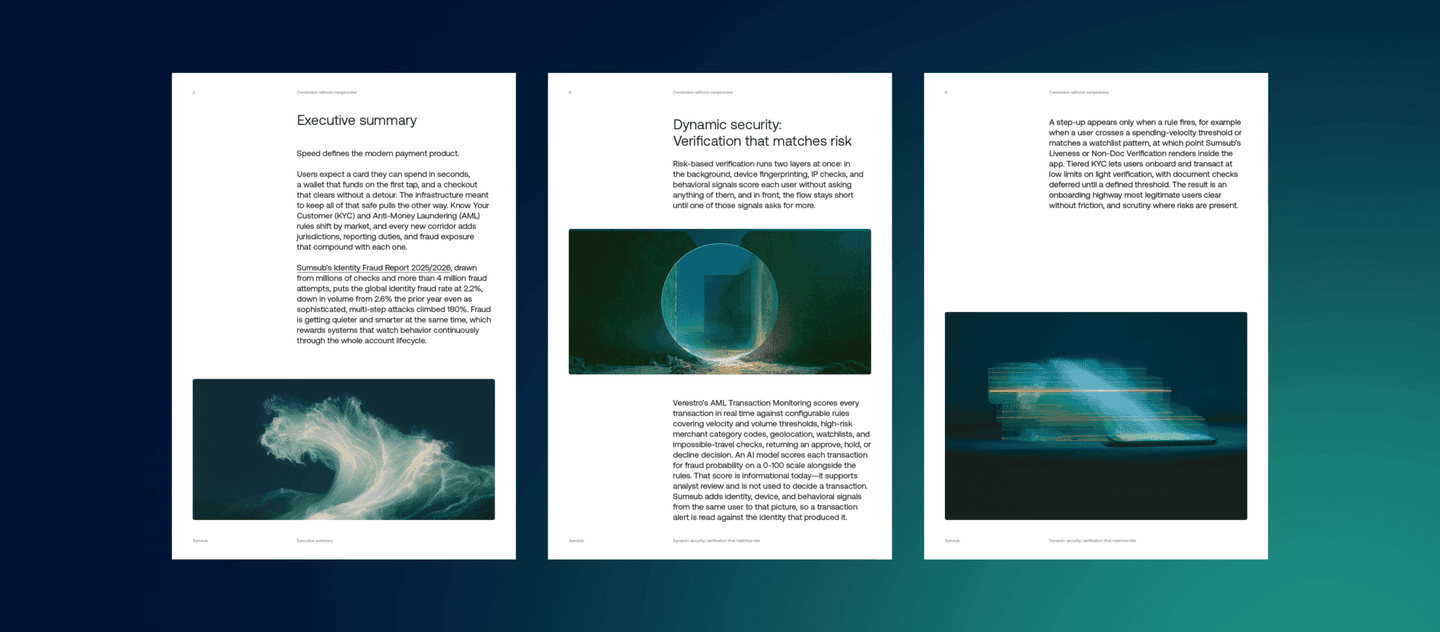
The risk that matters most usually surfaces after approval. Stolen or synthetic credentials can sail through sign-up and then be used for money-mule activity, multi-accounting, or smurfing later down the line. And that type of risk is growing: identity fraud is down in volume, but sophisticated, multi-step attacks climbed 180% in a year. Fraud is getting smarter and harder to see—especially if you’re only looking for it at sign-up.
The fix isn't a heavier gate at sign-up. In fact, the most demanding verification flows report abandonment as high as 70 to 80%. The fix is verification that keeps running after approval: clear low-risk users on a fast path, then keep watching, with heavier checks firing only when a signal warrants them.
This report shows how Sumsub and Verestro build that into a single flow, from sign-up to settlement. It draws on Sumsub's work in identity verification, AML screening, and fraud prevention, and on Verestro's expertise in card issuing, provisioning, and cross-border settlement. Sumsub supports 14,000+ document types across 220+ countries and territories, verifies users in about 20 seconds, and serves more than 4,000 clients. An independent Forrester Total Economic Impact study, modeling a composite of Sumsub customers, projected 272% three-year ROI with payback in under six months.
What you'll learn:
- Why a check that ends at sign-up misses behavioral fraud, and what continuous monitoring adds once an account is live
- How matching verification to risk clears low-risk users on a fast path, with heavier checks only when a signal warrants them
- How a stack stitched together from separate KYC, AML, payment, and fraud tools creates blind spots, and how one shared data layer changes how teams operate
- What an integrated trust and payment layer looks like in practice, from verification through real-time monitoring to global payout
- Two operational use cases in depth: a global neobank card launch and a high-growth cross-border merchant
This report is for:
Chief compliance officers, MLROs, financial crime leads, and the CTOs, heads of payments, and product owners who own onboarding and payment flows. Especially relevant for banks, fintechs, and merchants in crypto, iGaming, investment, payment services, and neobanking.