Benchmark identity verification for crypto
Verify users, businesses, and transactions everywhere with an AI-agent-friendly platform built for compliance at every touchpoint.

The AI-driven AML & fraud prevention powerhouse
in your target country
Sumsub’s average pass rate for France is 96.39%
Sumsub’s average pass rate for United Kingdom is 95.86%
Sumsub’s average pass rate for United States is 91.64%
Verify anything, expand anywhere
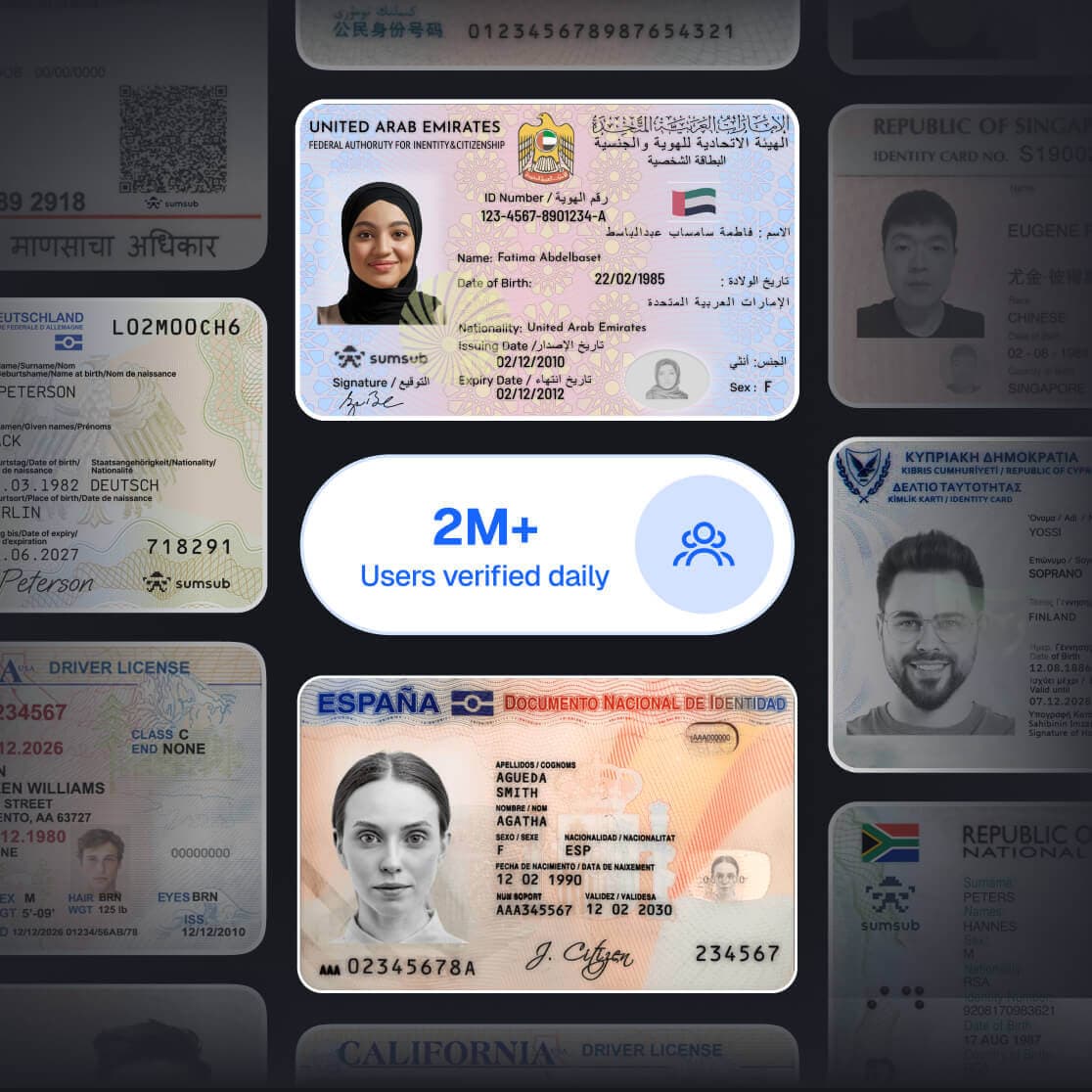
The entire world is at your fingertips. With Sumsub’s AI-based OCR, no document type, country, or typescript will stop you from growing business abroad.
Secure every step of the customer journey
Orchestrate identity verification checks, code-free. Place checks at any stage of the customer journey for top
anti-fraud protection and pass rates worldwide.

Don’t take our word for it.
Here’s what our clients have to say
- With Sumsub, we’ve managed to reduce user fraud to practically zero. Since we began using Sumsub, fraud is just one less thing we’ve had to worry about.
 Amram AdarCo-Founder and CEO at Oobit
 - Thanks to Sumsub, we've significantly improved our fraud prevention measures, safeguarding the assets of our 25 million users worldwide.
 Vugar Usi ZadeCOO at Bitget
 - Thanks to Sumsub, we were able to onboard a large number of users quickly and efficiently, driving exponential growth in our trading volume to millions of dollars. This surge in activity also resulted in a massive boost to Hata's revenue, growing over 30x.
 David LowCEO at Hata
Award-winning verification platform to keep your business compliant and future-ready

Category Award Winner for Travel Rule Functionality, Crypto, and Perpetual ID&V
Chartis 2025

Category Leader in RiskTech Quadrant for AML Transaction Monitoring Solutions
Chartis 2024

Winner in Financial Crime and Compliance 50
Chartis 2025

A leader for AML Transaction Monitoring
Liminal’s Link Index for AML Transaction Monitoring, 2025

Users Love Us
G2 2025 Identity Verification Spring Report

A Regional Leader in Europe
G2 2025 Identity Verification Fall Report

A Momentum Leader
G2 2025 Identity Verification Fall Report

Easiest Setup
G2 2024
FAQ
What is crypto verification?
Crypto verification, also referred to as crypto identity verification, is used by blockchain networks and cryptocurrency exchanges to ensure the authenticity of transactions. It involves checking the validity of a transaction by examining the cryptographic signatures associated with it. Without these checks, double-spending, fraud, and other malicious activities occur. It is also one of the main aspects of crypto onboarding for new users, as personal details may be verified to ensure regulatory compliance.
How does cryptocurrency verify identity?
Cryptocurrency verification platforms check identity through the Know Your Customer process (KYC). This process requires users to provide certain personal information, like proof of identification or a residential address. Cryptocurrency exchanges and other platforms that utilize KYC often employ crypto KYC providers to ensure a secure identification process. Providers like Sumsub offer advanced crypto AML/KYC frameworks that cross-check user-provided information against global databases to detect any potential risks.
How long does crypto verification take?
The length of the crypto verification process can vary depending on the platform and the specifics of the verification flow. The onboarding process involves checking the validity of a transaction, which is almost instantaneous due to the decentralized nature of blockchain technology. However, for KYC verifications, it could take anywhere from a minute to several days—if done manually. This depends on the volume of requests the platform is handling at a given time, the completeness of the information provided by the user, and the effectiveness of the crypto check procedures in place
What is the KYC platform for crypto?
The KYC platform for crypto is any service that assists cryptocurrency exchanges, blockchain companies, or other related entities in conducting user verification. These platforms provide crypto AML/KYC solutions to ensure compliance with local and international regulations. They enable these companies to verify the identities of their users and minimize the risk of fraud and money laundering. The choice of a platform often relies on processing speed, accuracy of the solution, and customization options.
What is the Travel Rule in crypto?
The Travel Rule is a crypto compliance requirement that obliges Virtual Asset Service Providers, or VASPs, to collect, verify, and share certain information about the sender and recipient of a crypto transaction. Its goal is to make crypto transfers more transparent and help prevent money laundering, terrorist financing, and other financial crimes.
What is KYT in crypto?
KYT, or Know Your Transaction, is the process of monitoring and analyzing crypto transactions to detect suspicious, high-risk, or potentially illicit activity. While KYC focuses on verifying who a customer is, KYT focuses on what they are doing with their funds.