Crypto Identity Verification
AML and anti-fraud platform designed for the crypto industry
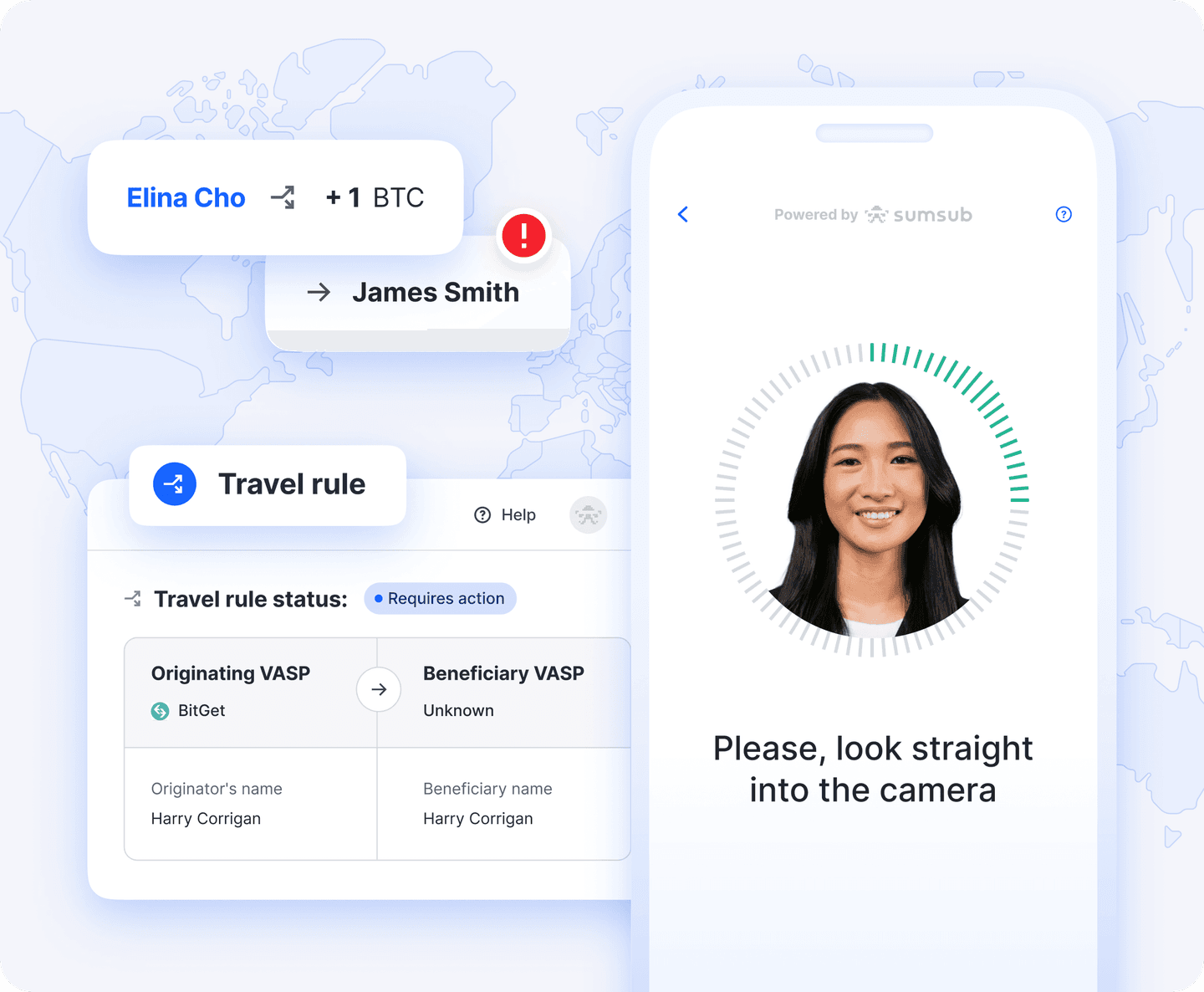
Stay compliant and fraud-free


Secure every step of the customer journey
Place verification checks where and when you need them most for top conversion rates and security, code-free.

Perfect match for every crypto project
8/10 top crypto exchanges are already using Sumsub.
Here’s what they have to say
- By partnering with Sumsub, we aimed to ensure compliance with a wide range of international regulations and adapt to the specific requirements of the regions in which we operate. Sumsub’s solution has helped address these challenges and maintain compliance across different jurisdictions.
 Vivien LinChief Product Officer at BingX
 - Thanks to Sumsub, we’ve significantly improved our fraud prevention measures, safeguarding the assets of our 25 million users worldwide.
 Vugar Usi ZadeCOO at Bitget
 - As a strategic partner, we have recommended Sumsub’s KYC/AML solutions to our clients for deployment alongside our white-label solutions. Our clients have provided positive feedback on Sumsub’s extensive database, automated systems, and robust compliance and risk management features.
 Sailor ZhongCOO at Bitget
 - We have been introduced to a wide range of additional tools offered by Sumsub, including advanced AML Screening, Travel Rule, and Transaction Monitoring solutions, which we look forward to exploring in the future to further strengthen its compliance and regulatory standing.
 Ben El-BazManaging Director at HashKey Global
 - Sumsub matched our values. Its products handle the complexities of ID verification while maintaining enterprise-grade security and regulatory compliance.
 Dejan DavidovicChief Operating and Integrity Officer at Kriptomat
 - With Sumsub’s reusable KYC — Share Token system, Mercuryo’s partners can share their applicants’ KYC data with one another. This way, users don’t have to manually verify their identity on the Mercuryo side and undergo KYC multiple times. And this not only helps us improve the user experience but also increases the conversion rate!
 Arthur FirstovHead of Sales at Mercuryo
 - Sumsub got our votes because of its flexibility. We dove deep into Sumsub’s platform functionality and discussed what we’d want to add or remove to the system with their team. Sumsub’s people were always quick to react and address our needs. Thanks to Sumsub’s Transaction Monitoring solution and Video Identification feature we optimised our false declines and increased conversion by 30%.
 Andrei IalamaCOO at Paybis
 - One key benefit is the relationship between Wirex and Sumsub. We have bi-weekly meetings to discuss issues and resolutions, which has been very useful in establishing mutual collaboration and understanding. It was great to note that Sumsub would change its approach to suit us. Real customer service starts when problems arise, and it’s about how we resolve them.
 Paul ChapmanGlobal Head of Financial Crime Operations at Wirex
 - With Sumsub, our clients can enjoy a more efficient onboarding process while simultaneously joining the fight against the growing threat of identity fraud in the cryptocurrency industry. Looking back, I can say that this was one of the best integration experiences we’ve ever had.
 Andrei AlekseevCMO at YouHodler
caption
title
text
FAQ
What is identity verification for crypto?
Identity verification in crypto, known as Know Your Customer (KYC), is similar to KYC processes in other industries. It involves crypto platforms verifying users’ identities to comply with anti-money laundering (AML) regulations, counter-terrorism financing (CTF), and other financial security measures. This typically requires users to submit personal information, government-issued identity documents, and biometric data, such as facial recognition. The primary goal is to prevent fraud, money laundering, and other illicit activities.
What sets crypto identity verification apart is that crypto companies operate globally and must comply with regulations across multiple jurisdictions, requiring localized verification methods tailored to each country’s requirements. Speed is also a key factor, as the industry prioritizes fast onboarding, which is facilitated by local non-document verification (Non-Doc KYC). Additionally, KYC providers should integrate blockchain analytics to screen wallet addresses, monitor crypto transactions, and detect suspicious activity, ensuring a more comprehensive approach to security and compliance.How long does a crypto KYC verification take?
The time required for crypto KYC verification varies depending on the platform and method. Automated verification can take only a few seconds if the system approves the submitted documents quickly. Manual review, sometimes necessary, may take several minutes to a few hours. Advanced KYC checks (enhanced customer due diligence), applicable to users requesting higher withdrawal limits or additional verification, might take longer if more documents are needed.
Is KYC mandatory for crypto wallets?
The wallet software itself does not require verification, but a user may need KYC to create and use the wallet. Non-custodial wallet providers are generally not required to implement KYC since users control their private keys and assets. However, custodial wallet providers typically enforce KYC because they offer AML/CTF-regulated services. While non-custodial wallet providers are not legally obligated to comply with KYC requirements, many implement them for security and regulatory alignment.
Not to be confused with wallet verification, which involves screening wallet addresses against blockchain analytics tools to detect potential illicit activities. This allows platforms to assess the risk level of a wallet before processing transactions, adding another layer of compliance and security.How much does crypto KYC cost?
Choosing a crypto KYC provider depends on the size of your business and its specific compliance needs. A scalable solution should support document and non-document verification, ensuring fast and accurate identity checks while detecting deepfakes and forged documents. It should also offer multilingual support and adapt to local regulatory requirements with easily customizable verification flows tailored to different regions and document types.
Additionally, businesses should prioritize providers that stay compliant with evolving regulatory frameworks, offer robust fraud detection capabilities, and provide flexible pricing models. Ensuring compatibility with the jurisdictions where a company operates is essential for a seamless and efficient verification process.What is fraud prevention in crypto?
Fraud prevention in crypto refers to the strategies, tools, and technologies used to detect, mitigate, and prevent fraudulent activities such as money laundering, account takeovers, and other illicit activities within the cryptocurrency ecosystem. Effective fraud prevention should follow AML procedures, including Know Your Customer (KYC), real-time transaction monitoring, fraud detection, and risk assessment to protect users and businesses from financial crime.
What is AML screening in crypto?
AML screening in crypto is the process of identifying and preventing financial crimes like money laundering and terrorist financing by analyzing users, transactions, and wallet addresses. It involves checking individuals and entities against global sanctions lists, politically exposed persons (PEP) databases, and watchlists to detect high-risk profiles. AML screening also includes transaction monitoring, which tracks crypto transfers in real-time to flag suspicious activities such as rapid large transactions, mixing services, or links to darknet markets.