- Mar 09, 2026
- 9 min read
Kick-Off for Fraud: How the Football World Cup 2026 Puts Betting Platforms Under Attack
The 2026 World Cup will drive massive betting traffic—and fraud. Learn how iGaming and betting platforms can stop bonus abuse, money mule activity, and false positives.


Every four years, the world seems to stop for football. From unexpected group-stage upsets and nail-biting finals to dramatic penalty shootouts and fan fun, the World Cup, organized by FIFA, delivers unmatched excitement. With so much going on, it’s no wonder it’s the world’s most-watched sporting event, and extremely likely to be one of the most bet-on events of 2026. At the last FWC in 2022, the UK alone wagered nearly US$2bn in a tidal wave of betting activity.
For iGaming operators, however, the World Cup is not just about goals and glory. With more users placing bets, this is also a prime season for iGaming fraud, such as sports betting fraud and organized abuse campaigns. During global events of this scale, fraudsters can operate like well-drilled squads: coordinated, strategic, and ready to exploit any weakness in a platform’s defense.
As millions of legitimate fans rush to place bets, fraudsters can blend into the crowd. So, are your defenses ready for kick-off in the Fraud World Cup?
Why the World Cup is a magnet for fraud
Betting is a big part of the World Cup, leading to surges in traffic, innovative marketing campaigns, and new users flooding platforms from across the globe. This makes it easier for fraudsters to stay unnoticed during the ensuing chaos, making gambling fraud prevention a priority for iGaming operators. Here’s why betting platforms need to be especially careful this summer.
Traffic surges hide fraudsters
Major tournaments like the World Cup generate extraordinary spikes on betting platforms. Services that normally process thousands of registrations per day may suddenly find themselves overwhelmed and handling hundreds of thousands.
First-time and casual betting is also predicted to surge during the World Cup, with nearly one in five football fans looking to place their very first bet during the tournament. And with the World Cup being held in countries that don’t typically follow football, like the USA and Canada, it could lead to significant interest in these emerging football markets.
Under these strained conditions, traditional review processes can collapse. Large groups of coordinated fraudsters, including money mules, can then take advantage, registering from the same IP ranges, device clusters, or shared geographies, and forming organized networks for targeted abuse.
Without adequate iGaming fraud detection, suspicious patterns risk getting lost in the massively increased noise. Effective money mule detection can help with risk scoring, checking blocklists, adverse media screening, device intelligence and behavioral analytics, and network detection. During peak events, relying on manual reviews is like defending against Messi with dumbbells strapped to your legs. You simply won’t keep up.
This is where robust betting fraud controls make the difference between clean play and catastrophic losses.
False positives stall onboarding
While high traffic volumes increase the risk of fraud, it’s also worth remembering that more users on a platform means more false positives, and legitimate bettors getting stuck in onboarding is a great way to lose customers.
When verification systems aren’t optimized, legitimate users can get flagged during KYC gambling checks. Verification times stretch, and frustrated fans give up and try registering with a competitor. Getting the right verification system can help reduce customer frustration and the risk of lost revenue.
Excessive false positive fraud detection undermines conversion rates when acquisition costs are highest. Platforms need to quickly distinguish between ordinary fans, prohibited users like politically exposed persons (PEPs), and fraudsters who could pose a risk.
Efficient identity verification systems on gambling platforms ensure that real customers can deposit and bet before kick-off, while bad actors are stopped at the gate.
Bonus abuse farms exploit promotions
World Cup marketing campaigns are creative and competitive by design, and the iGaming industry is no different, offering free bets, deposit matches, and more.
To legitimate customers, this can be a fun way to enhance their World Cup experience. But to fraudsters, these campaigns are an opportunity to take advantage. Bonus abuse accounts for 63.8% of all fraud in the iGaming sector, which has seen overall global fraud rates double in the last two years, according to Sumsub’s 2025 iGaming Fraud Report.
Organized gambling bonus abuse groups can create thousands of accounts to exploit welcome offers. Through multi-accounting fraud, they may bypass user limits and extract promotional value at scale. Some may even coordinate via syndicates, creating layered iGaming affiliate fraud schemes.
Without effective monitoring, detecting coordinated attempts to exploit loopholes is a near-impossible task. What looks like strong customer acquisition after a successful marketing campaign can soon turn into a massive liability.
Suggested read: What Is a Money Mule? Red Flags, Examples, and Prevention in 2025
Key fraud schemes targeting betting platforms
From multi-accounting to account takeovers, global sporting events like the World Cup can amplify nearly every form of iGaming fraud and betting fraud risk faced by operators. High transaction volumes, rapid betting cycles, and increased promotional activity create conditions that fraudsters exploit if online gambling fraud prevention systems are not sufficiently robust.
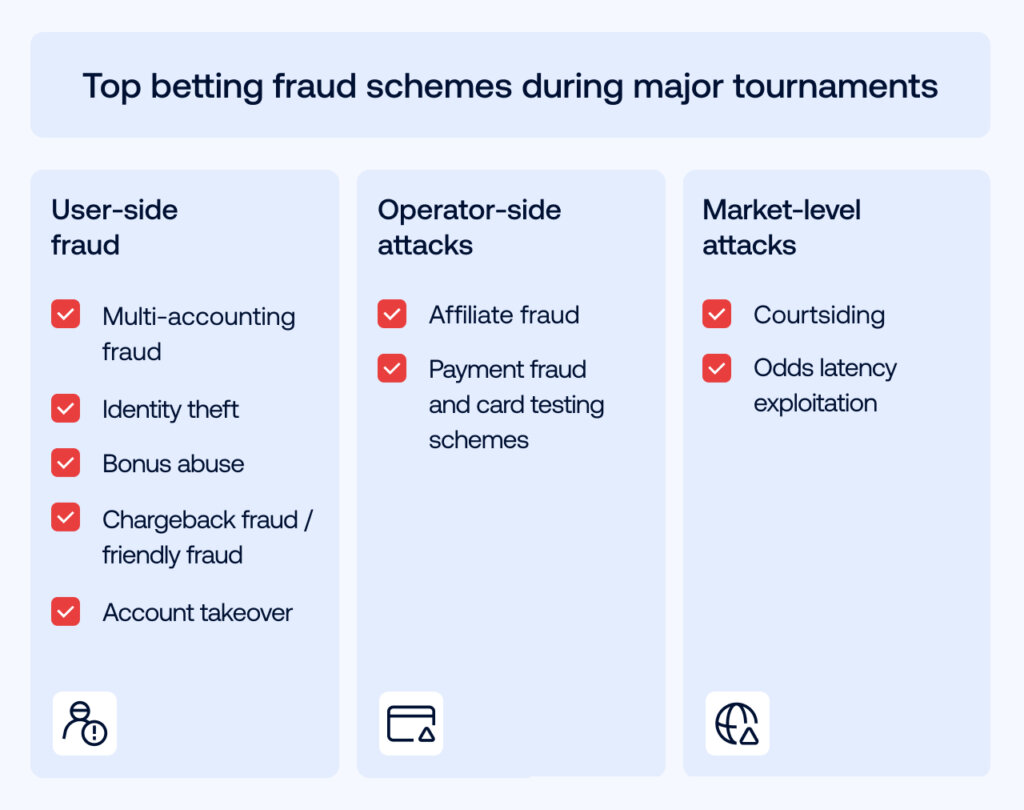
User-side fraud
Fraud rings may use synthetic identities, stolen credentials, and manipulated identity documents to bypass onboarding checks and exploit betting platforms at scale. In more advanced cases, attackers may attempt to bypass biometric verification using spoofing techniques or deepfake-generated videos.
Through multi-accounting fraud, users create multiple accounts to bypass wagering requirements, exploit bonuses, or circumvent betting limits. Identity theft adds another layer of risk, particularly when compromised or manipulated documents pass outdated onboarding checks. Common examples of user-side fraud in betting and iGaming include:
- Multi-accounting fraud
- identity theft
- bonus abuse syndicates
- chargeback fraud and friendly fraud
- account takeover attacks
Let’s take a closer look at the most widely spread user-side fraud types in betting.
Multi-accounting and identity fraud
Multi-accounting is one of the most persistent forms of iGaming fraud on betting platforms. Fraud rings often use synthetic identities, stolen credentials, and manipulated identity documents to bypass onboarding checks and create accounts at scale. In more advanced cases, attackers may attempt to defeat biometric verification through spoofing techniques or deepfake-generated videos.
In the UK, a fraudster was sentenced to prison after opening more than 1,000 betting accounts using false identities to repeatedly exploit promotional offers on a major sportsbook. The scheme combined identity fraud and multi-accounting to bypass platform controls and extract funds through bonus abuse.
Through multi-accounting fraud, users create multiple accounts to bypass wagering requirements, exploit promotional bonuses, or circumvent betting limits. In some cases, organized fraud rings obtain stolen or synthetic identity data and use it to register large numbers of betting accounts, each claiming welcome bonuses or promotional offers before coordinated withdrawals are made.
Identity theft further increases the risk when compromised or manipulated documents are able to pass weak or outdated onboarding checks. Strong identity verification gambling controls—including document verification, biometric authentication, and liveness detection—are therefore critical components of effective iGaming fraud detection and gambling fraud detection systems.
Account takeover and credential abuse
When our favorite football teams are doing well (or not so well), emotions run high. During major tournaments, fans tend to check scores, betting odds, and promotions far more frequently, often reacting quickly to match alerts, odds boosts, or last-minute offers. In that heightened emotional environment, users can become less cautious and more likely to fall for increasingly sophisticated phishing scams.
Fraudsters deliberately exploit this dynamic. Messages referencing live matches, promotions, or account activity can feel urgent and relevant, prompting quick action. A notification about a “final odds boost before kickoff,” a message claiming a bet has been suspended and requires verification, or an offer to claim a “tournament bonus” can easily appear legitimate when it aligns with what fans are already focused on.
This timing creates an ideal social-engineering environment where users are more likely to:
- click phishing links
- trust match-related notifications
- enter credentials on fake login pages without noticing subtle warning signs.
Phishing campaigns and credential stuffing attacks often increase ahead of major tournaments and are later used to facilitate betting fraud. Attackers distribute phishing links through channels such as:
- SMS (smishing)
- social media messages
- malicious advertisements
These links redirect users to imitation betting platform login pages. When users enter their email, password, or even one-time authentication codes, those credentials are captured and stored by attackers.
This approach is particularly effective in the betting ecosystem because users log in frequently, access platforms primarily from mobile devices, and sometimes reuse passwords across multiple services.
Once stolen, these credentials can be reused or tested across other platforms through automated credential stuffing attacks.
Compromised accounts allow fraudsters to quickly monetize access by:
- withdrawing existing balances from legitimate customers
- abusing stored payment methods
- exploiting bonuses and promotional offers tied to major sporting events.
In this way, large football tournaments create a particularly attractive window for fraud operations, combining high user engagement, increased financial activity, and emotionally driven decision-making.
Reducing this risk requires layered fraud prevention measures within iGaming platforms, including multi-factor authentication, device intelligence, behavioral monitoring, and anomaly detection systems integrated into broader gambling compliance and risk management frameworks.
Operator-side attacks
Some betting fraud schemes target the bookmaker's infrastructure rather than the sporting event itself. These attacks exploit weaknesses in payments, promotions, or onboarding processes to extract funds from the platform. Common examples include:
- affiliate fraud
- payment fraud and card testing schemes
Addressing these risks requires layered iGaming fraud prevention strategies that combine behavioral analytics, payment monitoring, and real-time igaming fraud detection capabilities. Robust AML gambling controls and integrated gambling compliance software help operators detect suspicious activity, monitor payment behavior, and maintain effective gambling compliance across high-risk events.
Market-level attacks
Market-level attacks exploit how betting markets operate, particularly the timing and pricing mechanics of live events. Fraudsters may use automation, courtsiding techniques, or data-feed delays to place bets before odds are updated, allowing them to profit from temporary market inefficiencies without manipulating the match outcome.
While these schemes may not always involve direct match manipulation, they still pose operational and financial risks and should be monitored within broader online gambling fraud prevention frameworks.
Suggested read: Bonus Abuse in Gambling: Types, Risks & How to Prevent It 2025
Money laundering through bets
iGaming, including online betting, is among the industries most exposed to fraud and money laundering risks due to high transaction volumes, rapid account activity, and the ability to move funds quickly across platforms. As Sumsub’s 2025 Identity Fraud Report indicates, fraud attempts are also increasing, rising by an average of 64% year-over-year in the online gaming sector.
Major sporting events can further amplify these risks. As the world’s most widely watched sporting tournament, the FIFA World Cup generates enormous global attention—and a surge in betting activity. This spike in transactions can provide cover for illicit financial flows seeking to blend in with legitimate user activity.
Criminals may exploit this increased activity on iGaming platforms through structured betting behavior designed to disguise the origin of illicit funds. Typical laundering patterns may involve:
- depositing illicit funds into betting accounts
- placing low-risk or hedged bets to minimize losses
- withdrawing proceeds as “legitimate” gambling winnings
Let’s not forget that gambling and betting operators are AML-obliged entities in most jurisdictions. These schemes can expose operators to regulatory scrutiny and significant penalties, as seen when William Hill was fined a record £19.2 million ($25.5 million) for “widespread and alarming” AML failures.
To reduce this risk, effective online gambling fraud prevention must combine AML transaction monitoring with behavioral analytics. Suspicious betting patterns, unusual funding sources, and coordinated mule account networks should trigger real-time alerts for investigation and escalation.
Suggested read: The 6 Most Popular Forms of Money Laundering in Casinos
How to stay protected during peak events
Winning the gambling fraud prevention game requires strategy, real-time intelligence, and automation to take the stress out of already stressful scenarios.
Automated KYC for speed and accuracy
Traffic spikes during major sporting events can put pressure on operators to maintain strong KYC gambling controls without slowing onboarding. Scalable online gambling KYC systems help platforms handle high volumes while maintaining compliance and fraud protection.
Modern solutions combine document checks, biometrics, AI-assisted risk scoring, and behavioral analysis to enable fast identity verification gambling processes. Automated workflows allow legitimate users to verify quickly while helping operators detect suspicious activity linked to identity fraud or mule accounts.
Real-time transaction monitoring
Advancements in AI mean fraud patterns are evolving rapidly, and this becomes especially visible during global tournaments like the World Cup. Static rules alone are no longer sufficient to protect businesses or their customers, making real-time transaction monitoring a critical component of iGaming fraud detection.
Transaction monitoring systems should analyze indicators such as:
- Deposit velocity and frequency: Sudden spikes in deposits or rapid funding across multiple accounts
- Withdrawal timing: Quick withdrawals following minimal betting activity
- Betting behavior: Low-risk or hedged bets that appear designed to minimize losses while moving funds
- Links between accounts: Shared devices, IP addresses, payment methods, or behavioral similarities indicating coordinated activity
- Funding sources: Unusual deposit methods, prepaid cards, crypto transfers, or inconsistent payment behavior
- Bonus and promotion abuse: Multiple accounts exploiting the same incentives
By analyzing these signals in real time, operators can detect patterns associated with money laundering, account takeover, and bonus abuse schemes.
Transaction monitoring enables operators to intervene early—freezing suspicious activity before funds are withdrawn and before regulatory exposure escalates. In this way, strong gambling AML software transforms compliance from reactive reporting into proactive risk mitigation.
Device fingerprinting and behavioral analysis
Due to risks of identity fraud and money mules, advanced iGaming fraud detection software needs to go beyond one-time identity checks at onboarding.
Device fingerprinting can link accounts operating from shared hardware or VPN clusters, while behavioral analysis can detect anomalies in things like click speed, navigation patterns, betting timing, and more.
These tools make money mule detection easier and create a strong betting fraud detection system capable of identifying coordinated abuse. Fraudsters may think putting on someone else’s jersey is enough to get away with crime, but their digital footprints remain.
Building a World-Cup-ready verification flow
A World Cup-ready defense requires an iGaming fraud prevention solution with layered controls designed for both scale and sophistication. For betting platforms, preparation is essential to attract customers, maintain gambling compliance, and navigate evolving online gambling compliance requirements while limiting fraud risk.
Minimal checks at registration
First impressions matter, and excessive friction during onboarding can hurt conversion. Modern online gambling KYC frameworks, therefore, apply a risk-based approach that begins before document checks.
Device intelligence and behavioral signals evaluate factors such as device fingerprinting, IP risk, geolocation consistency, proxy or VPN use, and links to previously flagged accounts. These signals help determine whether a user presents low or high fraud risk.
Low-risk users can pass streamlined identity verification for gambling, while higher-risk profiles trigger enhanced KYC gambling checks. This approach supports fast onboarding while strengthening iGaming fraud prevention.
Enhanced checks at deposit and withdrawal
Deposits and withdrawals are critical control points for detecting suspicious activity. Transaction monitoring, behavioral analytics, and risk scoring help operators identify fraud attempts while maintaining effective gambling fraud detection.
Enhanced monitoring can also reduce false positive fraud prevention outcomes, allowing operators to block suspicious transactions while minimizing friction for legitimate players. By combining these controls, operators can protect their platforms and ensure only legitimate funds move through the system—even during major tournament traffic spikes.
Suggested read: Arbitrage In Sports Betting: How To Detect It in 2026?
Are your defenses ready for kick-off?
No matter who wins, there’s no doubt the 2026 FIFA World Cup is going to be a global spectacle. But for sports betting and iGaming platforms, it also risks turning into a nightmare.
Massive onboarding spikes could cause friction and let bad actors like money mule networks in, risking exposure to fines from regulators. Coordinated bonus abuse can cut into all-important revenue, while surging false positive rates could threaten the customer experience and damage reputations.
Fraudsters and regulators will be preparing for the kick-off months in advance. Operators should too.
With scalable automation, real-time monitoring, and layered verification, Sumsub can help iGaming platforms stay ahead of fraud and help legitimate fans around the world safely focus on what really matters: football.
When the whistle blows this summer, make sure your fraud defenses are in formation.

FAQ: iGaming fraud and the World Cup
-
What is KYC in gambling?
KYC in gambling (Know Your Customer) refers to the identity verification process that online betting and casino platforms use to confirm a player’s identity before allowing deposits or withdrawals. Gambling KYC helps operators prevent fraud, stop underage or prohibited gambling, detect money laundering, and meet regulatory compliance requirements.
-
What is gambling fraud?
Gambling fraud refers to any deceptive activity aimed at exploiting betting or iGaming platforms for financial gain. This includes iGaming fraud, bonus abuse, identity theft, account takeover, and money laundering. Strong online gambling fraud prevention systems help detect and stop these activities before losses occur.
-
How does KYC work in online gambling?
Know your customer (KYC) in online gambling requires operators to verify user identities before allowing deposits or withdrawals on their platforms. Modern online gambling KYC often uses document verification, biometric checks, and database screening. Effective KYC gambling reduces fraud while supporting compliance.
-
Why does fraud increase during the World Cup?
Betting volumes surge dramatically during the World Cup. Increased marketing, World Cup betting bonuses, and new user registrations create ideal conditions for organized abuse. Fraudsters can use scale to drive spikes in sports betting fraud through syndicates and multi-accounting. Strong iGaming fraud prevention is essential to beat fraud during peak events.
-
How can betting platforms reduce false positives?
Platforms can reduce false positives in fraud detection by using advanced risk scoring, behavioral analytics, and device intelligence. Layered verification helps reduce KYC false positives, ensuring legitimate fans aren’t mistakenly blocked.
-
How can I report online gambling fraud?
If users suspect fraudulent activity, they should contact the betting platform directly through official support channels. Operators must comply with gambling compliance requirements and should report incidents to relevant regulators or financial intelligence units. Clear internal procedures strengthen the response to betting fraud incidents.
Relevant articles
- Article
- Feb 3, 2026
- 11 min read
Arbitrage in Sports Betting & Gambling in 2026. Learn how iGaming businesses detect arbers using KYC & fraud prevention tools.


- Article
- Feb 5, 2026
- 20 min read







What is Sumsub anyway?
Not everyone loves compliance—but we do. Sumsub helps businesses verify users, prevent fraud, and meet regulatory requirements anywhere in the world, without compromises. From neobanks to mobility apps, we make sure honest users get in, and bad actors stay out.
