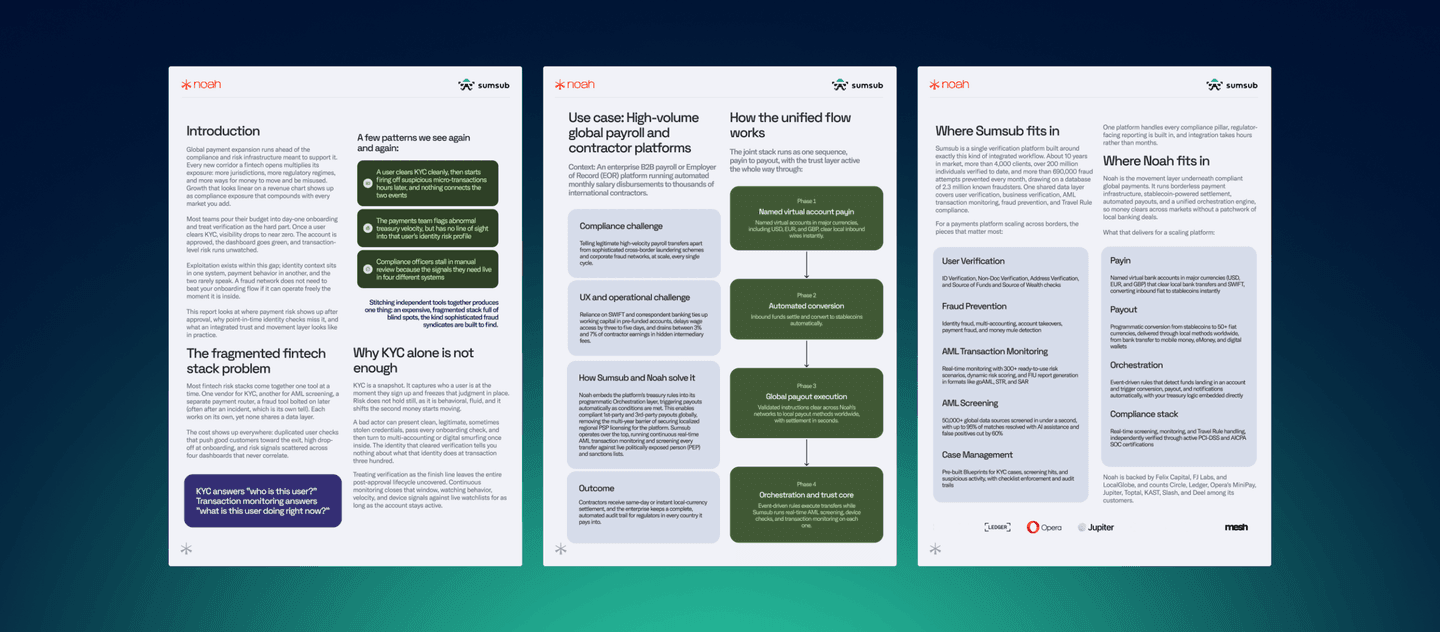
Where payment risk shows up after onboarding, and what payments, risk, and compliance teams can do about it.
Modern fintechs open new payment corridors faster than localized compliance and risk infrastructure can keep up. Most teams put their budget into day-one onboarding and treat verification as the hard part, then lose visibility the moment an approved user starts to transact. The exposure builds in the operational layer, across deposits, intra-platform transfers, withdrawals, cross-border settlement, and stablecoin off-ramping, long after onboarding is finished.
Identity verification, business verification, and AML screening clear most high-risk actors before they reach payment infrastructure. The harder question is what happens next. A user who cleared verification at sign-up can behave very differently a few hundred transactions later. This kind of risk builds quietly, and seeing it takes ongoing visibility into behavior, transaction velocity, and device signals over the life of the account.
This report works through what it takes to close that gap, drawing on Sumsub's work in identity verification, AML transaction monitoring, and fraud prevention, and on Noah's view of how stablecoin-powered payments move across borders at scale. Sumsub prevents more than 690,000 fraud attempts every month across the 4,000 companies it serves, and an independent Forrester Total Economic Impact study, modeling a composite of Sumsub customers, projected 272% three-year ROI with payback in under six months.
What you'll learn:
- Where payment risk shows up after onboarding, across deposits, transfers, withdrawals, cross-border settlement corridors, and stablecoin off-ramping
- Why point-in-time identity checks miss behavioral fraud, and what continuous transaction monitoring adds once an account is live
- How a stack stitched from separate KYC, AML, payment, and fraud tools creates blind spots, and how one shared data layer changes what teams can see and when
- What an integrated trust and movement layer looks like in practice, from verification through real-time monitoring to instant global payout
- Two operational use cases in depth, crypto and Web3 off-ramping and high-volume global payroll, with the controls and benchmark outcomes behind each
- How stablecoin-powered settlement and named virtual accounts move money across borders while every transfer is screened in real time
This report is for:
Heads and VPs of payments, payments product leads, chief compliance officers, money laundering reporting officers, financial crime and fraud leads, and product directors who own payment flows at fintechs scaling across borders, especially teams expanding into emerging market corridors.