Crypto compliance used to mean one thing: verifying individual users. KYC is now mature and automated. KYB — verifying the businesses you onboard — has not kept pace, and that gap is no longer defensible.
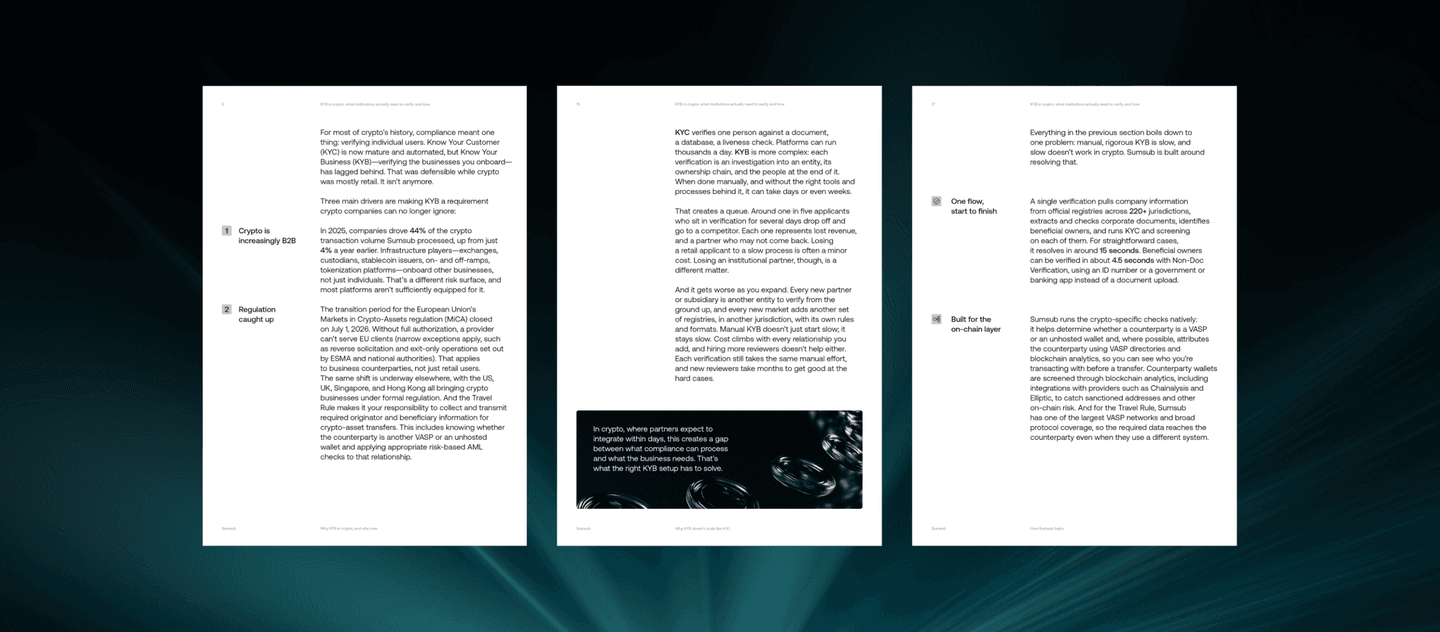
In 2025, companies drove 44% of the crypto transaction volume Sumsub processed, up from just 4% a year earlier. Exchanges, custodians, stablecoin issuers, on- and off-ramps, and tokenization platforms are all onboarding other businesses now, not just retail users. At the same time, regulation has caught up to the business side: MiCA's transition period closed on July 1, 2026, the Travel Rule puts counterparty due diligence on you directly, and institutional capital arriving through ETFs, tokenization, and custody services comes with its own due-diligence expectations.
The problem is that KYB doesn't scale the way KYC does. KYC verifies one person against a document and a database. KYB has no single subject — it's an investigation into an entity, its ownership chain, and every person at the end of it. Done manually, without the right tools, it can take days or weeks, and roughly one in five applicants who sit in verification that long simply walk to a competitor.
We built this guide to close that gap.
Inside you'll discover:
- Why KYB is a different discipline from KYC, not just "KYC for companies" — and what that means for what you actually need to verify
- The four things crypto makes harder: crypto-native counterparty types, the speed business relationships form at, deliberately opaque ownership structures (including DAOs and unhosted wallets), and regulation that now targets your counterparties directly
- The four pillars of KYB — the entity, the owners, screening, and risk — and what each one requires when your counterparty is a crypto business
- A practical checklist covering registry checks, UBO discovery, counterparty classification, on-chain screening, Travel Rule readiness, ongoing monitoring, and more, so you can judge any KYB setup — your own or a vendor's — against what crypto actually demands
Most KYB material is written for banks and general fintech. This guide is built for compliance teams at crypto and digital-asset businesses who already know KYC and need a clear model for KYB — one that accounts for on-chain exposure, crypto-native counterparty types, and the frameworks now in force.
Get a clear model for verifying the businesses you onboard, and start closing the gaps before a regulator — or an institutional partner's due diligence team — finds them.
Best for exchanges, custodians, stablecoin issuers, on- and off-ramps, tokenization platforms, and compliance officers at crypto and digital-asset businesses.