- Game
- Jun 16, 2026
- 10 min read
From Alchemy to Algorithms: A History of Fraud
From false weights in ancient markets to deepfakes and AI-powered deception: the tactics evolve, but the psychology never does.

Fraud has evolved with every technological leap—but it still exploits the same human instincts: trust, fear, greed, urgency, and authority. And sometimes, hope.
Join us on a journey through 3,000 years of fraud to discover how deception has evolved—and why understanding its history is key to recognizing the scams of today and tomorrow.
Origins of fraud: Deception as trade (Prehistory– ~500 CE)
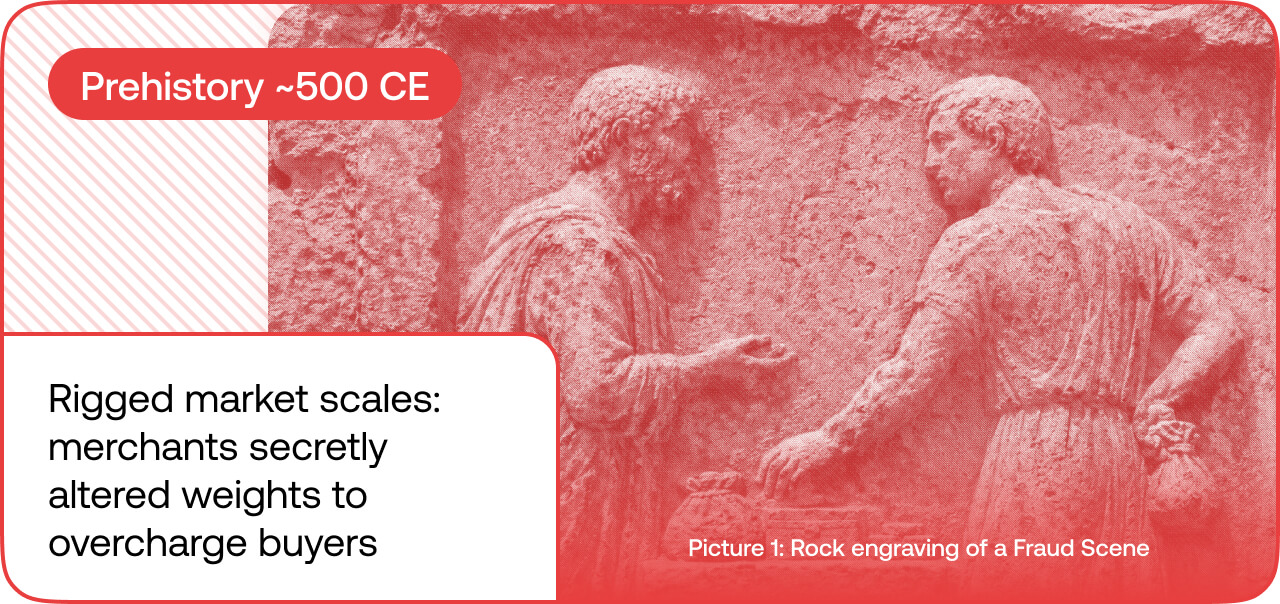
Fraud emerges wherever value becomes abstract (money, belief, authority).
In this era, fraud was mostly local, physical, and based on trust gaps. Examples: false weights and measures in early markets, counterfeit coins in ancient Greece and Rome, religious fraud (e.g., Oracle of Delphi, miracle relics).
Case: The debasement of the Roman denarius. One of history's most consequential frauds was state-sponsored. Between the 1st and 3rd centuries CE, Roman emperors systematically reduced the silver content of the denarius, the empire's primary coin. Under Nero (54–68 CE), the coin was about 90% silver. By the reign of Gallienus (253–268 CE), it had fallen to roughly 2–5%. The coins looked the same, and they were legally the same. But they were worth a fraction of their face value. The result was one of the worst inflation crises in the ancient world, contributing to the economic destabilization of the late Roman Empire. Historians consider this one of the earliest documented cases of monetary fraud at a systemic scale.
Case: Rigged weights in ancient markets. Archaeological excavations across the ancient Near East—in Mesopotamia, Egypt, and Greece—have uncovered sets of weights that do not match their marked values. Merchants kept two sets: one for buying (heavier), one for selling (lighter). This practice was so widespread that it became the subject of specific legal prohibitions in multiple ancient legal codes. The fraud required no complexity, just the information asymmetry between a merchant who weighed goods every day and a customer who did not.
Medieval era: Selling hope and the impossible (500–1500)
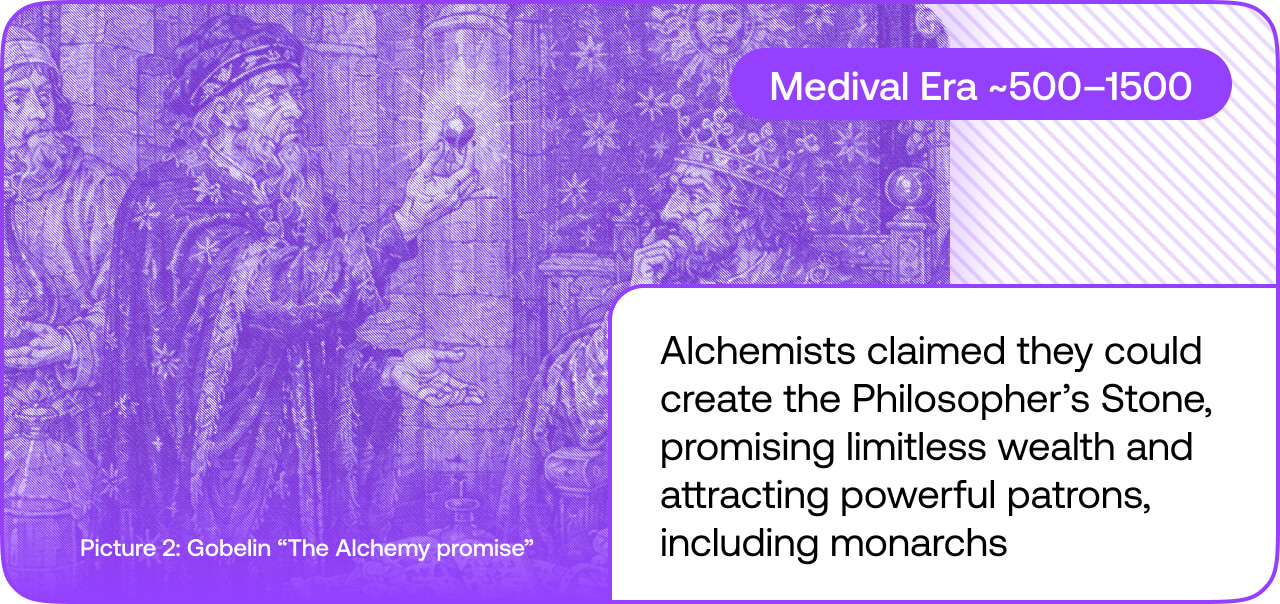
Fraud in the medieval era evolved beyond simple deception into persuasive storytelling. Alchemists claimed they could create the Philosopher’s Stone, promising limitless wealth and attracting powerful patrons, including monarchs.
Early chain letters and proto–pyramid schemes began to circulate, relying on participation and belief rather than tangible value. In this period, fraud became narrative-driven: success depended less on proof and more on the ability to make others believe in the story.
Case: The relic trade. The medieval relic market was one of the most organized fraud industries in history. Pieces of the True Cross, vials of the Virgin Mary's milk, the bones of saints—all commanded extraordinary prices and could anchor a church's income for generations. The problem: there were simply too many of them. The reformer John Calvin, writing in 1543 in his Treatise on Relics, cataloged relics held across Europe and noted that the collected fragments of the True Cross would require several large wagons to transport. He documented multiple churches claiming to possess the same saints' complete skeletons. The trade was so lucrative that specialized workshops produced relics commercially. Authenticity was rarely questioned; the incentives ran the other way.
Case: Edward Kelley and Emperor Rudolf II. The English alchemist Edward Kelley spent years at the court of Holy Roman Emperor Rudolf II in Prague in the 1580s, claiming he had discovered the secret of transmuting base metals into gold. Rudolf, a serious patron of both science and the occult, funded Kelley's experiments extensively and eventually knighted him. Kelley produced small demonstrations convincing enough to maintain patronage for years. When pressed for results at scale, he stalled, fabricated, and eventually attempted to flee. He died in 1597, reportedly trying to escape from a castle tower. Rudolf II, one of the most powerful men in Europe, had been strung along for nearly a decade. The con worked because the possibility of alchemy was scientifically plausible at the time, and because the patron wanted to believe.
Age of Exploration: Fraud goes global (1500–1800)
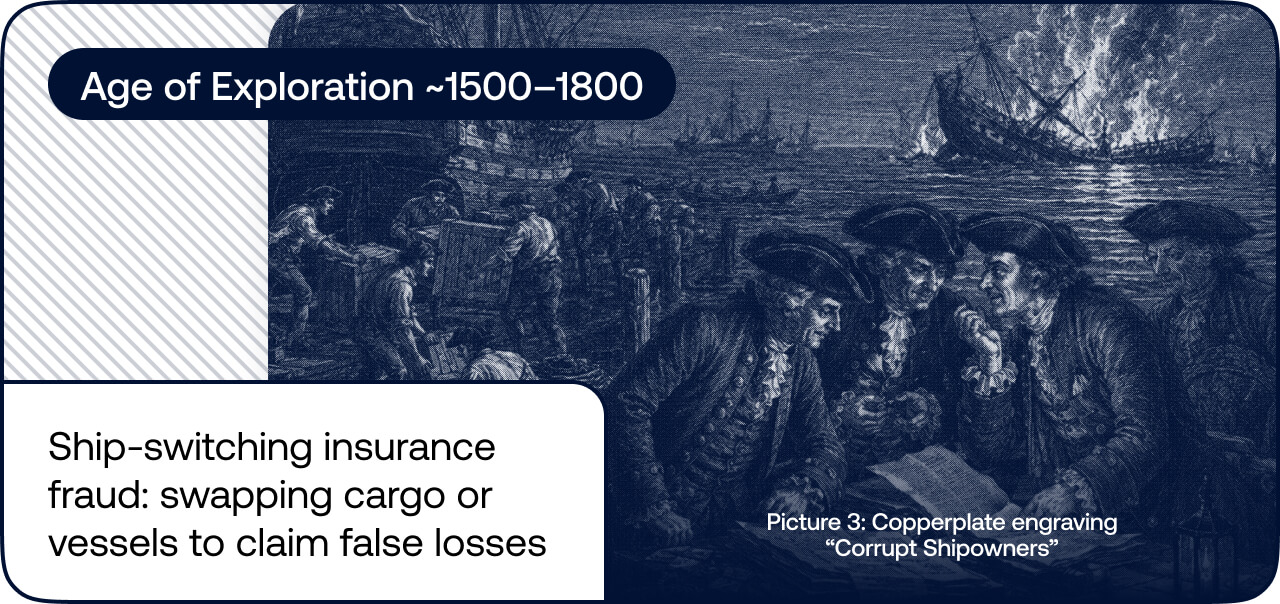
During the Age of Exploration, distance enabled deception on a scale entirely new. Fraudsters exploited the vast gaps between continents, where verification was slow or impossible. Fake land grants and exaggerated exploration claims misled investors and settlers, while deceptive treaties were used to exploit indigenous populations.
At sea, maritime fraud flourished through insurance scams and ship-switching schemes. In this era, fraud thrived on slow communication and deep information asymmetry, allowing deception to spread far beyond its point of origin.
Case: The Poyais scheme (1822). This is arguably the most audacious land fraud in recorded history. Scottish soldier Gregor MacGregor returned to London in 1822 claiming to be the "Cazique" (prince) of a prosperous Central American nation called Poyais, which he said he had been granted by a local king. He produced detailed maps, a guidebook describing fertile land and an established capital city, a currency, and even a land office in London where plots could be purchased. Around 250 Scottish settlers, farmers, tradespeople, and a banker sold their belongings and sailed to Poyais in 1822–1823. They arrived to find jungle, disease, and nothing else. Roughly half died before rescue ships arrived. MacGregor was never convicted. He later ran a near-identical scheme in France. Poyais has since become a case study in fraud education because of how convincingly MacGregor constructed a false reality, with documents, infrastructure, and social proof.
Case: Ship insurance fraud. Maritime insurance fraud was so common in the 17th and 18th centuries that Lloyd's of London, an insurance marketplace, developed much of its verification infrastructure specifically in response to it. Common schemes included deliberately sinking ships that were heavily insured and nearly worthless, switching cargo manifests to claim losses on goods never loaded, and "constructive total loss" fraud deliberately damaging ships enough to claim insurance while salvaging the valuable parts. The problem was structural: insurers in London could not easily verify what had happened to a ship in the Caribbean or Indian Ocean.
Financial revolution: Mass financial manipulation (1700–1900)
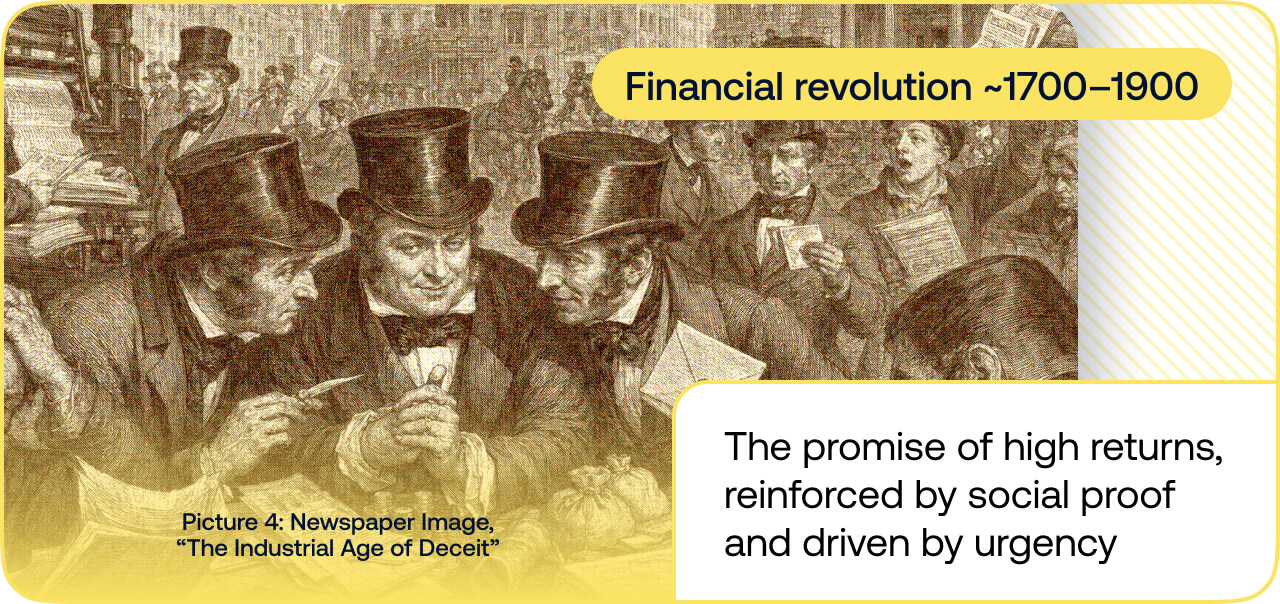
As financial systems grew more complex, they unlocked entirely new opportunities for large-scale fraud. Speculative bubbles like the South Sea Bubble and the Mississippi Scheme demonstrated how mass belief could inflate value far beyond reality.
Charismatic fraudsters and Victorian-era con artists refined the art of persuasion, culminating in schemes like that of Charles Ponzi. During this period, the core formula of modern fraud emerged: the promise of high returns, reinforced by social proof and driven by urgency.
Case: The South Sea Bubble (1720). The South Sea Company held a monopoly on British trade with South America, a territory Spain actually controlled and had no intention of opening. The monopoly was worthless, but through government corruption and aggressive promotion, shares rose from £100 to over £1,000 in 1720. When the bubble collapsed, thousands were ruined, including Isaac Newton, who lost around £20,000. The fallout led to the Bubble Act of 1720, which restricted joint-stock companies in Britain for over a century.
Case: The Mississippi Scheme (1716–1720). Scottish financier John Law convinced the French government to let him issue paper money, then merged his bank with the Mississippi Company, which held trading rights to Louisiana—a territory he promoted as fantastically wealthy. Share prices rose 20-fold. The paper money printed to fuel the boom created massive inflation, and when confidence broke in 1720, both the currency and the company collapsed. Law fled France, and the episode left the French public distrustful of paper money for generations.
Case: Charles Ponzi (1919–1920). Ponzi claimed to arbitrage international postal reply coupons, a real instrument, and promised returns of 50% in 45 days. None of it was real: early investors were paid with money from new ones. At its peak, he was taking in $1 million per week. The scheme collapsed within a year after a Boston newspaper investigation. Ponzi had paid out $15 million to 17,000 investors. The structure wasn't new, but his name stuck to it permanently.
20th Century: Industrialized fraud (1900–1990)
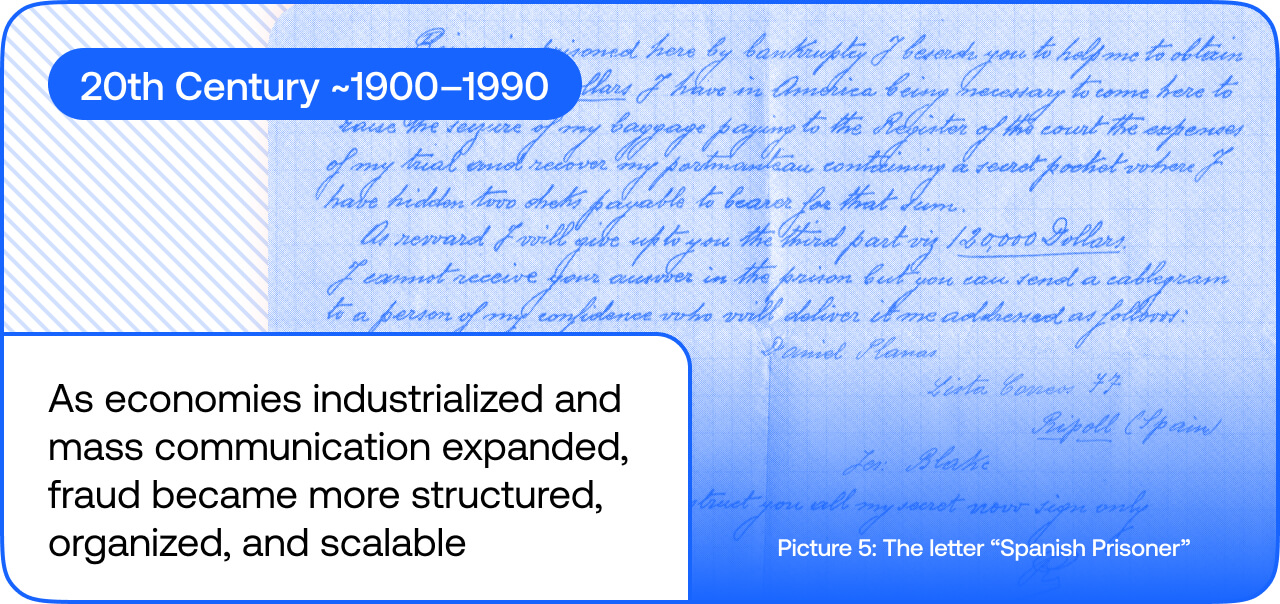
As economies industrialized and mass communication expanded, fraud became more structured, organized, and scalable. The rise of corporations, global finance, and new media channels enabled fraudsters to reach wider audiences more efficiently.
Large-scale schemes moved beyond individuals to operate across networks, using postal systems, telephones, and early computing. Financial statement fraud, insider trading, and corporate scandals exposed how complex institutions themselves could be manipulated. Fraud became systematized and network-driven, setting the foundation for digital-scale deception.
Case: The "Spanish Prisoner" letter and its descendants. The Spanish Prisoner con—in which a writer claims to be a wealthy person imprisoned under a false identity and asks for help extracting a fortune in exchange for a share—dates to at least the late 19th century. Versions circulated by post throughout the 20th century. By the 1980s, such letters were being sent by fax. This scheme is the direct ancestor of the "Nigerian prince" email. The structure is identical: an implausible but emotionally compelling story, a request for upfront funds, a promised larger reward. It has run continuously, in various forms, for over 130 years.
Case: Bernie Madoff's Ponzi scheme (c. 1970–2008). Bernie Madoff ran the largest Ponzi scheme ever uncovered, with approximately $65 billion in claimed assets, with actual losses to investors of around $17 billion. Rather than generating returns through legitimate investments, Madoff used money from new investors to pay existing investors, creating the illusion of a consistently profitable business.
What made Madoff's scheme unusual was its longevity (likely running from the early 1970s, with confirmed fraud from at least the early 1990s) and its clientele: sophisticated institutional investors, major banks, charities, and prominent individuals. Madoff's firm generated consistent returns of around 10–12% annually regardless of market conditions—a statistical impossibility that somehow went uninvestigated for decades.
The SEC received credible warnings about Madoff from analyst Harry Markopolos as early as 2000. His analysis showed Madoff's returns were mathematically impossible. But the SEC did not act. Madoff's scheme collapsed in December 2008 during the financial crisis when he could no longer meet redemption requests.
Digital shift: Fraud becomes remote (1990–today)
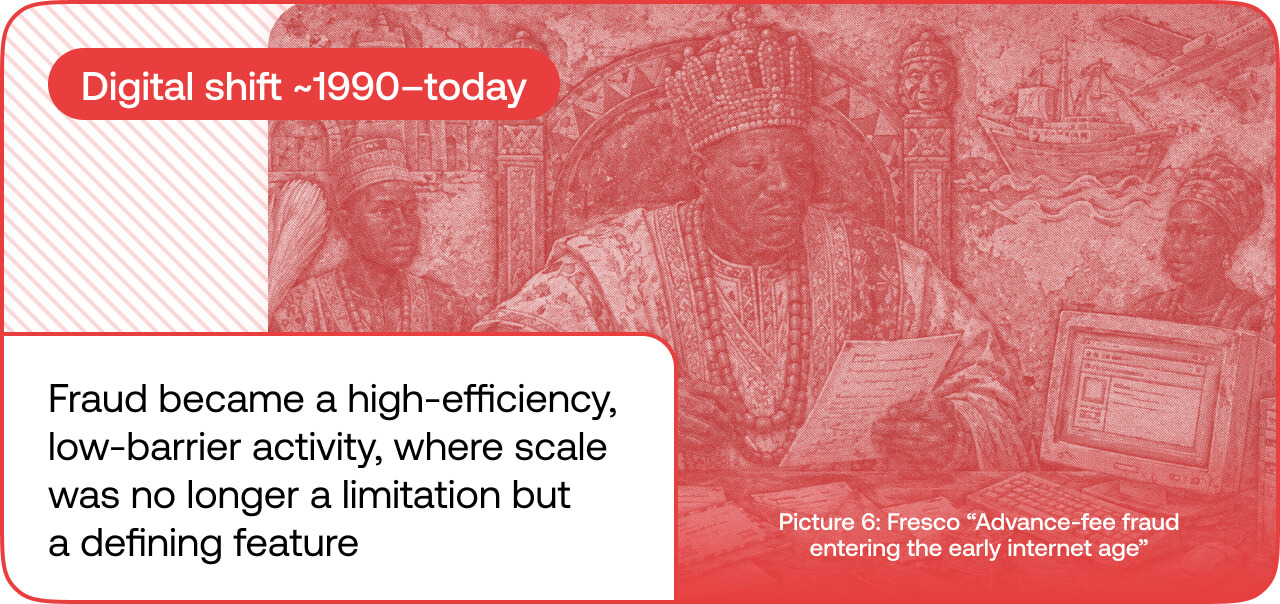
With the rise of the internet, fraud no longer required physical presence, allowing it to scale exponentially. Phishing attacks, “Nigerian prince” scams, and large-scale data breaches became common, while early organized cybercrime groups began operating across borders. As the cost of executing fraud dropped dramatically, its potential returns increased just as sharply. Fraud became a high-efficiency, low-barrier activity, where scale was no longer a limitation but a defining feature.
Case: The Nigerian prince email (advance-fee fraud). The "419 scam" (named after the relevant section of Nigerian criminal law) became the defining fraud of the early internet era. The mechanics were identical to those of the Spanish Prisoner letter: a wealthy person, trapped by circumstances, offering a large reward in exchange for a small upfront fee. What the internet changed was scale: emails could reach millions for effectively nothing. The scheme's low response rate was irrelevant because the volume made even a tiny conversion rate profitable. By the early 2000s, advance-fee fraud was generating well over a billion dollars in losses globally each year. The emails were crude by design: their implausibility filtered out skeptical recipients, leaving only the most susceptible.
Case: The Bangladesh Bank heist (2016). In February 2016, hackers, later attributed to the Lazarus Group, connected to North Korea, sent fraudulent instructions through the SWIFT interbank messaging system, directing the Federal Reserve Bank of New York to transfer $951 million from Bangladesh Bank's account. Thirty-five transfer requests totaling $951 million were sent. Five went through before the scheme was detected—netting $81 million, much of it transferred to casinos in the Philippines and largely unrecovered. The attack required no physical presence, no weapons, and no traditional bank robbery infrastructure. It required understanding of how SWIFT worked, patient reconnaissance (attackers had been inside Bangladesh Bank's systems for months), and well-crafted digital instructions. The $81 million remains one of the largest single bank thefts in history.
Crypto & decentralization (2015–today)
The emergence of cryptocurrencies and decentralized systems introduced a new frontier where innovation rapidly outpaced regulation. Fraudulent ICOs, rug pulls, and DeFi exploits proliferated in an environment built on trustless technology.
Yet paradoxically, these systems created new forms of trust dependency—on code, founders, and communities. As a result, trustless systems did not eliminate fraud but reshaped it, introducing new, often less visible vulnerabilities.
Case: OneCoin (2014–2019). OneCoin was not technically a cryptocurrency—it had no blockchain. Ruja Ignatova, known as the "Cryptoqueen," marketed it as a bitcoin competitor with enormous growth potential, selling it through a multi-level marketing structure. At its peak, OneCoin was operating in over 175 countries, with sales events filling arenas. Ignatova raised an estimated $4 billion from investors worldwide before disappearing in 2017. She remains on the FBI's Ten Most Wanted list as of 2024. Her brother Konstantin pleaded guilty in the US in 2019. The fraud succeeded partly because most investors had little framework to evaluate whether a cryptocurrency was real—it looked and sounded like all the others.
Case: The Squid Game token (2021). In October 2021, as the Netflix series Squid Game became a global phenomenon, a token called SQUID launched with branding implying a connection to the show (there was none). The token rose approximately 45,000% in a few days, reaching around $2,861. The contract code contained an anti-dumping mechanism—buyers could not sell. On November 1, 2021, the creators drained the liquidity pool and disappeared with approximately $3.38 million. The incident was reported in real time by CoinMarketCap and multiple news outlets, making it one of the most documented rug pulls on record. What it illustrated was how quickly a token could be created, promoted through social media, and liquidated—the entire lifecycle from launch to collapse was about two weeks.
AI era: Fraud as infrastructure (2022–today)
In the current era, fraud is evolving into a fully automated and adaptive system. Technologies such as voice cloning and deepfakes enable highly convincing impersonation, and AI-driven social engineering can be executed at a massive scale. Automated “fraud factories” and Fraud-as-a-Service (FaaS) models lower the barrier to entry, allowing even non-experts to deploy sophisticated attacks. At the same time, fraud increasingly targets digital identity systems and embedded finance, operating across interconnected platforms.
This also marks a so-called “sophistication shift”: fraud may become less frequent in raw numbers, but far more complex, targeted, and destructive. The central challenge is detecting it fast enough—before fraudsters using automated systems can exploit vulnerabilities at scale.
Case: The Hong Kong deepfake CFO (2024). In February 2024, a finance worker at a multinational firm in Hong Kong was invited to a video call with what appeared to be the company's CFO and several colleagues. All of them were deepfakes, or AI-generated video recreations of real people, convincing enough to pass a live video call. The employee transferred HK$200 million (approximately $25 million USD) before discovering the fraud. The case was confirmed by Hong Kong police at a press conference and reported by the BBC, CNN, and other media outlets. It is the first publicly documented case of a large financial transfer executed via deepfake video call, and almost certainly not the last.
Case: Fraud-as-a-Service (FaaS). Fraud-as-a-Service has emerged as a category in itself. On dark web marketplaces and Telegram channels, operators sell ready-made kits for phishing, identity fraud, and social engineering—with customer support, refund policies, and subscription pricing. By 2023, researchers had documented the rapid commercialization of AI-powered fraud tools. Large language models were already being used to generate convincing phishing emails in multiple languages, while voice-cloning systems could replicate a person's voice from just a few seconds of audio. At the same time, researchers warned that AI was making it possible to automate social engineering at an unprecedented scale. The economics are stark: a FaaS subscription can cost less than $100 per month. A single successful fraud can return thousands. The barrier to entry has effectively collapsed.
Human nature doesn’t change
Technology has changed in every era, but the psychological mechanisms have not.
Across 3,000 years of documented fraud, from debased Roman coins to deepfake CFOs, every successful scheme has operated through the same five levers: trust (exploiting existing relationships or simulating authority), fear (creating urgency around consequences), greed (offering returns that seem exceptional but plausible), urgency (compressing decision time to prevent verification), and authority (impersonating institutions, titles, or familiar faces).
A Roman merchant with two sets of weights and a FaaS operator selling AI phishing kits are running structurally identical operations; one just has better tools.
Conclusion
The history of fraud leads to one main conclusion: awareness and education are as critical as technology.
The most sophisticated fraud systems in history have failed against informed, skeptical “victims.” And the simplest frauds have succeeded against brilliant, accomplished people who had no framework for what they were seeing. Isaac Newton lost a fortune in the South Sea Bubble. Bernie Madoff's clients included major financial institutions with entire risk departments.
Today, the signals are harder to read than they have ever been: a voice message that sounds like your “CEO”, or a video call with your “CFO” who isn't even there. It can be a LinkedIn message that leads to WhatsApp that leads to a wire transfer, and fraud can now simulate familiarity itself.
In this environment, question what seems familiar, verify through independent channels, and treat urgency itself as a warning sign. Because urgency—the pressure to act before you can think—has been a feature of fraud for three thousand years.
Organizations can no longer rely on single-layer defenses. Multi-layered, adaptive approaches that combine technology, processes, and human vigilance are not best practices—they are the baseline. In 2026, combating fraud is a continuous discipline, not a solved problem.

Relevant articles
- Article
- 1 week ago
- 7 min read
Explore some of the biggest money laundering scandals in the XXI century and the AML tools businesses use to detect and prevent financial crime today.


- Article
- 2 days ago
- 4 min read
Every business venture is its own Odyssey. Fraudsters lurk in the shadows, regulatory storms are brewing, and mythical creatures stand between our He…



What is Sumsub anyway?
Not everyone loves compliance—but we do. Sumsub helps businesses verify users, prevent fraud, and meet regulatory requirements anywhere in the world, without compromises. From neobanks to mobility apps, we make sure honest users get in, and bad actors stay out.
