- Apr 13, 2026
- 13 min read
Top 10 Crypto Scams in 2026 (And How to Avoid Them)
Crypto scams in 2026: Discover the most common crypto scams, the concepts behind them, who they target, and how businesses and users can protect themselves.



The global cryptocurrency market is worth more than $2 trillion, as of March 2026, with over 560 million people worldwide holding crypto assets. Crypto is now being taken seriously, not just by tech-savvy millennials or DeFi degens, but by governments, asset managers, and even pension funds. As geopolitical tension and economic volatility persist, digital assets are increasingly viewed as a kind of financial safe haven—neutral, borderless, and resilient.
However, this fertile soil is bringing out fraudsters. In 2025, $17 billion was lost to cryptocurrency fraud and scams, with some of the biggest crypto scams costing victims billions.
According to Sumsub’s State of the Crypto Industry 2026, fraud pressure is not abating; it is being redistributed and reshaped as crypto services and products strengthen some defenses and attackers adapt their techniques.
Crypto has long been hailed as the future of finance—but if that future is going to be inclusive, sustainable, and reliable, both businesses and users need to prioritize security, which is foundational.
In 2025–2026, we observe a sophistication shift in fraud. If you think you’re too smart to get scammed, you’re already a target. From social engineering playbooks to surgical exploits, crypto scams in 2026 are sharper than ever. Let’s check out the most common types of crypto scams out there—and the smart practices every user and business should adopt to stay one step ahead of scammers.
Why crypto scams are surging in 2026
The idea that crypto scams are surging in 2026 might seem confusing, given that global fraud rates stayed the same from 2024 to 2025 at 2.2% (up from 1.5% in 2023), according to Sumsub’s 2026 Crypto Report.
However, it’s important to understand that this only tells us what percentage of crypto companies’ customer verification attempts were fraudulent, i.e., attempts by criminals to sign up for platforms under false identities or by other illegitimate means. Demand from new customers spiked several times in 2025 in response to market movers, such as MiCA's operational phase, and Bitcoin's $118K peak and $19B liquidation cascade. This produced corresponding spikes in fraud attempts. While fraud rates remained stable, we still saw increases in actual cases at times.
Regional shifts in crypto fraud rates also suggest that businesses and users in some countries need to be particularly wary. For example, in the Asia-Pacific region, fraud rates hit 3.3% in 2025, up from 2.0% in 2024—a 65% year‑on‑year increase. Meanwhile, Europe has seen a more modest but consistent upward trend in recent years, with crypto fraud rates of 1.0% in 2023, 1.3% in 2024, and 1.4% in 2025.
While it’s too early to say what cryptocurrency fraud trends for 2026 will look like, last year’s data does suggest that growing demand for crypto could well lead to a surge in crypto scams.
How many crypto scams are detected is also not the only concern - we also have to think about the fraud we don’t see. Identity fraud in particular is going through a ‘sophistication shift’, with tools such as generative AI making scams harder to detect.
Our research shows that crypto fraud attacks in 2025 were more targeted, with greater use of automation, and a focus on weaknesses in identity verification and transaction monitoring processes. Increasingly, fraudsters are using a potent combination of techniques, including social engineering, synthetic identities, and mule networks, to bypass crypto companies’ anti-fraud controls.
This suggests that the threat from fraudsters using techniques such as AI crypto scams could be greater than ever in 2026, so businesses and investors must remain vigilant.
10 crypto scams to be aware of in 2026
The popularity of specific cryptocurrency scam types changes over time. High-yield investment scams and “pig butchering” schemes have become most common, while AI-driven tactics make crypto fraud more sophisticated and harder to detect. Here’s the list of the biggest crypto scams to be aware of in 2025:
1. AI deepfake scams
A deepfake scam uses AI-generated video or audio to impersonate trusted figures—such as family members, CEOs, or influencers—in order to trick victims into sending cryptocurrency or revealing sensitive information. These highly realistic forgeries make scams more convincing and difficult to detect, and their use has been on the rise in both traditional finance and the crypto space.
Suggested read: Fraud Trends for 2025: From AI-Driven Scams to Identity Theft and Fraud Democratization
In recent years, deepfake crypto scammers have widely used AI-generated deepfakes of famous people, such as Elon Musk, to promote fraudulent cryptocurrency giveaways on platforms like YouTube. In one documented AI crypto fraud case from June 2024, a deepfake Musk video was used during a live YouTube stream to solicit funds. The scammer’s wallet received contributions from multiple victims within 20 minutes, ultimately collecting at least $5 million between March 2024 and January 2025. These funds were traced to major exchanges such as MEXC and even to darknet markets.
Suggested read: AI Deepfakes and Creator Economy Fraud: Detection & Protection Guide 2026
2. Fake investment schemes
Scammers posing as savvy “investment managers” promise sky-high returns—if you just send them some crypto first. It’s classic social engineering, dressed up as a financial opportunity.
Cryptocurrency investment scams usually involve legitimate-looking websites or well-designed apps, using fancy investing jargon to seem real. These fake crypto platforms can be hard to distinguish from the real thing, with devastating consequences for those who fall victim.
In May 2025, a resident of Warriewood, Australia, reported a loss of nearly $64,000 to a cryptocurrency investment scam. The victim was initially contacted via the Signal messaging app in June 2024 about an investment opportunity, starting with a $500 outlay and a promise of a tenfold return. He invested more with a company called Ultra Trade Investments, encouraged by the promised returns. However, when attempting to withdraw profits, he was told to pay additional fees. Over several months, he continued to pay and realized he was a victim of crypto investment fraud when he could not recover his funds.
3. DeFi rug pulls
DeFi rug pulls are a growing form of cryptocurrency scam where developers of a decentralized finance project suddenly withdraw all user funds and disappear, leaving investors with worthless tokens. These DeFi scams are becoming more complex, with tactics such as "honeypot tokens" (where malicious smart contracts prevent users from selling the tokens) and multi-wallet control strategies to evade detection.
The nature of rug pulls in crypto is evolving, with a shift from DeFi protocols and NFT rug pull projects in 2024 to predominantly memecoin-related rug pulls in 2025. Memecoins have often been behind these schemes, as the hype around them rapidly gains traction before scammers disappear with user funds.
In the recent Meteora memecoin case, Meteora, its founder Benjamin Chow, and others are accused of manipulating the price of the Solana-based M3M3 token for personal profit at the expense of public investors. A lawsuit alleges the token’s price was artificially inflated through coordinated internal trading, then, once the price spiked, insiders sold off their holdings, crashing the market, and losing investors over $69 million. The lawsuit also seeks to classify stake-based meme coins as securities to bring in regulatory clarity equal to crypto assets.
4. Crypto phishing attacks
Phishing is a classic scam that’s now widespread in the crypto world. Crypto phishing is used to compromise login credentials, such as crypto wallet keys (seed phrases). These wallet phishing attacks usually start with scammers sending an official-looking email that asks the victim to log in to their account, which is actually a trap:

Once the scammers have access to a victim’s crypto accounts, they can transfer the funds to wallets they control before the victim realizes anything is wrong. Because crypto transactions cannot be reversed, it is often very difficult for the funds to be recovered, even if the account holder can prove they were the victim of fraud.
Phishing scams in crypto often serve as the entry point for ransomware by tricking users into clicking on malicious links or downloading infected files. Once inside, the ransomware encrypts personal data or accesses crypto wallets, then demands cryptocurrency payments to unlock access—blending deception, malware, and extortion in one attack.
5. Fake crypto giveaways
A crypto giveaway scam is when fraudsters pose as legit cryptocurrency exchanges, businesses, or notable individuals to deceive victims into sending them cryptocurrency. They typically promise to return double or triple the amount sent by the victim, only to vanish with the funds once received.
Fake crypto giveaway scams are frequently promoted on social media platforms like X and YouTube and often involve fake websites resembling legitimate exchanges or companies. One high-profile Bitcoin giveaway scam involved British man Joseph O'Connor hijacking more than 130 X accounts in order to steal cryptocurrency worth more than £4.1 million (approx. US$5.5 million).
Crypto scammers are increasingly using deepfakes to impersonate famous figures—like Elon Musk (once again!) and Donald Trump—to promote fraudulent giveaways on X.
- The giveaway is promoted on social media or dubious websites - It promises to return more cryptocurrency than you send - It requires you to send cryptocurrency to a specified address - It creates a sense of urgency or scarcity by claiming limited time or participant availability
If you encounter a crypto giveaway, be skeptical and do research to verify its legitimacy before sending any cryptocurrency. To avoid falling victim to such scams, consider these tips:
- Only participate in giveaways offered by reputable cryptocurrency exchanges or companies - Avoid sending cryptocurrency to a specific address to participate in a giveaway - Be cautious of giveaways promising excessive returns on your investment - Exercise caution with giveaways that impose a sense of urgency or scarcity.”

Stanford Cardoz
AML Director at BitOasis in the UAE
6. Pig butchering scam
Pig butchering is a long-term scam where fraudsters build trust—often through romance or social networking—before convincing a victim to invest in fake crypto platforms. Once the victim has deposited significant funds, the scammer disappears, taking all the money. It’s called a ‘pig butchering scam’ because scammers “fatten up” their victims with attention and trust before “slaughtering” them by stealing their funds. Crypto romance scams can be particularly damaging for victims, causing emotional and psychological harm, as well as financial losses.
In April 2025, a woman from Maryland, US, lost millions of dollars in a pig butchering scam, where scammers (allegedly based in Southeast Asia) gained her trust and convinced her to invest increasing amounts into fraudulent crypto accounts. After the initial scam, she was targeted again by fake “recovery” companies promising to retrieve her lost funds for a fee—a common secondary fraud tactic.
Suggested read: Pig Butchering: Inside the Billion-Dollar Scam Factories
7. Pump-and-dump schemes
The oldest trick in the book: blow up the hype, sell at the top, vanish before the crash. In pump-and-dump schemes, fraudsters artificially inflate the value of a crypto asset by generating fake hype—often through social media—to create the illusion of high demand. This crypto market manipulation drives up the price, making it difficult for investors to ignore. Once the price is high enough, the scammers immediately sell—or “dump”—the asset, causing a collapse in its price.
8. Crypto wallet drainers
A crypto drainer is a malicious script or a smart contract designed to steal cryptocurrency directly from users’ wallets. This is done by tricking victims into connecting their wallets and unknowingly authorizing transactions that transfer their funds to the attacker.
Unlike traditional phishing that steals login credentials, drainers rely on deceiving victims into signing fraudulent transactions, often through fake websites, airdrops, or malicious browser extensions, enabling rapid and automated theft of assets. These scams have evolved into a "drainer-as-a-service" model, where ready-made malware kits are sold to criminals, making crypto drainers a growing and sophisticated threat in the Web3 ecosystem.
Losses from crypto wallet drainers actually fell 83% in 2025, but patterns of attacks closely followed market spikes, suggesting this is still a significant threat, especially during periods of intense trading.
9. SIM-swap and account takeover
A SIM swapping attack involves a fraudster using stolen personal information to have a victim’s mobile phone number transferred to a SIM in the fraudster’s control. They can then use this to access and take over the victim’s crypto accounts by passing two-factor authentication (called a ‘2FA bypass’).
SIM-swap crypto fraud cost victims in the US alone almost $26 million in a single year, showing the scale of this type of crime.
10. NFT and Metaverse scam
Non-fungible token (NFT) scams rely on a number of different tactics. One common scenario is a fake giveaway of free NFTs that requires victims to connect their crypto wallets to a phishing website that allows the fraudsters to steal their assets. NFT rug pulls are also used, with victims being enticed to invest in fake NFT schemes offering high returns, only for the criminals to then disappear with the funds. Fraudulent versions of real NFTs may also be sold on fake NFT marketplaces, leaving the purchaser with a worthless copy.
There is also growing concern about crypto fraudsters targeting victims in the Metaverse, with the potential for criminals to collect highly sensitive information, such as biometric data, from Metaverse users.
Business-focused crypto threats in 2026
This year, crypto companies are also navigating a rapidly shifting threat landscape, including deepfake scams and ransomware, as well as additional complicating factors, such as the rise of Web3 security protocols. This can make crypto fraud and money laundering prevention much more challenging.
Ransomware and supply chain attacks
In 2025, total ransomware payments dropped to $820 million, down 8% from the previous year, despite a 50% increase in reported attacks.
Attackers are adapting quickly—rebranding old ransomware strains, shortening negotiation times, and exploiting trusted vendors to access multiple organizations. Groups like LockBit and Clop remain active, and emerging players such as Anubis and Linkc Pub continue targeting global enterprises.
Scammers also try to reach businesses through third-party vendors. Compromised tools used by crypto companies can inject malicious code or steal data. This ‘crypto ransomware’ turns supply chains into attack vectors. Supply chain attacks in the crypto industry can quickly compromise hundreds of businesses, making them particularly dangerous.
Deepfake executive impersonation
Deepfake-driven employee impersonation is another threat. This deepfake fraud trend targeting businesses is expected to persist in the coming years across all industries. Fraudsters mimic CEOs and CFOs to trick teams into making wire transfers or approving fake partnerships. In 2025 alone, deepfake crypto scams caused over $200 million in losses. Deepfake scams thrive in remote or fast-paced environments where identity checks are weak.
Phishing remains a go-to tactic. Generative AI is the best friend of all scammers in 2026, helping attackers to craft highly convincing fake emails, dashboards, and chats to steal employee credentials. Once inside, they gain backend access or directly drain user funds.
Synthetic identities and money mule networks
Synthetic IDs and money mule networks remain a key concern. Fraudsters use fake documents and AI-generated identities for crypto money laundering, often slipping past legacy verification systems. In reported cases, Gen-AI created highly realistic counterfeit driver’s licenses and passports, and these fake IDs were then used to successfully pass Know Your Customer (KYC) checks on several cryptocurrency exchanges.
Suggested read: AI Fake IDs and the New KYC Risk
A similar approach is used in synthetic ID fraud. Synthetic identity fraud involves fake IDs that blend real and false information, making them much harder to detect and better able to bypass KYC processes. If missed, these activities can lead to compliance breaches and regulatory penalties.
Drainer scams, credential stuffing, and exploiting vulnerabilities
DeFi platforms face threats from drainer scams. These imply a malicious code injected into wallets or SDKs that siphons funds. They often go unnoticed until it’s too late, especially when embedded in legitimate-looking integrations.
Credential stuffing continues to plague businesses. Attackers reuse leaked credentials to access dashboards or customer accounts, underscoring the importance of strong MFA and breach monitoring.
Smart contracts and governance exploits round out the threat landscape. Attackers can manipulate DAO votes or exploit code flaws to hijack funds or take control of projects.
How to spot a crypto scam: Warning signs
Crypto scams can take many forms. Fraudsters use various psychological tricks that can be extremely convincing. It’s essential to keep your customers informed about how to identify crypto scams. Remind them to conduct thorough research and exercise caution when considering any crypto-related investment or business opportunity.
Knowing crypto scam warning signs is the first line of defense. If someone promises easy and guaranteed returns, it’s likely a scam. Legitimate projects will offer detailed documentation, disclose their team, and operate transparently. If a platform avoids questions, pushes for rushed decisions, or lacks verifiable registration, that’s not even a red flag; it’s a burgundy red flag. Protect your personal info and always do your own research.
Here’s how crypto scams can be detected in 2026:
- Promises of guaranteed returns. Remember that the crypto market is highly volatile, and all investments come with risks. If an investment opportunity guarantees high or consistent returns with no risk, it’s 99% a scam.
- Lack of documentation and transparency. Scammers often avoid providing clear and transparent information about the investment, their team, or the technology behind it. Ask for detailed documentation and information about the project, the founders, and the team.
- No verifiable company registration or licensing. Check if the platform or company is registered with relevant financial authorities. Lack of regulatory registration or vague details about the legal entity are a common red flag.
- Pressure to make a decision quickly. Scammers often pressure victims to make an immediate decision or claim that the opportunity is time-sensitive. They try to get their victims to make an emotional decision without conducting proper due diligence.
- Cold calls and messages. Be cautious of unsolicited offers through cold calls, emails, or messages on social media. Legitimate investment opportunities are typically not presented in this manner.
- Fake websites and unverifiable information. Check the information presented by the “investment manager”. Look for inconsistencies, misspellings, or a lack of information about the project or its team. Scammers may use fake news articles, testimonials, or endorsements to appear legitimate; they also often create fake websites and social media profiles to impersonate legitimate projects or individuals.
- Token or coin has no utility or purpose. If a new cryptocurrency or token is being promoted solely as an investment (with no clear use case or ecosystem), it may be a pump-and-dump scam.
- Inability to withdraw funds. If a platform delays or blocks withdrawal requests—especially while encouraging reinvestment—that’s a serious red flag. Always test withdrawals early.
- Requests for personal information. Never share your private keys, passwords, ID or Social Security numbers. Legitimate investment projects should not require this level of personal detail.
*As regards personal information, neither private keys nor passwords fall within this category. Personal information (or data) must relate to an identified or identifiable natural person, and private keys and passwords do not possess this quality.
How crypto users can protect themselves
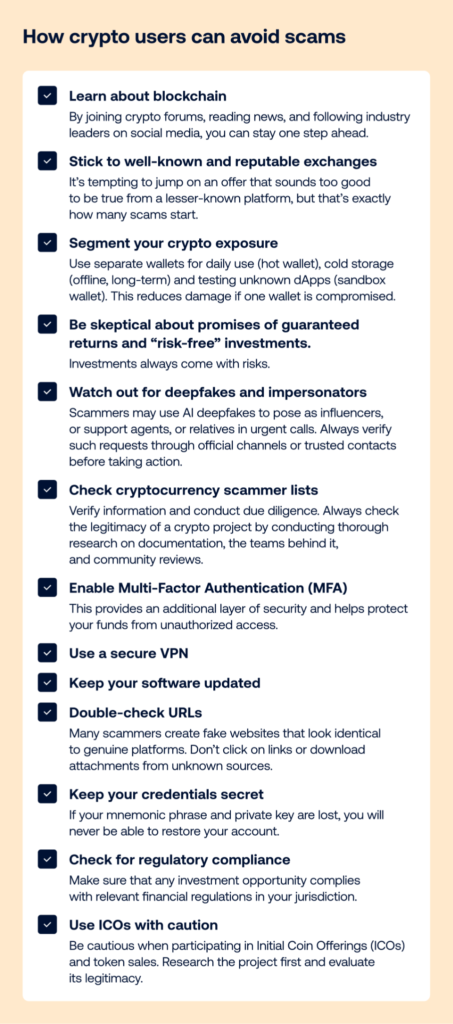
Start by learning the basics—understand how blockchain and cryptocurrencies work. The more knowledgeable you are, the easier it is to spot a scam. Staying active in crypto communities, reading the latest news, and following reputable voices on social media can help you stay on top of how to avoid crypto scams.
When trading or investing, always use established, well-known exchanges. Offers from unknown platforms may be tempting, but that’s often where scams begin. Another smart move for crypto fraud prevention is to segment your crypto exposure. Use separate wallets: a hot wallet for daily use, a cold wallet for long-term storage, and a sandbox wallet for testing new decentralized applications. This approach limits the damage in case one wallet is compromised.
Be cautious of any project or person promising “guaranteed returns” or “risk-free investments.” No legitimate investment is ever without risk. If someone asks you to urgently send crypto, always verify the request through another channel or a trusted contact.
It’s also wise to consult public scam lists and trackers to see if a platform or token has been flagged. Verify information by researching the team, reading documentation, and checking reviews. Enable Multi-Factor Authentication (MFA) on all your accounts and wallets, and use a secure VPN whenever possible. Regularly update your software and double-check URLs. Many scam websites look identical to legitimate ones but have slightly altered web addresses.
Protect your crypto wallet, private keys, and mnemonic phrases at all costs. If lost or stolen, you won’t be able to recover your funds. Store them securely and offline using tools like hardware wallets. Before investing, make sure the project complies with your local financial regulations, and don’t hesitate to consult a trusted cryptocurrency advisor if you’re uncertain.
Here’s the checklist for your convenience:
How crypto businesses can prevent fraud
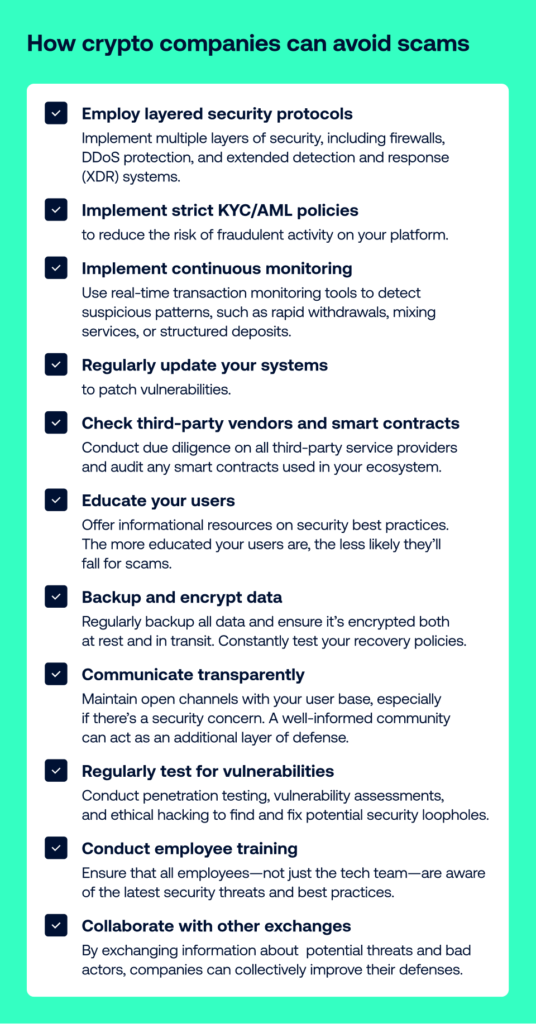
To protect against attacks in 2026, crypto companies should adopt a robust, multi-layered security approach that incorporates Web3 security protocols. This would include a combination of firewalls, DDoS protection, and Extended Detection and Response (XDR) systems.
At the same time, strict KYC and AML compliance processes are essential for crypto fraud prevention and to maintain trust with users and regulators. KYC and AML in crypto are also regulatory requirements in many jurisdictions, making this doubly important. Understanding how to manage KYC in the Web3 age is particularly important for crypto businesses.
Real-time transaction monitoring can detect red flags like rapid withdrawals or suspicious deposits. Regular system updates and audits of third-party vendors and smart contracts close common attack vectors. Many breaches stem from insecure integrations, which makes diligence crucial.
Educating your user base on crypto security best practices not only protects them but also strengthens your platform’s defenses. Likewise, regular backups, encryption, and tested recovery procedures make sure business continuity is smooth. Open, transparent communication builds community trust and helps detect threats early.
Don’t overlook your internal team—ongoing employee training is vital, as human error often leads to breaches. Finally, collaborate with other exchanges to share threat intelligence and collectively raise industry security standards.
Download our comprehensive checklist to help crypto businesses strengthen their security posture:
How to report a crypto scam in 2026
If you’ve encountered a crypto scam, it’s crucial to immediately report it to:
- Law enforcement. They can investigate and take action against scams that operate within your jurisdiction.
- Federal authorities, such as the Federal Trade Commission (FTC) and the Federal Bureau of Investigation (FBI), in the United States.
- Financial regulators. In many countries, financial regulatory authorities oversee and investigate fraudulent financial activities, including crypto scams.
- Social media platforms, if you come across crypto scams on Facebook, X, etc.
When reporting cryptocurrency fraud, provide as much information as possible, including details about the scam, the individuals, firms, or apps involved, and any communication you’ve had with them (emails, messages, screenshots, transaction records, etc.).
Reporting scams is a crucial step in combating cryptocurrency fraud, protecting others, and potentially recovering lost funds. Besides, educating others about the risks can help with crypto fraud prevention.

Crypto scam FAQ
-
How do crypto scams work?
Crypto scams work by deceiving individuals through various tactics, such as phishing, fraudulent investment schemes, impersonation, and more. The goal is to trick victims into sending crypto to the scammers, who then disappear without delivering the promised “return on investment”.
-
What is a pig butchering scam in crypto?
A pig butchering scam is a form of investment fraud in which criminals build a long-term fake relationship with a victim (often of a romantic nature), in order to convince them to invest large amounts of money into fake investments. The scammer then disappears with the money. Pig butchering in crypto involves a long-term relationship scam in which the criminal’s goal is to secure a crypto investment into their fraudulent scheme.
-
What are the red flags for crypto scams?
Knowing how to identify a crypto scam is essential in order to avoid falling victim to one, so it is important to recognize the warning signs for crypto scams at an early stage.
Crypto scam red flags include:- unsolicited offers
- promises of guaranteed high returns with no risk
- lack of transparency
- pressure tactics
- requests for personal information.
-
How can we prevent cryptocurrency scams?
Crypto fraud prevention includes:
- Staying informed about scam trends
- Learning as much as you can about the crypto world
- Being skeptical
- Backing up data
- Avoiding pump-and-dump schemes
- Using secure VPN and keeping your software updated
- Conducting thorough research and due diligence
- Prioritizing security measures (adding extra layers of security, e.g.firewalls, DDoS protection)
-
How can you recover from a crypto scam?
Victims of crypto scams can struggle to recover the funds they have lost, but there are steps that can improve their chances. First, victims should report the crypto scam to the relevant authorities as soon as possible. They should also keep records of all key information, including screenshots of communications with the scammers and transaction data. Blockchain analysis tools can potentially help with crypto scam recovery through tracking stolen funds.
-
What are the penalties for cryptocurrency fraud?
Crypto fraud is generally treated as a criminal offense rather than a mere regulatory breach. This means that liability extends beyond administrative fines or civil penalties and may include criminal prosecution, with consequences such as restriction of liberty, asset forfeiture, and other sanctions for applicable law.
While the specific outcomes vary depending on the jurisdiction, they typically depend on factors such as the scale of the fraud, the number of victims, the role of the accused, and the level of sophistication involved. In larger or more organized schemes, enforcement authorities are more likely to pursue serious criminal charges, reflecting the gravity of the offense and its broader impact.
Relevant articles
- Article
- 2 weeks ago
- 8 min read
Hospitality fraud trends are evolving. Learn the threats within the hospitality sector today and what can help stop scams, chargeback abuse, and loya…


- Article
- Feb 13, 2026
- 10 min read
AI-powered romance scams are rising fast. Learn how dating fraud works and how platforms and users can protect themselves from online deception.





What is Sumsub anyway?
Not everyone loves compliance—but we do. Sumsub helps businesses verify users, prevent fraud, and meet regulatory requirements anywhere in the world, without compromises. From neobanks to mobility apps, we make sure honest users get in, and bad actors stay out.
