- Sep 25, 2026
- 11 min read
Ponzi Scheme vs. Pyramid Scheme Explained
Ponzi scheme vs. pyramid scheme: compare how each works, real cases, legal risks, and how AI compliance agents help detect and prevent both scams.


In August 2026, the US Securities and Exchange Commission charged Goliath Ventures and its founder over an alleged Ponzi scheme that raised at least $425 million from more than 1,300 investors, with at least $51 million allegedly diverted for personal use. Two months earlier, the couple behind Blessings in No Time were each sentenced to 40 years in prison for running a pyramid scheme that inflicted more than $30 million in losses on over 10,000 people.
People who feel the ground moving under them – conflicts, prices, jobs that look less permanent than they used to – tend not to gamble. They look for somewhere safe to put money away for the worst case. A scheme that promises steady returns, or life-changing ones, answers that wish better than an honest investment can, because an honest one cannot promise it. Ponzi schemes and pyramid schemes both run on that trust, paying early participants with money from later ones to manufacture the appearance of a working investment or business.
What is a Ponzi scheme?
A Ponzi scheme is an investment scam that uses money from new investors to pay earlier investors, disguising those payments as genuine investment returns. As the US Securities and Exchange Commission (SEC) explains, existing investors are paid with money collected from new investors, and the organizer presents those payments as investment success.
The advertised opportunity might involve shares, property, foreign exchange, or cryptocurrency. Some operators run a small, legitimate business alongside the fraud. Others fabricate their investment activity entirely. The defining feature of a Ponzi scheme is its hidden reliance on new investors’ contributions to sustain the promised payouts.
When the scheme collapses, investors who have not withdrawn their money typically suffer substantial losses, although some earlier investors may have already recovered their initial investment or made a profit.
The name comes from Charles Ponzi, who promised spectacular profits from international postal reply coupons in 1920.
Suggested read: From Alchemy to Algorithms: A History of Fraud
How a Ponzi scheme works
Consider this example:
- An organizer collects $100,000 from ten investors and promises a 10% monthly return from a trading strategy.
- No profitable trading takes place. The organizer uses $10,000 of the pooled money to make the first month’s payments.
- Investors interpret the payments as evidence that the strategy works. Some invest more, while others recommend it to friends.
- New investors contribute another $100,000. That money helps cover further payouts, withdrawals, and the organizer’s spending.
- Account statements continue to show profits, even though the pool cannot cover what investors believe they own.
In this example of a Ponzi scheme, after the first payout, only $90,000 remains from the original deposits, before expenses. Yet those investors may still believe their $100,000 principal is intact. Incoming money temporarily hides that gap and creates additional obligations.
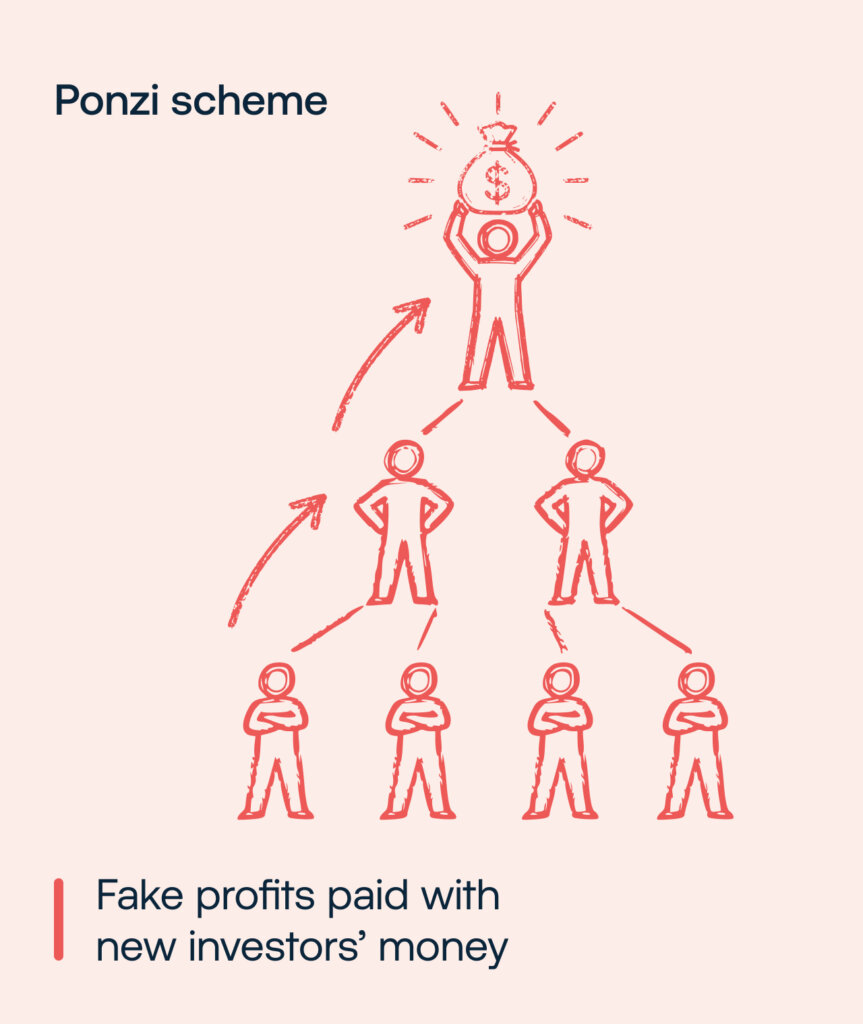
If investors leave their supposed profits in the account, the organizer can increase a statement balance without making a cash payment. The apparent balance grows, but no corresponding wealth has been created.
An early successful withdrawal proves only that the operator could pay that particular amount at that particular time. It does not independently verify the investment strategy or show that everyone else could withdraw too.
Ponzi schemes spread through personal trust. A recommendation from a trusted colleague, friend, or family member can feel reassuring while carrying no independent knowledge of the investments. People passing on their apparent success may sincerely believe they are helping others, which makes early victims effective advocates for the fraud.
What is a pyramid scheme?
A pyramid scheme is a recruitment-driven scam in which people pay to participate and receive rewards funded primarily by new participants’ payments rather than by genuine sales to customers outside the network. Although some early participants may receive money, the structure requires an ever-larger pool of recruits beneath them, resembling a pyramid, and inevitably leaves many later joiners unable to recover what they paid.
This differs from legitimate affiliate marketing, where a person receives a commission for generating a genuine commercial action. For example, an affiliate might recommend a software subscription and be paid when somebody buys it through their link. Affiliates typically do not pay for the right to earn commissions, and customers do not have to become affiliates or recruit anyone else.
In a pyramid scheme, recruitment into the earning opportunity drives the economics. Participants might pay an entry fee, buy a starter package, or purchase products to qualify for commissions. Those they recruit form their “downline,” with some of the newcomers’ payments flowing to people higher in the structure.
The Federal Trade Commission (FTC) warns that pyramid schemes can sell real, recognizable products. The question is whether the compensation structure primarily rewards recruitment rather than genuine retail sales to customers outside the network.
Pyramid schemes appeal because the opportunity feels like running a small business. In practice, recovering an initial investment generally depends on persuading somebody else to take the same risk and repeat the pattern.
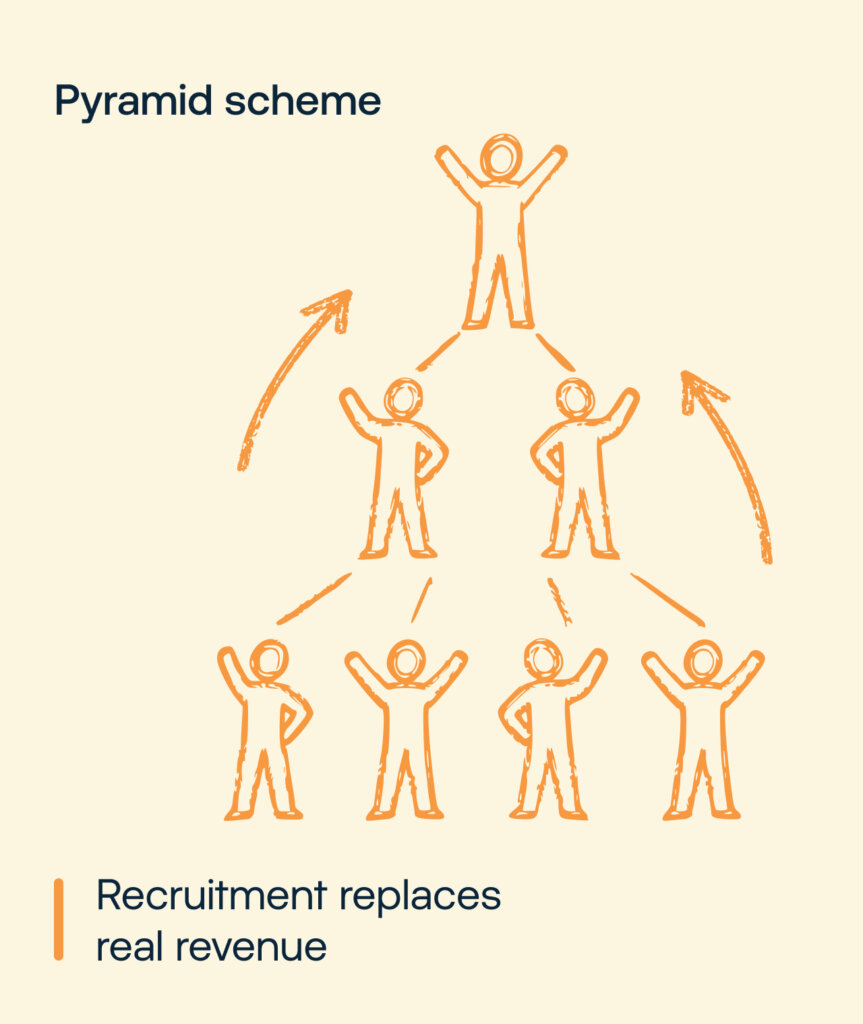
How a pyramid scheme works
Regardless of whether the entry payment is described as membership, training, or a product purchase, many examples of a pyramid scheme follow a similar pattern.
Consider a program charging $500 to join:
- One participant pays $500 to enter. They are told they can earn $150 for each new member they recruit.
- They recruit five people. Those recruits collectively pay $2,500, while the original participant receives $750 and appears to have made $250 before other costs. Parts of the entry payments may also fund rewards higher in the network.
- The five recruits must repeat the process. To pursue the same return, they need to recruit another 25 people between them.
- Each successive level requires five times as many newcomers. The network grows from five recruits to 25, then 125, and 625, transferring the recruitment challenge to an increasingly large group.
People further down the structure face an increasingly crowded market for the same opportunity.
Real compensation plans can obscure this arithmetic through ranks, points, bonuses, and purchase requirements. The SEC identifies complex commission structures and an emphasis on recruitment among the warning signs worth investigating.
Picture the company closing enrollment tomorrow. A business built on retail demand keeps paying its distributors. A pyramid scheme stops because the commissions were coming from the entry fees of people who are no longer joining.
Key differences between the two scams
The main difference between a Ponzi scheme and a pyramid scheme is how participants expect to earn money. In a Ponzi scheme, participants expect money to come from investment performance. In a pyramid scheme, participants expect to earn money by expanding a network.
| Feature | Ponzi scheme | Pyramid scheme |
| Main pitch | Invest money and receive returns | Join a business opportunity and build a network |
| Participant’s role | Usually a relatively passive investor | Usually an active recruiter or distributor |
| Source of payouts | Other investors’ contributions disguised as profits | Payments linked primarily to new recruits entering the network |
| Typical organization | An operator controls the investment pool | Participants occupy successive recruitment levels |
| Main vulnerability | Incoming funds cannot meet withdrawals and promised returns | Recruitment cannot sustain the expanding network |
Structure and source of payouts
In a Ponzi scheme, investors typically believe a manager, trader, or trading system is generating the returns. They may recommend the opportunity to friends, but recruiting others is not normally the condition for receiving their advertised return.
In a pyramid scheme, the compensation structure pushes participants to expand the network. They may need several recruits, or a specified volume of purchases from their downline, to qualify for rewards.
Ponzi and pyramid schemes vs. MLM
Multi-level marketing (MLM) is a distribution model in which participants sell products and may receive commissions connected to their sales network. It is not automatically a pyramid scheme, although fraudulent operators can use similar language and organizational structures.
Well-known examples of companies using MLM or related direct-selling models include Amway, whose independent business owners sell nutrition, beauty, personal-care, and home products, and Mary Kay, whose independent beauty consultants sell cosmetics and skincare products directly to customers.
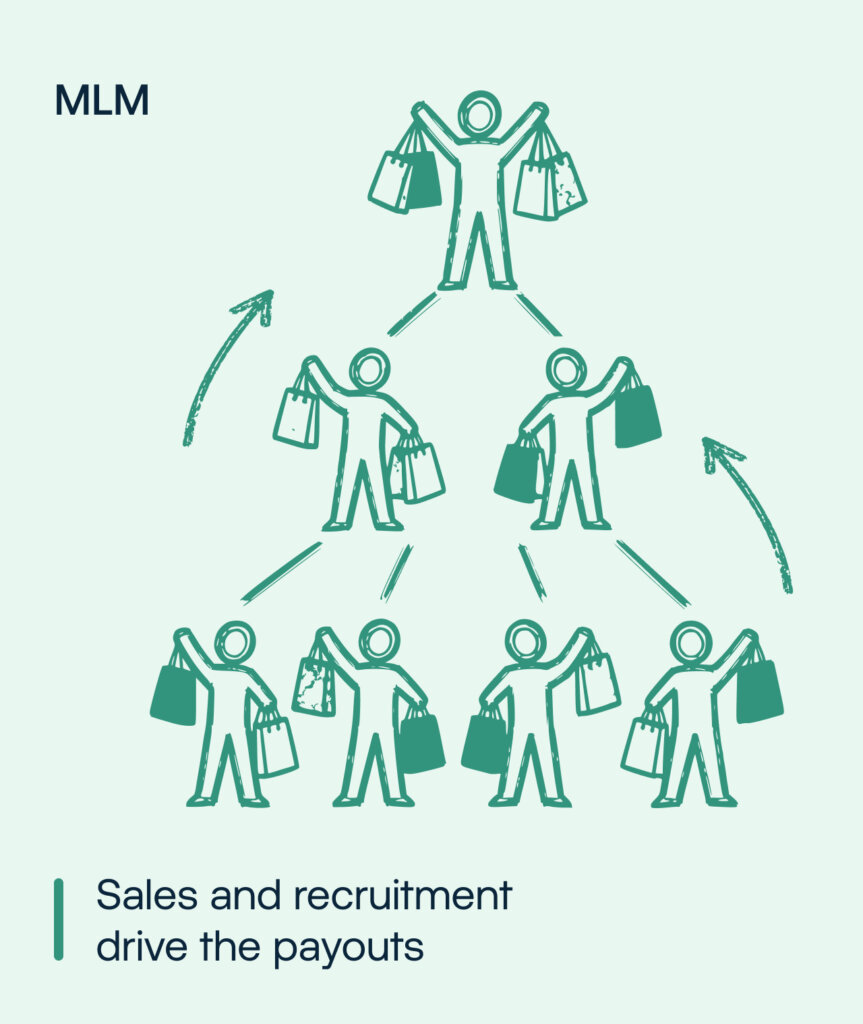
A 2024 FTC staff review of 70 MLM income disclosures found that many participants received no payments from the MLMs and that most received $1,000 or less per year. Most of the disclosures did not account for participants’ expenses.
Some jurisdictions go further and ban multi-level structures outright. In mainland China, MLM structures with downlines and override commissions are unlawful under the 2005 anti-pyramid-selling regulations, while licensed single-level direct selling is permitted in limited product categories.
Under FTC guidance in the United States, assessment of a scheme considers what the compensation plan encourages and how the business operates in practice. Amway’s independent business owners, for example, can earn from their own retail sales and from product sales generated by a team they sponsor. This sales network and the financial incentive to build a team can look superficially similar to a pyramid scheme.However, in its 1979 decision, the FTC found that the Amway plan examined was not an illegal pyramid scheme. It identified safeguards that encouraged retail sales and prevented inventory loading, including a buy-back policy.
Suggested read: From Panic To Expertise: Transaction Monitoring Edition
Why Ponzi and pyramid schemes always collapse
Both structures contain an unsustainable promise, with participants led to expect rewards that the underlying economic activity cannot support. Their collapse may be postponed by attracting new participants, bringing in fresh money, or delaying withdrawals, but the underlying shortfall remains.
A failed investment is not automatically securities fraud, as businesses may lose money without deceiving anyone. The main distinction is whether participants were misled about how funds were used, where returns came from, or the nature of the opportunity.
In a Ponzi scheme, the immediate breaking point is often a cash shortage. A downturn may expose a gap, withdrawals may increase, fresh deposits may slow, or the organizer may divert too much money from the scheme.
In a pyramid scheme, recruitment eventually meets a mathematical limit. With five recruits per person, the tenth recruitment level alone would require 9,765,625 new people. The fifteenth level alone would require more than 30.5 billion, nearly four times the world’s population. This calculation assumes that every participant successfully recruits five distinct newcomers.
In reality, recruitment can fail much sooner as local networks overlap, prospective members lose interest, and participants exhaust their money. Those near the bottom are left without enough people to recruit.

Suggested challenge: Memory Game: The Beast Edition
Real-world examples of Ponzi and pyramid schemes
Ponzi and pyramid schemes come in many forms, from conventional investment funds like Bernie Madoff’s to cryptocurrency platforms. The examples below show how both can be repackaged to appear credible.
Notorious Ponzi scheme cases
Bernie Madoff
The Bernie Madoff case is perhaps the best-known Ponzi scheme. When it collapsed in December 2008, thousands of victims – individual investors, charities, businesses with staff retirement accounts, and several celebrities – faced billions of dollars in losses. The FBI’s account describes how fictitious trades and falsified account records sustained the illusion, while Madoff’s reputation attracted clients who believed they had access to exceptional investment expertise.
Madoff pleaded guilty in 2009 and received a 150-year prison sentence. In December 2024, the US Department of Justice announced a final distribution bringing Madoff Victim Fund payments to over $4.3 billion for 40,930 victims in 127 countries.
Mirror Trading International
Mirror Trading International accepted Bitcoin from investors and claimed that an automated trading bot generated average monthly returns of 10%. South Africa’s Financial Sector Conduct Authority raised doubts about those claims after it was unable to verify that the reported funds and trading activity existed.
In 2023, the Western Cape High Court concluded that MTI had operated an unlawful Ponzi scheme, generating returns for earlier investors with money supplied by later ones. MTI also offered referral commissions, illustrating how real schemes can combine Ponzi and pyramid features.
BitConnect
BitConnect promoted a lending program supposedly powered by proprietary trading software. In reality, the US Department of Justice described it as a Ponzi scheme paying earlier investors with later investors’ money.
Its leading US promoter, Glenn Arcaro, pleaded guilty in 2021 and was sentenced to 38 months, a term reflecting his cooperation and his role as a promoter rather than an architect. Prosecutors indicted founder Satish Kumbhani separately in 2022 on charges carrying a maximum of 70 years. He has never been arrested, and his whereabouts remain unknown.
Well-known pyramid scheme cases
TelexFree
TelexFree presented itself as an MLM business selling internet telephone services in Brazil. However, participants’ rewards depended primarily on bringing new members into the network rather than genuine demand for those services.
In 2015, the Acre State Court of Justice ruled that TelexFree was a financial pyramid rather than a legitimate MLM business. The court declared its participant contracts void and ordered the company to pay R$3 million (US$585K) in collective damages. Like other pyramid scheme examples, TelexFree demonstrates that the presence of a real product does not make recruitment-driven rewards sustainable or lawful.
The G&T scheme
The G&T scheme consisted of a series of 15-person pyramids in which existing members recruited others to supply the money needed for payouts. More than £20 million (US$26 million) passed through the scheme before its organizers were prosecuted.
Nine people were convicted of organizing or promoting the scheme following three trials.
OneCoin
Based in Sofia, Bulgaria, OneCoin combined a fraudulent cryptocurrency pitch with a global MLM network. Members earned commissions by recruiting people to purchase cryptocurrency packages, helping the operation defraud more than 3.5 million victims of over $4 billion.
Co-founder Karl Sebastian Greenwood was sentenced to 20 years in prison in 2023. Co-founder Ruja Ignatova, known as the “Cryptoqueen,” remains a fugitive.
In April 2026, the US Department of Justice opened a victim compensation process, announcing that more than $40 million in forfeited assets was available at that point.
Suggested read: Pump-and-Dump vs Rug Pull: Biggest Crypto Exit Scams
Are Ponzi and pyramid schemes illegal?
The short answer is yes: a Ponzi scheme is illegal because its operator is deceiving investors about what happens to their money and how returns are generated.
The name commonly describes the mechanism, not a specific offense. Depending on the jurisdiction and conduct involved, operators may be prosecuted for fraud, theft, providing unlicensed financial services, securities violations, money laundering, or a combination of offenses.
A pyramid scheme is illegal in many jurisdictions when participants pay for an opportunity to earn money derived primarily from recruiting others.
The precise rules vary. European Union consumer law requires Member States to prohibit establishing, operating, or promoting qualifying pyramid schemes where consumers pay for the chance to receive compensation primarily from introducing others, as listed in Annex I to the Unfair Commercial Practices Directive. In the UK, equivalent restrictions are now contained in the Digital Markets, Competition and Consumers Act 2024. Its unfair commercial practices regime, including the list of banned practices (such as pyramid promotional schemes), applies to conduct from April 6, 2025. Australian consumer law also prohibits participating in a pyramid scheme or persuading someone else to join one.
Potential consequences include imprisonment, financial penalties, asset freezing or forfeiture, compensation orders, and restrictions on future business activity. The measures available depend on the jurisdiction, the participant’s role, and whether the case proceeds through criminal, civil, or regulatory action.
Being deceived into joining is not necessarily equivalent to knowingly organizing or promoting a scheme. However, participants should not assume they are protected from liability, because some jurisdictions also prohibit participation or recruitment.
How Ponzi and pyramid schemes are detected and investigated
Different bodies have distinct roles in combating Ponzi and pyramid schemes. Law enforcement investigates suspected crimes, prosecutors bring criminal cases, financial institutions detect and report suspicious activity, and regulators set requirements and supervise regulated firms. Their powers and processes vary by jurisdiction.
Law enforcement and prosecutors
Investigations may begin with victim complaints, or with FIU reports: suspicious activity and transaction reports (SARs/STRs). Investigators can interview victims and witnesses, obtain financial and corporate records, trace funds, compare promotional claims with the actual use of money, and identify the people controlling or benefiting from the operation. Prosecutors then decide whether the evidence supports charges such as unfair business practices or fraud, while authorities may seek court orders to freeze or seize assets.
Financial institutions and compliance teams
Learning how to spot a Ponzi scheme begins with testing whether an investment operator’s claims match verified records and observed payment activity. Effective financial fraud detection combines KYC/KYB information, transaction monitoring, complaints, and evidence of genuine business operations.
Compliance teams do not decide whether fraud has legally occurred. They can verify identities, beneficial ownership, and regulatory permissions and examine whether transactions fit the stated business model. Compliance teams can also identify patterns such as payments from numerous individuals followed by rapid distributions to earlier payers. Delayed withdrawals, pressure to reinvest, inconsistent explanations, or recruitment-linked payments may also warrant review.
When the relevant reporting threshold is met, firms can escalate the case and submit a SAR, STR, or equivalent report to the appropriate authority. FinCEN case studies show Bank Secrecy Act reports have helped the FBI document the flow of money through Ponzi schemes.
AI agents can support this work across authorized systems by retrieving customer records, identifying linked accounts, comparing transactions with the stated business model, and preparing summaries for human review.
Regulators and regulatory oversight
Applicable laws and regulators establish requirements for customer due diligence, beneficial ownership checks, monitoring, record-keeping, and suspicious activity reporting. Regulators may authorize firms, examine their controls, require remediation, impose civil or administrative sanctions, or refer suspected crimes to law enforcement. Some securities and consumer-protection regulators can also investigate scheme operators and bring their own enforcement proceedings.
Suggested read: Transaction Monitoring in AML: Ultimate Guide For 2026
How Ponzi and pyramid schemes are evolving
In 2026, social media makes recruitment faster and less dependent on geography. A promoter can use public posts to attract attention, move prospects into private groups, and encourage participants to share their apparent success with their own networks.
The JuicyFields case illustrates how these channels can combine. According to Europol, suspects used social-media advertisements to direct people to websites offering supposed investments in medicinal cannabis cultivation. Around 186,000 participants transferred money through bank payments or cryptocurrency, while funds from newer investors were used to pay earlier participants. Judicial estimates placed the resulting damage at €645 million (US$738 million), prompting coordinated enforcement across 11 countries in 2024.
Crypto and digital payments also make collecting and moving funds across borders easier. Multiple wallets and service providers may fragment the evidence, although public blockchain records can still help investigators reconstruct transfers.
AI supplies both persuasive material and a selling point. INTERPOL’s 2026 global assessment describes how generative AI, deepfakes, and autonomous systems help criminals impersonate trusted people and operate fraud campaigns at greater scale. Claims about AI-powered trading bots can also give an old investment model a new technical veneer without proving that genuine profits exist.
For compliance teams, the practical response is to compare the advertised business model with observed activity. Numerous payments from newly recruited participants, distributions to earlier members, rapid movement across accounts or wallets, and flows inconsistent with genuine product sales may all warrant further examination. Postal coupons in 1920, autonomous trading agents in 2026 – the pitch changes faster than the mechanism behind it. Trace the payouts and count how many came from outside the scheme.
Suggested read: AI in Anti-Money Laundering: Use Cases, Benefits & How It Works
Ponzi scheme vs. pyramid scheme FAQ
-
Is a Ponzi scheme illegal?
Yes, operating a Ponzi scheme is illegal because it involves deceiving investors about how their money is used and where their returns come from. Depending on the circumstances and jurisdiction, operators may face charges for securities fraud, wire fraud, money laundering, or other offenses.
-
Is a pyramid scheme illegal?
Yes, pyramid schemes are illegal in most jurisdictions, although the applicable offenses and enforcement routes vary by jurisdiction. Selling products does not make them lawful if their compensation structure meets the legal test for a prohibited pyramid scheme.
-
What's the difference between an MLM and a pyramid scheme?
A lawful MLM rewards genuine product sales, while an illegal pyramid scheme makes recruitment the central driver of compensation. Amway is a common test case: in 1979, the FTC found the Amway plan it examined was not an illegal pyramid scheme – a finding limited to that model and evidence.
-
How does a Ponzi scheme eventually collapse?
Understanding how a Ponzi scheme works explains its failure: supposed returns are funded by investors’ contributions rather than sufficient genuine earnings. This investment fraud becomes impossible to sustain when available money can’t meet payouts and withdrawals, although authorities may shut it down earlier.
-
Can AI agents detect a Ponzi or pyramid scheme?
AI in AML compliance can help identify suspicious payment patterns and connections consistent with Ponzi or pyramid activity. An AI agent compliance workflow can gather evidence and prioritize cases, but establishing fraud requires reliable information and human investigation.
Relevant articles
- Article
- 1 week ago
- 10 min read
New account fraud and fraud beyond onboarding differ in timing, signals, and risk. See how AI-powered detection tackles both fraud types.

- Article
- 1 week ago
- < 1 min read




What is Sumsub anyway?
Not everyone loves compliance—but we do. Sumsub helps businesses verify users, prevent fraud, and meet regulatory requirements anywhere in the world, without compromises. From neobanks to mobility apps, we make sure honest users get in, and bad actors stay out.
