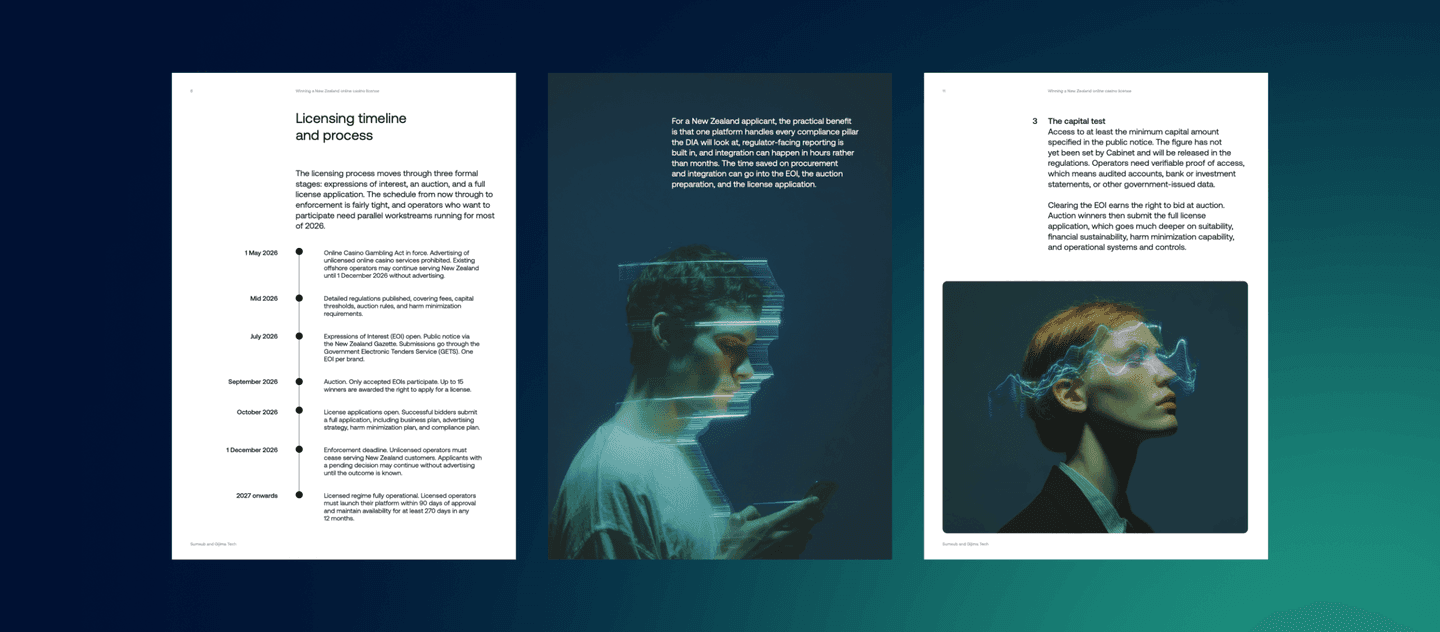
What iGaming operators need to know about licensing, compliance, and getting ready before New Zealand's December 2026 cutoff.
New Zealanders already gamble on hundreds of offshore sites every day. The government has decided to bring that activity under a controlled regime, and the timeline it has set is tight. EOI submissions open in July 2026, and from December 1, unlicensed operators are required to stop serving New Zealand customers, with penalties for non-compliance reaching NZD $5 million.
The process has three stages:
- Expressions of interest
- An auction
- A full license application
At EOI, operators need to disclose ownership structures, prove capital access, and submit certified criminal background checks and credit reports for every key officer, along with a full history of every gambling license the entity holds or has previously had suspended or cancelled. The bar is set high, and operators who underestimate the documentation workload tend to find out too late.
The DIA expects evidence that an operator can run a well-governed business in New Zealand for the full license term. Compliance, in that context, is more of a signal. The report examines what the compliance setup needs to look like when the platform goes live, drawing on Sumsub's experience helping iGaming operators meet regulatory obligations across markets, and Gijima Tech's understanding of how those requirements translate in a New Zealand context.
What you'll learn:
- How New Zealand's three-stage licensing process works, from EOI through auction to full application, and what the timeline looks like between now and December 2026
- What the DIA requires at EOI stage, including the 20% significant influence threshold, key officer checks, capital proof, and the documentation that tends to catch operators off guard
- What KYC, AML, age verification, and transaction monitoring need to look like under the Online Casino Gambling Act 2026, and how to have it in place before the platform goes live
- How to meet NZ's mandatory age verification and responsible gambling requirements without adding friction that affects player conversion
- How to handle deepfakes and synthetic identity fraud in a market where a small fraudster group can generate up to $2.5 million in losses within a month
- What global operators most often get wrong on local execution in New Zealand, from accepted document types to banking relationships, DIA communication, and data residency obligations
This report is for:
Compliance officers, AML specialists, fraud and risk teams, legal and regulatory leads, and iGaming operators planning to enter the New Zealand market in 2026, whether they're based offshore or already operating locally.