- Spotlight
- May 15, 2026
The AI Fix: How to Stop Compliance From Killing Conversion
Polina Komarova, Head of Financial Transaction Monitoring and AI Copilot at Sumsub, reflects on what breaks onboarding flows and how agentic solutions can align compliance with conversion.


Every business obsesses over conversion—it’s the quiet, relentless math behind growth. Users are revenue, so every step in an onboarding flow is scrutinized, optimized, and measured. And yet, every additional field, every extra click, every moment of friction chips away at that conversion rate. The trade-off is brutal and well-understood: more steps mean fewer users making it through.
The data backs this up. Industry research shows that a growing number of firms are losing clients due to inefficient onboarding processes, with the trend worsening year over year. Client abandonment now averages around 10%. Every added field, every document re-upload, every jurisdictional edge case that triggers manual review nudges that drop-off curve higher.
At the same time, these companies face a second, equally persistent problem: how quickly their engineering teams can adapt onboarding flows to new regulatory requirements. In practice, it takes weeks—more often months—for a new rule to become live product behavior. The process is heavy: regulatory interpretation, vendor configuration, engineering implementation, QA, and supervisor sign-off. Multiply that across jurisdictions, and the problem compounds fast. Each country has its own regulator, and those regulators are accelerating. Moreover, 2026 is shaping up to be a major year for AML and financial crime regulation, driven by the rollout of AMLA, FATF updates, and expanding global compliance requirements.
Meanwhile, the typical regulation-to-production cycle inside a regulated business still takes 6 to 18 months. The mismatch is painful: regulators are now moving faster than compliance teams can respond. And it’s just structurally unsustainable.
Same root problem
Here’s the twist: conversion and engineering velocity aren’t separate problems, they share the same root cause.
Conversion suffers because updating onboarding flows is expensive and slow. And updating those flows is expensive because every change must pass through a multi-team regulatory translation cycle. The result is predictable. Compliance teams overbuild defensively—trying to cover every possible jurisdiction. Engineers treat compliance work as a burden. Product teams own conversion metrics but don’t have the freedom to meaningfully change the flow. Over time, the onboarding experience calcifies into the worst possible state: rigid enough to hurt conversion, slow enough to miss regulatory deadlines, and costly enough that no one wants to touch it.
What’s really happening is a structural disconnect. Regulatory knowledge lives in one place, and flow logic—in another. Translating between the two takes time, coordination, and a lot of back-and-forth.
Any practical solution?
An AI agent with embedded regulatory intelligence would close the gap. Instead of passing requirements between teams, you would describe the jurisdiction and the user context, and the system would generate a compliant onboarding flow on the spot. In this scenario, compliance teams don’t need to overbuild. Engineers aren’t stuck treating regulatory work as overhead. Product teams can finally move the conversion needle. Most importantly, the flow stops being something you carefully maintain and becomes something you can regenerate—quickly, accurately, and as often as needed. In our reality, where the rules change monthly, that shift starts to feel more like a necessity.
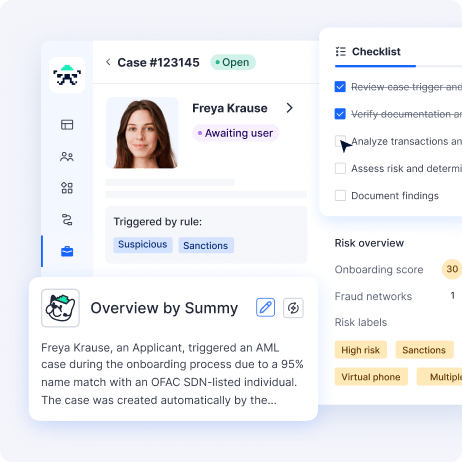
That’s exactly what we’ve been tackling with Summy AI—an agent that can build and adapt user verification flows based on jurisdiction and user context. Instead of hardcoding flows or constantly revisiting them, you can generate the right flow for each case, aligned with current requirements and flexible enough to change as those requirements evolve.
It’s a more direct way of working. You’re no longer stitching together compliance logic across multiple teams—the system already understands how those pieces fit.
Summy AI brings clarity and speed to every team involved in onboarding and compliance, each in a way that fits how they actually work.
The bigger shift here is alignment. When the same system understands regulation, user context, and how the product behaves, the gaps between teams start to disappear. Onboarding becomes something you can adjust and improve continuously without slowing everything down or taking on extra risk.
Fix the structure, not just the flow
That brings us back to the gap between regulation and flows. At its core, the problem is not a lack of tools, but a structural mismatch. As long as regulatory knowledge and product logic live in separate systems (and separate teams), onboarding will remain slow to change, expensive to maintain, and fragile under pressure. You can optimize individual steps, redesign screens, or tweak conversion funnels—but if every meaningful update still requires a multi-team translation cycle, the bottleneck stays exactly where it is.
A more durable approach is to treat compliance not as something you implement, but as something you generate.
That means shifting from static, pre-built flows to systems that can produce the right flow dynamically, based on jurisdiction, user context, and current regulatory requirements. It also means collapsing the distance between policy and execution, so changes in regulation can translate directly into changes in product behavior, without months of coordination in between.
The principle is this: keep regulatory logic modular and updatable, tie onboarding decisions to context rather than hardcoded paths, and reduce handoffs between compliance, product, and engineering wherever possible. The tooling you use to get there is secondary—what matters is that the system understands regulation, user context, and product behavior in the same place, at the same time.
Summy AI was built for this. When regulatory understanding is embedded directly into the system that generates onboarding flows, it removes the constant translation between teams and turns compliance into something that can move at the same speed as your product. Not faster forms, but a different way of building them altogether.
Relevant articles
- spotlight
- Aug 5, 2026
In this article, Simon Jones, CEO at Sumvin, discusses the problem of identity as the missing layer of the internet.


- spotlight
- Sep 2, 2026
Follow Erin West and Paul Raffile as they chase a scammer in Nigeria targeting teenagers online.







What is Sumsub anyway?
Not everyone loves compliance—but we do. Sumsub helps businesses verify users, prevent fraud, and meet regulatory requirements anywhere in the world, without compromises. From neobanks to mobility apps, we make sure honest users get in, and bad actors stay out.
